
What if the “salary ceiling” in the repair industry isn’t about how many screens you swap, but which specific chips you can solder? Many professionals feel stuck at the national average phone repair technician salary of $36,219, wondering if there’s a real path toward those $50,500 top-earner spots. You might feel like you’re running on a treadmill in a basic retail environment where wages stay flat while technology gets more complex. It’s a common pain point for talented fixers who want their paycheck to reflect their technical expertise and hard-earned skills.
It’s frustrating to deal with confusing commission structures or wonder if a new certification will actually result in a raise. We understand that you want transparency and a clear way to increase your professional value. This guide delivers the most accurate national salary data for 2026 and reveals how specialized training can maximize your earning potential. We’ll break down the national benchmarks, identify which certifications offer the highest ROI, and provide a direct roadmap to achieving Master Technician status. By the end, you’ll know exactly how to move from entry-level pay to high-tier earnings through mastery of Samsung, iPhone, and MacBook repairs.
Key Takeaways
- Review the 2026 national benchmarks to see how your current earnings compare to entry-level and master technician pay scales.
- Identify the high-value technical skills, such as microsoldering and MacBook repair, that significantly increase a phone repair technician salary.
- Compare the different compensation structures between corporate retail environments and independent shops to find your highest earning potential.
- Follow a clear five-year career roadmap to transition from basic screen swaps to a high-paying role as a Lead Diagnostic Specialist.
- Learn why professional training programs offer a faster return on investment than self-teaching by reducing costly motherboard errors.
National Benchmarks: Phone Repair Technician Salary in 2026
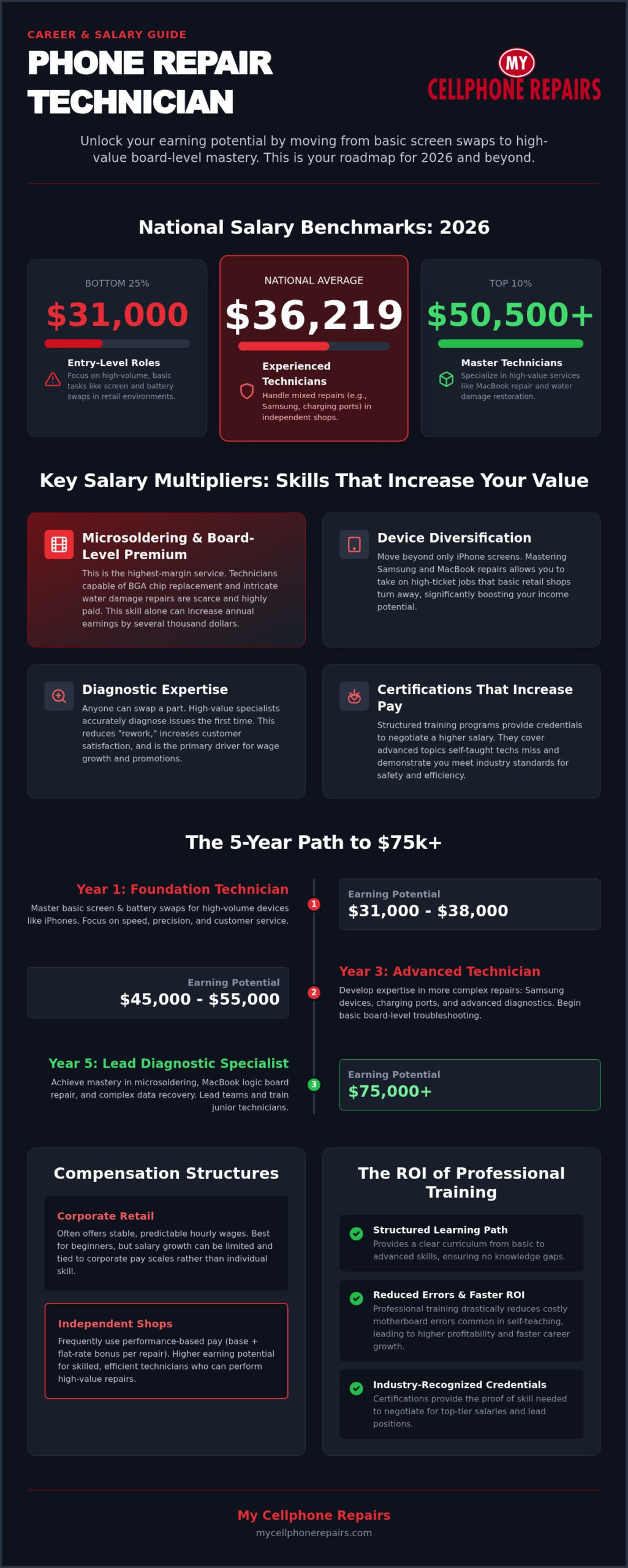
The mobile repair industry is no longer a “side hustle” market. In 2026, the U.S. cell phone repair market is valued at over $4.1 billion. This growth is driven by a clear “repair over replace” consumer mindset. High flagship prices make fixing a screen or battery more logical than buying new hardware. The national average phone repair technician salary currently sits at $36,219 per year. However, this figure is just a baseline. Your actual take-home pay depends on your technical tier and the complexity of the devices you can service.
The “Right to Repair” movement has fundamentally shifted labor demand. New laws ensure that independent shops have better access to parts and manuals. This creates a more professional landscape for an Electronics Technician specializing in mobile hardware. As the industry becomes more regulated, shops are willing to pay a premium for technicians who can handle advanced diagnostics rather than just basic assembly. Total compensation now often includes base pay plus performance bonuses, making the field more lucrative for those who work efficiently.
Salary Percentiles and What They Mean
Understanding where you fall on the pay scale is vital for career planning. The bottom 25% of the market typically earns around $31,000. These roles focus on high-volume, basic tasks like iPhone screen repair in retail settings. The median earner makes roughly $36,219 and usually works in busy independent shops handling a mix of Samsung phone repair and charging port issues. The top 10% of earners reach $50,500 or more. These master technicians specialize in high-value services like MacBook repair and water damage restoration.
The Shift Toward Performance-Based Pay
Total compensation is moving away from simple hourly wages. Many shops now use performance-based structures to reward high-quality work. You might receive a base rate plus a “flat-rate” bonus for every successful repair completed. Accuracy is just as important as speed in this model. High “rework rates” (when a device returns because it wasn’t fixed correctly) will often disqualify a technician from their monthly bonuses. In 2026, the most successful professionals treat every device with precision. This focus on quality is the fastest way to increase a phone repair technician salary and secure a lead role.
Factors That Multiply Your Earning Potential
Your phone repair technician salary isn’t a fixed number. It’s a direct reflection of the complexity of the problems you can solve. If you only offer iPhone screen repair, you’re competing in a crowded market of entry-level workers. To reach the top-tier pay brackets, you must master “salary multipliers” like Samsung phone repair and MacBook repair. Diversifying your device expertise allows you to handle a wider range of high-ticket tickets that basic retail shops often turn away.
Diagnostic expertise is another critical factor. Most junior techs can swap a battery, but few can identify a short circuit on a logic board. According to the Occupational Outlook Handbook, technical proficiency remains the primary driver for wage growth in electronics repair. Shop owners value technicians who can accurately diagnose issues the first time, as this reduces “rework” and keeps customers happy. Mastering these nuances is how you transition from an hourly worker to a high-value specialist.
The Microsoldering and Board-Level Premium
Motherboard repair is the highest-margin service in the entire industry. It requires specialized equipment and a steady hand for microsoldering. Technicians capable of BGA chip replacement and intricate water damage repairs are incredibly scarce in the 2026 labor market. Because these repairs save customers from buying entirely new devices, shops can charge a premium for the labor. Professionals with these skills often see their earning potential increase by several thousand dollars annually compared to modular-only technicians.
Certifications That Actually Increase Pay
Structured training provides the credentials needed to negotiate a higher starting salary. Graduates of a smartphone repair certification program demonstrate they’ve met industry standards for speed and safety. A comprehensive cell phone repair course curriculum covers advanced topics that self-taught technicians often overlook, such as static discharge safety and precise diagnostic workflows. These credentials act as a “fast-track” on your resume, proving you’re ready for lead roles without months of on-the-job hand-holding. If you’re looking to maximize your ROI, enrolling in a professional Technician Training Program is the most efficient way to secure these high-earning skills.
Comparing Compensation Across Different Work Environments
Where you choose to work has a massive impact on your total take-home pay. A phone repair technician salary in a corporate retail setting looks very different from one in an independent shop or a high-volume refurbishment center. According to the Bureau of Labor Statistics occupational data, employment settings influence not just your hourly rate, but also your access to benefits and long-term stability. Understanding these differences is the first step in choosing a career path that meets your financial goals.
Corporate Retail vs. Independent Shops
Corporate environments like big-box retailers or manufacturer-owned stores offer high stability and standardized pay scales. These roles often come with “hidden” benefits like health insurance, 401k matching, and paid time off. While the floor is higher, the ceiling is often capped by rigid corporate tiers. It’s difficult to negotiate a significant raise without moving into a non-technical management position. These environments are best for those who value a predictable schedule and a steady paycheck above all else.
Independent repair shops operate on a more agile model. These businesses often use commission-based pay or performance bonuses to reward their most efficient workers. If you can handle advanced tasks like Samsung phone repair or MacBook repair quickly, your earning potential is significantly higher than in a corporate setting. The path to becoming a Lead Diagnostic Specialist or even a shop manager is much shorter. You’ll also have more direct influence over the tools and parts the shop uses, which can make your daily work more efficient.
Depot and Refurbishment Center Roles
Depot-level repair and insurance fulfillment centers represent the industrial side of the industry. In these facilities, technicians focus on high-volume throughput. Productivity is tracked with precise metrics, and your salary is often tied to your “units per hour” output. This environment is ideal for technicians who enjoy a methodical, process-driven workflow. The growth of the certified refurbished device market has created a surge in demand for these roles. It’s a stable sector that prioritizes accuracy and speed over customer-facing interactions.
The independent contractor model offers the highest potential rewards but carries the most risk. Working as a 1099 technician allows for total flexibility. You set your own hours and choose your own clients. However, you’re responsible for your own taxes, insurance, and equipment costs. For most professionals, finding a W2 position in a busy independent shop provides the best balance. You get the benefits of an established business while maintaining the ability to earn more through technical mastery and high-volume repairs.
The Path to $75k+: Career Progression for Technicians
Reaching the upper limits of a phone repair technician salary requires a strategic approach to your professional development. You cannot simply wait for a raise based on tenure. In the 2026 market, pay increases are tied directly to the complexity of the problems you can solve. A typical five-year career trajectory moves from basic component replacement to advanced diagnostics and, eventually, shop leadership or technical education. By focusing on high-value skills early, you can significantly compress this timeline.
Entry-level technicians often start with modular repairs. This is the foundation where you prove your reliability and attention to detail. However, staying in this phase too long is a common mistake that leads to stagnant wages. To move toward the $75,000 mark, you must transition from a “parts swapper” to a “diagnostic specialist” who understands the underlying circuitry of modern hardware.
Year 1-2: Building Speed and Foundation
Your first two years are about mastering the fundamentals and building muscle memory. You will spend a significant amount of time perfecting iPhone screen repair and battery swaps. The primary goal in this phase is achieving “zero-rework” status. Shop owners value technicians who do the job correctly the first time, as returns kill profitability. If you can handle high-volume Samsung models with 100% accuracy, you will be in a strong position for your first major performance review.
Year 3-5: Specialization and Leadership
By year three, you should aim for a Lead Diagnostic Specialist role. This involves developing Samsung phone repair expertise that goes beyond basic component swaps. You’ll start identifying motherboard shorts and performing microsoldering. At this stage, your value to the business shifts. You may take on mentorship roles, overseeing quality control for junior staff or consulting for corporate device fleets. These senior roles are where you see the most significant jumps in a phone repair technician salary.
You don’t have to spend years on the bottom rungs of the ladder. Enrolling in professional cell phone repair technician training allows you to skip the trial-and-error phase that holds many people back. It prepares you for advanced diagnostics and board-level work on day one. Senior technicians often move into high-level management or technical education, where they influence industry standards and command top-tier wages. This path is about moving from “doing the work” to “managing the expertise.”
Maximizing ROI: Why Professional Training is the Best Investment
Investing in specialized education is the most direct way to increase your phone repair technician salary. While self-teaching might seem cost-effective, the “lost opportunity cost” is substantial. Every time you damage a motherboard during a practice repair, you lose more than just parts. You lose time, profit, and customer trust. A single mistake on a high-end MacBook or Samsung device can wipe out an entire week’s earnings. Professional training eliminates this risk by teaching you precise, industry-standard workflows from the start.
The timeline difference between a self-taught path and a structured program is stark. A self-taught individual might spend two years reaching a mid-tier skill level through trial and error. A student in a professional program can reach that same level in weeks. This acceleration means you start earning a higher wage much sooner. You also gain access to a national network of professionals. These connections often lead to job placements in high-end independent shops that don’t post on public boards. My Cellphone Repairs acts as the definitive bridge between entry-level labor and professional-grade earnings.
Avoiding the ‘YouTube Ceiling’
Free tutorials are a great starting point, but they have a “ceiling.” Most videos show you the “how” without explaining the “why” of diagnostics. If a repair doesn’t go exactly like the video, a self-taught technician is often stuck. Modern 2026 device architectures require a deeper understanding of power rails and signal lines. Outdated techniques found in older videos can cause permanent damage to sensitive components. Real-time feedback from an expert instructor ensures you develop the right habits before they become expensive mistakes.
Building a Professional Portfolio
A formal certification acts as a “salary floor” when you’re job hunting. It proves to a shop owner that you’ve been vetted by experts and meet industry standards. You can use your training background to justify a higher starting wage during negotiations. It shows you’re a serious professional who values precision and efficiency. Employers are always willing to pay more for someone who doesn’t need constant supervision. Take the first step toward a higher salary with our Professional Training Program and secure your future in the 2026 repair market.
Secure Your Future in the 2026 Repair Market
The landscape for electronics repair is changing rapidly. You’ve seen how a phone repair technician salary isn’t just a flat rate but a reflection of your specialized expertise. Moving from basic screen swaps to advanced logic board diagnostics is the most effective way to shatter the industry pay ceiling. While self-teaching has its place, professional training provides the structure needed to avoid costly mistakes and master high-value repairs for iPhone, Samsung, and MacBook devices. Our curriculum is designed by industry veterans with national expertise to ensure you enter the workforce with Master Technician skills from day one.
You don’t have to wait years for a promotion when you can gain the technical edge today. Every motherboard you fix and every diagnostic you nail brings you closer to those top-tier earnings. Take control of your career trajectory and start earning what you’re truly worth. Enroll in our Technician Training Program to boost your earning potential and join a community of high-earning professionals. Your journey toward technical mastery starts with a single step. We’re here to help you succeed.
Frequently Asked Questions
What is the average starting salary for a phone repair technician in 2026?
The average starting phone repair technician salary in 2026 is approximately $36,500 per year. This breaks down to about $16.79 per hour for entry-level roles. Most junior positions focus on high-volume tasks like battery replacements and iPhone screen repair. While this is a foundational wage, technicians who quickly master advanced diagnostics can move into higher pay brackets within their first twelve months of employment.
Do I need a degree to earn a high salary in mobile repair?
You don’t need a college degree to earn a high salary in the mobile repair industry. Most employers prioritize technical proficiency and hands-on experience over formal academic credentials. Success in this field depends on your ability to perform complex repairs like water damage restoration and microsoldering. Completing a professional Technician Training Program provides the specific hardware knowledge that shop owners value more than a general four-year degree.
Does microsoldering certification actually increase my pay?
Yes, a microsoldering certification is one of the most effective ways to increase your earnings. Board-level repair is a high-margin service that few technicians can perform accurately. By mastering BGA chip replacement and circuit diagnostics, you move from a “parts swapper” to a specialist. This scarcity of skill allows you to negotiate for top-tier wages or performance-based bonuses that basic screen technicians cannot access.
How much more do MacBook technicians earn compared to phone technicians?
MacBook technicians generally earn more than those who only service smartphones. Laptops have higher repair costs and more complex internal architectures, which justifies a higher labor rate. Mastering MacBook repair alongside Samsung phone repair acts as a significant salary multiplier. Technicians with this diverse skill set are often considered “Master Technicians” and can command annual pay that is significantly higher than the national average for phone-only roles.
Can I earn more as a freelance technician or a shop employee?
Freelance technicians have a higher earning ceiling but face more financial risk. A solo operator can potentially earn a full-time income of $50,000 to $85,000 per year, but they must cover their own taxes, insurance, and equipment. Shop employees enjoy more stability and benefits like health insurance. Most professionals find that working in a busy independent shop provides the best balance of steady income and performance-based commissions without the overhead of running a business.
What is the highest-paying role in the cell phone repair industry?
The highest-paying roles in the industry are typically Lead Diagnostic Specialists or Master Technicians who specialize in data recovery and board-level work. These individuals often earn upwards of $75,000 per year. Management roles and technical educators also sit at the top of the pay scale. These positions require a combination of advanced technical mastery and the ability to oversee quality control or train junior staff in a high-volume environment.
How do Right to Repair laws affect technician wages?
Right to Repair laws are making the industry more professional and regulated. These laws provide independent shops with better access to official parts and diagnostic manuals. This shift increases the demand for highly skilled technicians who can perform manufacturer-grade repairs. As the market expands and becomes more transparent, wages for certified professionals are expected to stabilize and grow, rewarding those who invest in formal technical education and stay current with new hardware.
Is it worth paying for a phone repair course to get a better salary?
Investing in a professional phone repair course offers a high return on investment. While self-teaching is possible, it’s often slow and leads to expensive mistakes on customer devices. A structured Technician Training Program allows you to master high-value repairs like Samsung phone repair and water damage restoration in weeks rather than years. This speed-to-market is the fastest way to increase your phone repair technician salary and secure a position in a top-tier shop.