What if the “advanced” training you’re paying for is just a collection of free YouTube tutorials you’ve already seen? It’s a common fear for technicians who want to earn the $36,219 average phone repair technician salary reported in 2026. You know that simply turning screws isn’t enough to handle modern, complex hardware. Finding a professional cell phone repair course curriculum is the only way to move past basic fixes and start mastering high-revenue skills like micro-soldering.
We’ve built this guide to help you identify exactly what a professional program must include to be worth your investment. You’ll discover the essential modules that bridge the gap between basic repairs and engineering solutions, including AI-powered diagnostics and specialized water damage restoration. We’ll show you how to choose a program that leads directly to a career working on Samsung, iPhone, and MacBook devices. Use this guide to gain confidence in your training choice and start your journey toward becoming a specialized authority in your community.
Key Takeaways
- Identify the specific 2026 industry standards, including 5G infrastructure and advanced OLED technology, that separate professional training from basic hobbyist guides.
- Learn how a comprehensive cell phone repair course curriculum builds a foundation in electronics physics and precise hardware identification for Samsung, iPhone, and MacBook devices.
- Explore why microsoldering is the highest-paid skill in the industry and how to master the specialized tools needed for logic board restoration.
- Understand the business side of repair, from setting profitable service prices to implementing professional customer intake procedures and liability waivers.
- Discover how learning from a national repair chain provides real-world diagnostic insights that you won’t find in a standard classroom setting.
Defining the Standard: What Is a Professional Repair Curriculum?
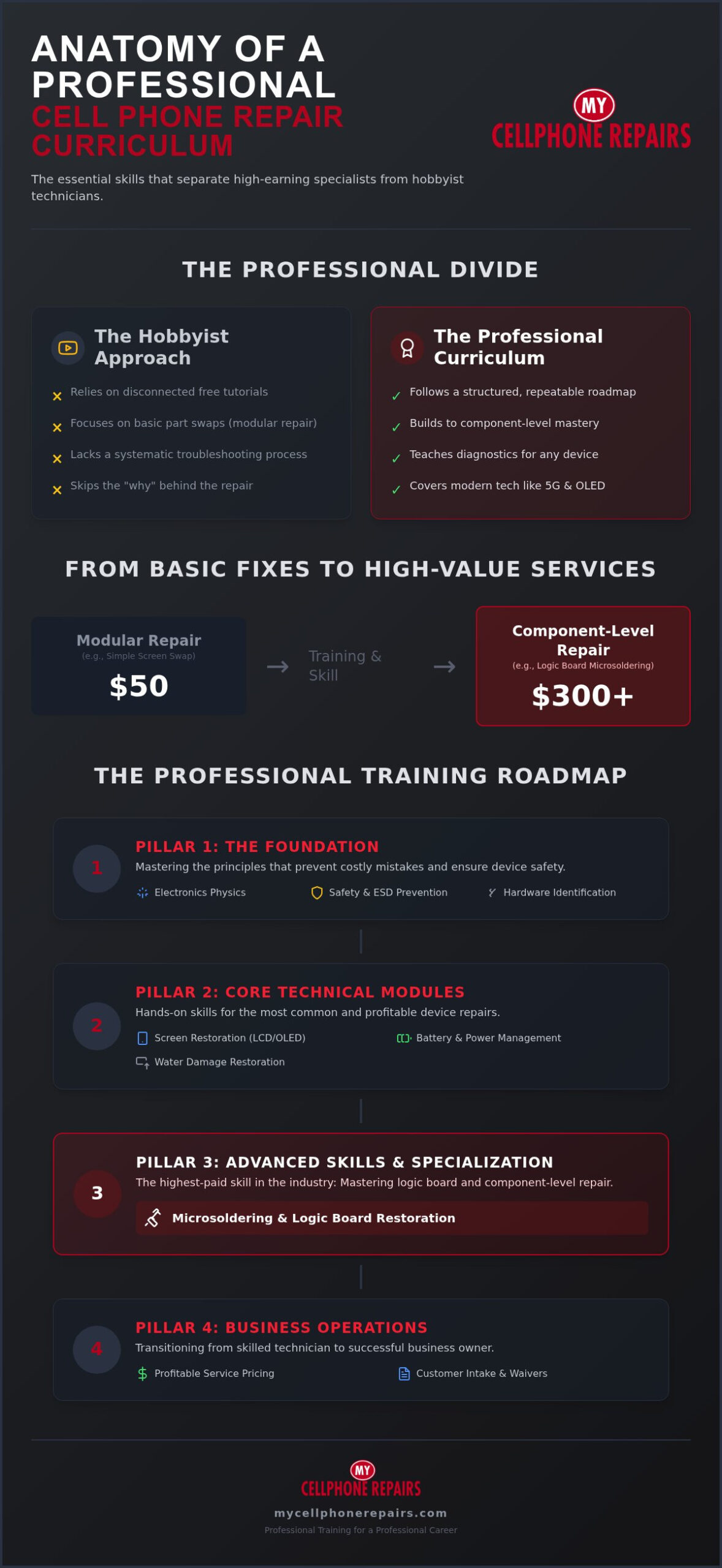
A professional cell phone repair course curriculum isn’t just a list of steps. It is a structured roadmap that covers three critical pillars: diagnostics, hardware repair, and business operations. In 2026, the industry has moved beyond basic screen swaps. A modern curriculum must include 5G infrastructure and advanced OLED technology to be relevant. These devices are more integrated than ever. You need a training plan that evolves as fast as Apple and Samsung release new hardware.
Many beginners start with YouTube tutorials. These videos are helpful for quick fixes, but they lack the structure needed for a professional career. YouTube often skips the “why” behind a repair. Certified training pathways provide a systematic approach to troubleshooting that free videos cannot match. This professional structure ensures you don’t just memorize a specific fix, but instead learn to diagnose any device that crosses your bench.
The Shift from Modular Repair to Component-Level Mastery
Replacing broken parts is called modular repair. It is the entry point for most technicians. However, professional mastery requires moving to component-level repair. This involves identifying and fixing specific failed parts on a logic board rather than replacing the entire board. Our cell phone repair technician training program focuses on this transition. You learn to understand the electrical path of a device. This mastery is what separates a high-earning specialist from a basic repair tech. It’s the difference between a $50 fix and a $300 specialized service.
Certification vs. Skill-Based Training
A certificate proves you completed a course. It holds value in the job market. It shows employers you are serious about the trade. However, a certificate is only as good as the skills behind it. The primary goal of any cell phone repair course curriculum should be hands-on skill verification. You need to demonstrate that you can handle delicate flex cables and microsoldering tasks under pressure. Employers want to see your work, not just your paperwork.
Professional standards are often aligned with broader Electronics Technician Education requirements. These standards include a deep understanding of circuits and digital electronics. While certifications from organizations like WISE or CTIA matter, your ability to perform a clean, functional repair is what builds a local reputation. Look for programs that prioritize bench time over classroom lectures. Real skills are built with a soldering iron in hand, not just a pen and paper. If you want to understand which credentials actually matter to employers in 2026, reviewing a comprehensive smartphone repair certification program guide can help you choose a path that delivers recognized authority alongside practical skills.
Core Technical Modules: The Curriculum Foundation
A strong cell phone repair course curriculum begins with the physics of electronics. You must understand how electricity moves through a circuit before you ever open a device. This foundation prevents you from guessing during a repair. Precision is your best tool. You need to recognize every screw, bracket, and flex cable within a device. Mixing up screws can lead to long screw damage. This error can kill a logic board instantly. If you want to master these fundamentals, consider a professional Technician Training Program that prioritizes hands-on shop experience.
Safety is the first module you should master. Handling lithium-ion batteries requires specific protocols to prevent thermal events. You also need to learn about Electrostatic Discharge (ESD) prevention. A single static shock can destroy a sensitive component. These foundational modules ensure you work safely and protect the customer’s property. Professional training teaches you the “Why” behind the “How” of every device failure.
Screen and Display Restoration Modules
Modern displays require more than just a quick swap. Your training should include a deep dive into LCD, OLED, and AMOLED replacement techniques. Every technology has different fragility points and brightness standards. A professional curriculum for iPhone screen repair must also include True Tone programming. Without this, the device loses its native display features. You should also master frame cleaning and adhesive application standards. These steps are vital for maintaining the water-resistant seal of the phone.
Battery and Power Management Training
Power issues are among the most common customer complaints. The curriculum should focus on battery health diagnostics and safe removal techniques. You need to understand charging circuits and charging port repair protocols for various brands. Technicians must identify signs of battery swelling and critical failure points before they become dangerous. Learning to test the current draw helps you determine if the problem is the battery or the motherboard itself.
Advanced Diagnostic Tools and Software
Professional diagnosis requires specialized equipment. You will learn to use multimeters and DC power supplies to find short circuits. These tools allow you to see what is happening inside the phone’s circuits. Software diagnostics are equally important for iOS and Android system recovery. Diagnostic Logic is the ability to trace power rails to find faults. Mastering these tools reduces your diagnostic time from hours to minutes, allowing you to handle more repairs each day.
Advanced Skills: Microsoldering and Logic Board Repair
Microsoldering is the highest-paid skill in the mobile repair industry. It separates general technicians from elite specialists who can command top-tier salaries. Much like how Pro On The Go Locksmith serves a niche market with specialized mobile automotive locksmith services, mastering board-level repair allows you to offer high-value solutions that generalists cannot provide. A professional cell phone repair course curriculum must prioritize this skill to ensure you are job-ready for 2026. You’ll spend significant time mastering microscope usage. Seeing components at 40x magnification is the only way to work on modern, densely packed logic boards. Heat gun precision is equally vital. You must learn to control temperature and airflow to avoid “popcorning” chips or damaging nearby components.
The curriculum should cover FPC connector replacement. These plastic connectors melt easily under improper heat. Learning the specific wicking and tinning process ensures a clean, factory-standard bond every time. You’ll also tackle backlight circuit repair. This often involves replacing tiny filters or diodes that blow when a screen is replaced without disconnecting the battery. Finally, you’ll explore data recovery. This is the process of making a dead device temporarily functional just to pull precious files. It’s a high-value service that customers are willing to pay a premium for when their memories are at stake.
You can’t fix what you don’t understand. This module teaches you to read schematics and board views using tools like ZXW or PhoneBoard. These digital maps show you exactly where every trace leads. You’ll learn to identify Integrated Circuits (ICs) and their specific functions, such as the Power Management IC (PMIC) or the Audio IC. Practice is essential for mastery. A good program provides “donor” boards for you to practice reballing. You’ll remove an IC chip, clean the pads, apply new solder balls, and reseat the chip until the process becomes second nature.
Water Damage Restoration Protocols
Professional training debunks the common myth of “putting it in rice.” Rice does not stop the chemical reaction of corrosion; it only delays the inevitable. A real curriculum focuses on ultrasonic cleaning. This process uses high-frequency sound waves and specialized solutions to strip away mineral deposits from under IC chips. You’ll learn chemical corrosion removal techniques to stabilize the board and prevent further rot. This is a critical skill for providing expert Samsung phone repair services. Samsung devices often have complex internal layouts that require methodical cleaning to restore full functionality after a liquid spill.
Business Operations: From Technician to Shop Owner
Technical skill is useless if you don’t know how to price your services for profit. A professional cell phone repair course curriculum must teach you the business side of the bench to ensure your career is sustainable. You need to calculate overhead, labor, and part costs for every job. Without this knowledge, you’re just an enthusiast with a hobby. Mastering the financial side allows you to invest in better tools and grow your local reputation. This commitment to excellence is universal across the repair sector, as demonstrated by Rhino Appliance Repair, where professional diagnostics and customer trust drive success in the household appliance market.
Intake procedures are your first line of defense against liability. Every device that enters your shop should come with a signed waiver. This document protects you from pre-existing issues like Face ID failure or hidden water damage. You’ll learn to document the device’s condition before you touch a single screw. This transparency builds trust and prevents disputes with customers later. Professional training ensures you have the templates and legal understanding to protect your business.
Similarly, you can discover H Roadside Rescue to see how they provide specialized 24/7 mobile assistance, illustrating the importance of availability and trust in the service industry.
This demand for convenience is equally high for vehicle maintenance; for example, Mobile Tyre Service provides professional tyre fitting and repair directly at the client’s location, ensuring safety and quality without the need for a garage visit.
The same principle of technical precision applies to performance automotive care; for instance, Speedy Roo Motorsports & Repair Inc focuses on unlocking power and efficiency through specialized tuning for Japanese brands, highlighting how deep technical knowledge creates value for customers.
The requirement for specialized expertise extends to the aesthetic industry as well, where precision and safety are paramount; you can explore החלקת שיער אורגנית to see how professional salons like Haomanim apply expert techniques to deliver high-quality results.
Managing customer expectations is one of the hardest parts of the job. You must explain repair times and the risks of data loss clearly. Most customers are stressed when their phone breaks. Professional communication helps de-escalate these situations. You’ll learn how to explain complex technical issues in simple terms that the average person can grasp. If a repair fails later, you need a methodical process for handling warranty claims. “Comeback” repairs aren’t a burden; they’re an opportunity to prove your reliability and win a customer for life.
The Supply Chain: Sourcing and Quality Control
Not all parts are equal. You’ll learn to distinguish between OEM, refurbished, and aftermarket components. Sourcing from reliable national wholesalers is critical to avoid “YouTube-level” knockoffs that fail within a week. A high-quality cell phone repair course curriculum teaches you how to establish these relationships. You’ll also learn to implement a Quality Control (QC) checklist for every completed repair. Test the touch response, camera, and charging port before the customer arrives to pick up their device. This step drastically reduces your return rate and improves your profit margins.
Marketing your skills is the final piece of the puzzle. New technicians should focus on Local SEO and building a digital presence for 2026. If people can’t find you on Google, they won’t bring you their broken phones. If you’re ready to turn your technical interest into a profitable career, explore our Technician Training Program today. It’s the fastest way to gain the skills needed to launch your own shop or join an elite repair team.
Selecting Your Path: My Cellphone Repairs Training Standards
The My Cellphone Repairs Technician Training Program isn’t based on academic theories. Our cell phone repair course curriculum is built directly from real-world store data gathered from our active national repair chain. We analyze thousands of successful repairs to identify the exact diagnostic patterns that work. This data-driven approach ensures you spend your time learning high-revenue skills that customers actually need in 2026. You won’t waste hours on outdated techniques. Instead, you focus on the current challenges found in Samsung, iPhone, and MacBook devices. Learning from a national brand means your training is validated by the same standards used in professional shops every day.
Choosing between online flexibility and hands-on intensity is a major decision. Online courses work well for learning circuit theory and business basics. However, repair is a physical trade that requires muscle memory. Our lab sessions provide an environment where you can fail safely and learn quickly. In your first week, you will dive into hardware identification and safe battery handling. We walk you through the enrollment process to ensure you have the right tools and mindset from day one. You’ll move from a student to a confident technician through a methodical, step-by-step progression. Aspiring professionals who want to understand exactly how a smartphone repair certification program translates into real employment opportunities will find that hands-on lab experience is the single most important factor employers evaluate.
Why Hands-On Training Wins in 2026
Tactile feedback is critical when you handle delicate flex cables. One wrong move can tear a component and turn a simple fix into a costly mistake. In a lab setting, you get real-time instructor feedback. This prevents you from forming bad habits that could damage customer devices later. You also gain access to professional-grade tools that are often too expensive for home use. Learning on high-end microscopes and DC power supplies gives you a competitive edge. This physical experience builds the confidence you need to handle expensive hardware without hesitation.
Your Career Roadmap After Graduation
Your journey doesn’t end when you receive your certificate. We provide a clear roadmap for your professional growth. Top graduates often find job placement opportunities within the My Cellphone Repairs network. If you prefer independence, we offer support for students looking to open their own independent repair shops. This includes guidance on inventory management and local marketing. The industry moves fast, and we stay ahead of it. We provide ongoing education to keep you updated with 2027 hardware releases and new diagnostic software. You will always have a path to advance your skills and increase your earning potential. Understanding the full scope of phone repair technician salary benchmarks and top-earner thresholds can help you set clear financial goals as you progress through each stage of your career.
Launch Your Future in Mobile Technology
You now have a clear roadmap for evaluating a professional cell phone repair course curriculum. Success in 2026 requires more than basic part replacement. It demands component-level mastery and a deep understanding of logic board diagnostics. You’ve learned why hands-on lab experience is essential for building muscle memory and why business operations are just as critical as technical skills. Choosing the right training path is the most important step in your career journey.
Leverage our national repair chain expertise and comprehensive curriculum. Our hands-on diagnostic labs provide the real-world experience you need to handle complex Samsung, iPhone, and MacBook repairs with confidence. Stop guessing and start repairing like a professional. Start Your Career with Our Technician Training Program Today and join a network of elite specialists. Your path to becoming a local authority in mobile repair starts right here. You have the drive to succeed; we have the tools to get you there.
Frequently Asked Questions
What is the most important module in a cell phone repair curriculum?
Diagnostic logic is the most critical module in any professional cell phone repair course curriculum. It teaches you to trace faults to their source rather than just swapping parts. You learn to use multimeters and DC power supplies to verify failures. This skill reduces repair times and prevents unnecessary part costs. Mastering diagnostics ensures you can handle new device releases without waiting for a tutorial video to appear online.
Can I learn cell phone repair online, or do I need hands-on training?
You can learn theory online, but hands-on training is essential for mastering physical skills. Repairing modern devices requires precise tactile feedback that a screen cannot provide. Handling delicate flex cables and performing microsoldering tasks safely requires direct supervision. A professional environment offers real-time instructor feedback. This prevents costly mistakes on customer devices. Most students find that physical lab sessions build the confidence needed for immediate employment.
How long does it typically take to complete a professional repair course?
A professional repair course typically takes between two to four weeks to complete. Intensive programs focus on high-impact skills like screen restoration and battery replacement in the first week. More advanced modules, such as board-level repair and microsoldering, often require additional dedicated time. Your progress depends on your prior experience and the depth of the curriculum. Comprehensive programs ensure you have enough bench time to master each technique before moving forward.
Is micro-soldering included in most basic repair curriculums?
Microsoldering is rarely included in basic curriculums because it requires specialized equipment and advanced manual dexterity. Most introductory courses focus on modular repairs like screen and battery swaps. However, a high-quality cell phone repair course curriculum will offer microsoldering as a core advanced module. It is the highest-paid skill in the industry. Learning it allows you to fix logic board issues that other shops might turn away, increasing your revenue potential.
Do I need a background in electronics to start a repair course?
You don’t need a formal background in electronics to start a repair course. A well-structured curriculum begins with the foundational physics of mobile devices. You will learn about voltage, current, and resistance as they apply to smartphones. Instructors guide you through reading schematics and using diagnostic tools from scratch. Having a steady hand and an interest in technology is more important than prior technical education. Everything else is taught during the program.
Are business management skills included in the technician training program?
Yes, the Technician Training Program includes essential business management skills. Technical expertise is only half of the equation for a successful career. You will learn how to price your services for profit and manage inventory effectively. The curriculum also covers customer intake procedures and liability waivers to protect your business. If you need help with official document certification or other professional mobile services, you can learn more about experts who provide on-site legal support. These modules prepare you to transition from a bench technician to a shop owner who understands the local repair market.
You will be trained on a wide range of professional-grade tools. This includes precision screwdrivers, heat guns, and specialized prying tools for safe device opening. The curriculum also covers the use of multimeters, DC power supplies, and digital microscopes for board-level diagnostics. You will learn to operate ultrasonic cleaners for water damage restoration. Mastering these tools ensures you can perform factory-standard repairs that look and function like the original device.
Will the curriculum cover laptop and MacBook repair as well?
Yes, a comprehensive curriculum includes modules for laptop and MacBook repair. These devices share many diagnostic principles with smartphones but require different disassembly techniques. You will learn to handle larger internal components and more complex cooling systems. Training covers screen restoration, battery replacement, and charging port repairs for various laptop brands. This expanded skill set allows you to serve a wider range of customers and increases the value of your repair services.