
A long list of repairs doesn’t show whether you’ll practise or learn to diagnose faults. A Smartphone repair training course should make its learning focus clear, including how hands-on instruction connects with hardware knowledge and diagnostic techniques.
To compare programs, look beyond the topic list. Check which parts of the training are practical, what subject areas are named, and whether diagnostics are included. These details help you judge whether a program matches what you want to learn.
This guide explains how to compare course scope, hands-on instruction, and diagnostic training. My Cellphone Repairs’ Technician Training Program includes hands-on instruction covering hardware components and diagnostic techniques, offering a clear example of how these elements can come together.
Key Takeaways
- Start with the repair topics you want to understand, then compare them with each course’s stated scope.
- Compare practical instruction and subject coverage together, rather than relying on a list of repair terms.
- Look for named components or repair areas, such as screens, batteries, charging ports, cameras, speakers, or water damage.
- Check whether diagnostic techniques and repair quality are addressed in the course description.
- My Cellphone Repairs’ Technician Training Program combines hands-on instruction with hardware and diagnostic topics.
What Does a Smartphone Repair Training Course Help You Learn?
A smartphone repair training course teaches knowledge and practical skills related to smartphone hardware and repair. It can introduce learners to device components and diagnostic techniques, connecting what a part does with how a technician investigates a reported problem.
These subjects work together. Knowing component names and functions provides useful context, but a symptom alone doesn’t identify its cause. A phone that won’t charge, for example, presents a problem to investigate. It doesn’t prove that one particular part has failed. Diagnostic thinking helps you consider the issue before settling on a repair approach.
Smartphones bring multiple components together in a compact device. For background, Smartphone technology and components offers an overview of smartphones and their development. Repair education applies component knowledge to practical work, helping learners understand how hardware and reported problems relate.
It’s useful to distinguish learning about a repair from practising repair work. Reading about a component can build familiarity; hands-on instruction adds a practical element. When comparing courses, check what the program says about both the subject matter and the practical learning, rather than assuming one means the other.
How hands-on instruction fits into repair training
My Cellphone Repairs’ Technician Training Program includes hands-on instruction alongside education about hardware components. This gives practical learning a place in the training, rather than relying on component descriptions alone. The program also covers diagnostic techniques, bringing practical instruction together with technical subject matter.
When comparing programs, look for a clear connection between the practical instruction and the stated topics. Does the description identify hands-on learning as well as hardware education? This distinction helps you understand the program’s focus without assuming that every course follows the same format.
Why diagnostics matter alongside component knowledge
Diagnostic techniques are part of the My Cellphone Repairs program, alongside hardware components. They help learners consider a reported symptom as a problem to investigate. Charging trouble, a power issue, and a screen concern are examples of repair areas you might use to compare course descriptions. Treat them as comparison points, not as guaranteed course modules.
As you review a Smartphone repair training course, check whether its stated scope includes both hardware and diagnostic techniques. That gives you a clearer picture of the learning focus than a list of repair terms on its own.
Which Smartphone Repair Skills Should a Course Address?
A practical way to compare course content is to look at three areas: hardware components, diagnostic techniques, and repair-quality awareness. Component knowledge gives context, while diagnosis helps frame what may be causing a reported problem. A list of topics can show a program’s stated scope, but it doesn’t by itself tell you which topics include hands-on practice.
Hardware topics to consider when comparing courses
Start with the components you’re most interested in learning about. Screens, batteries, charging ports, cameras, and speakers are useful examples to look for in course descriptions. Other possible comparison topics include back glass, Face ID, home buttons, and motherboards. These are examples of repair areas, not a promise that a particular program covers them.
Water damage is another repair topic to consider. As you review a Smartphone repair training course, note whether the description names the hardware areas that match your goals. Pay attention to the wording: a broad reference to hardware doesn’t necessarily mean every component or repair type is addressed. Clear scope makes it easier to distinguish general training from instruction focused on particular areas.
Diagnostic thinking and repair-quality questions
My Cellphone Repairs’ Technician Training Program includes diagnostic techniques alongside hardware components. When considering an issue such as a phone that won’t charge, look for whether a course identifies diagnostics as part of its instruction, rather than focusing only on possible components. Diagnosis and cost can also be topics of inquiry, but a course description should not be read as a promise of specific prices or repair methods.
Repair quality is another useful point to compare. Look for whether a program explains how it addresses quality in repair work. Certification is a separate question: a reference to certification as a topic doesn’t mean that a course awards a credential. The Industry-recognized smartphone repair certifications resource can help you consider certification separately from course instruction.
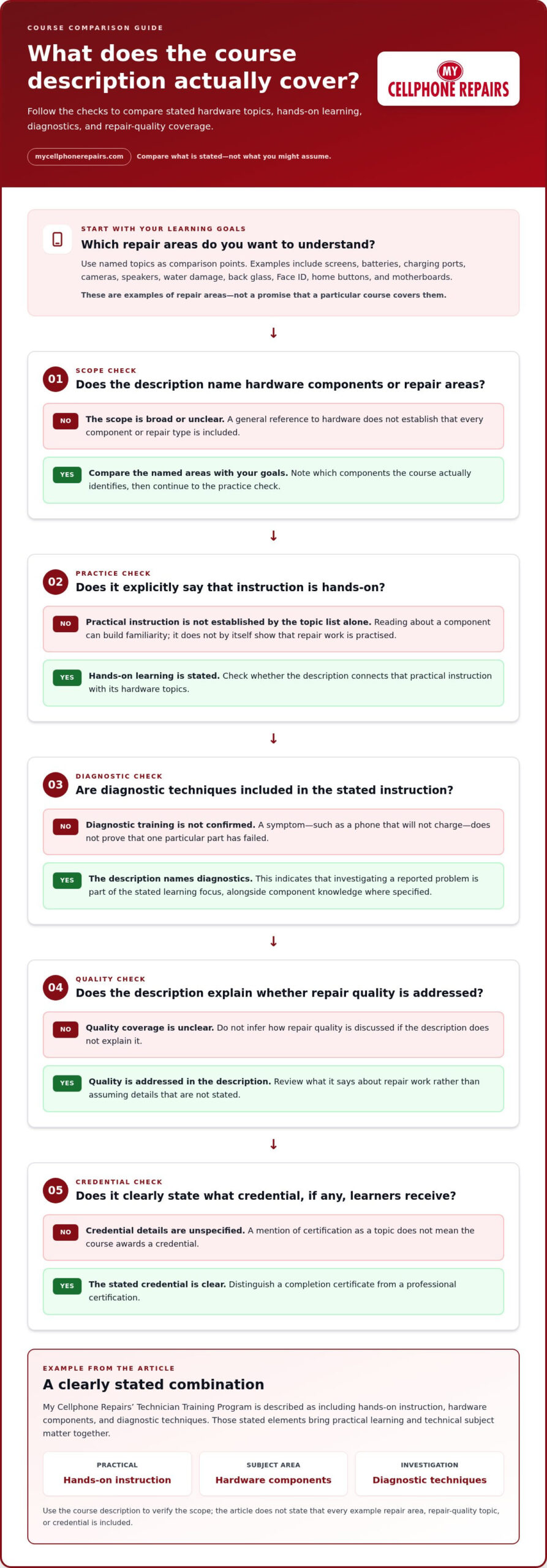
Use these questions to assess the stated scope:
- Hardware: Which components or repair areas does the course name?
- Diagnostics: Does it identify diagnostic techniques as part of the instruction?
- Quality: Does the description explain whether repair quality is discussed?
- Credentials: Does it clearly state whether learners receive a completion certificate or a professional certification?
These checks help you compare course descriptions without assuming more than they say. To explore a program that combines hands-on instruction with hardware and diagnostic topics, visit the My Cellphone Repairs Technician Training Program.
How to Compare Smartphone Repair Training Courses
Course descriptions can use similar language while describing different learning experiences. Compare practical instruction, named subject areas, diagnostic focus, and how repair quality is addressed. A useful comparison asks what the course covers, whether it includes hands-on instruction, and how it treats diagnosis and repair quality. Use the criteria below to organize your review.
| Criterion | What to look for | Question it answers |
|---|---|---|
| Practical instruction | A clear statement about whether hands-on instruction is included. | Does practical learning accompany the course material? |
| Component coverage | Named hardware topics that match your interests, such as screens, batteries, or charging ports. | Which repair areas does the course address? |
| Diagnostics | Diagnostic techniques identified as part of the instruction. | Does the course cover how to think through a reported issue? |
| Repair quality | An explanation of whether repair-quality considerations are discussed. | How does the course address the quality of repair work? |
Compare practical instruction with course scope
Match the stated topics to your learning interests. A course may name hardware components without saying whether it includes practical instruction, so look for both details. My Cellphone Repairs’ Technician Training Program includes hands-on instruction covering hardware components and diagnostic techniques. Compare those elements with the areas you want to study instead of assuming that every program uses the same format, equipment, or schedule.
Keep your comparison specific. If you’re interested in screen or battery repairs, note whether those topics are named in the course description. Then consider whether the course explains how practical instruction relates to its stated scope. This helps you distinguish a broad overview from a program that explicitly combines hands-on learning with hardware education.
Assess how the course treats quality and certification
Repair quality and certification are separate points to evaluate. Look for whether the course discusses quality in repair work and clearly states any credential learners receive. A reference to certification as a subject doesn’t mean the course awards a certification. A certificate of completion and a professional certification are also different claims. Read the wording carefully, and don’t infer credentials that aren’t expressly described.
Use the table as a comparison tool, not as a scorecard based on promises. It helps you assess what a course says about instruction and scope without relying on assumed guarantees, prices, or credentials. The Smartphone repair training course that fits your needs is one whose stated topics and practical instruction align with your learning goals. My Cellphone Repairs’ program brings hands-on instruction together with hardware and diagnostic topics. Explore the Technician Training Program as you compare these criteria.
How to Decide Whether a Smartphone Repair Course Fits Your Goals
Start with the repair work you want to understand, then compare the course’s stated focus with its approach to teaching. This helps separate your interests from assumptions about what a program covers or what you’ll be able to do afterward. Use the steps below to make your decision more concrete.
Map your interests to repair topics
Decide whether you’re more interested in component repairs or diagnostic problem-solving. A screen, battery, or charging-port issue gives you a subject area to look for in a course description. Water damage is another possible topic. These examples can help narrow your interests, but a course topic alone doesn’t promise a particular career outcome or level of expertise.
- Name your main interest. Write down whether you want to focus on screens, batteries, charging ports, water damage, or understanding how technicians diagnose problems.
- Choose a priority. If you’re interested in several areas, decide which matters most to you now. This makes it easier to compare descriptions without treating every topic as equally important.
- Match your interests to the stated scope. Look for the hardware topics and diagnostic techniques the program actually describes. Don’t infer specific lessons from a broad phrase such as “repair training.”
- Consider the learning approach. Compare the listed subject matter with whether hands-on instruction is included. This helps you decide whether the program’s approach suits your learning preferences.
- Review the whole picture. Consider practical instruction, hardware coverage, diagnostic focus, and any explanation of repair quality together.
Use a focused checklist before choosing
Read the course description carefully. Does it explain the hardware and diagnostic focus, or leave the scope broad? Does it state whether hands-on instruction is included? These details give you a clearer basis for comparison. My Cellphone Repairs’ Technician Training Program includes hands-on instruction covering hardware components and diagnostic techniques.
Keep a short checklist as you review your options:
- Does the stated course focus connect to your repair interests?
- Are hardware components and diagnostic techniques both addressed?
- Is hands-on instruction clearly described?
- Does the program explain how it discusses repair quality?
For additional context on training as a possible career path, read Cell Phone Repair Technician Training: Your Path to Career Mastery. Use it alongside your course comparison, and assess each program based on its stated scope.
Once you’ve identified the topics and learning approach you want, explore the My Cellphone Repairs Technician Training Program.
Explore the My Cellphone Repairs Technician Training Program
Choosing a program comes down to its stated learning focus and how that focus relates to your goals. My Cellphone Repairs operates a Technician Training Program with comprehensive educational courses and hands-on instruction. The training covers hardware components and diagnostic techniques, bringing practical instruction and technical subject matter together.
What the confirmed program description tells prospective learners
For aspiring repair specialists, the program provides technician training focused on smartphone repair. Its stated elements include comprehensive courses, hands-on instruction, hardware components, and diagnostic techniques. Use these details to understand the program’s focus and compare it with your learning priorities.
If you want to learn about device hardware, components are part of the instruction. If you’re interested in how repair issues are assessed, diagnostic techniques are included too. Hands-on instruction is also part of the program. Together, these elements give you a clear basis for considering whether the training fits your interests.
Take the next step toward repair training
Before choosing a training option, write down what you hope to learn and compare it with the program’s stated focus. Consider whether hands-on instruction matters to you and whether hardware components and diagnostics align with your interests. This keeps your decision tied to the program’s actual learning focus, rather than assumptions about credentials or outcomes.
For broader context on technician training as a path into repair work, the article Cell Phone Repair Technician Training: Your Path to Career Mastery offers another point of reference. Use it to support your thinking, while basing your course decision on the program details that matter to you.
If hands-on instruction, hardware components, and diagnostic techniques fit what you’re looking for, explore the My Cellphone Repairs Technician Training Program.
Turn Your Interest Into a Clear Next Step
Before choosing a Smartphone repair training course, write down what you want to understand better. Use that list to focus on the knowledge you want to build and to track how your priorities change as you learn more. You don’t need to have every career decision figured out before taking a practical next step.
My Cellphone Repairs’ Technician Training Program brings together hands-on instruction, hardware components, and diagnostic techniques. Compare those elements with your interests to see whether the program’s learning focus aligns with your goals.
Explore the program and decide whether it fits the direction you want to take. Explore the My Cellphone Repairs technician training program.
Frequently Asked Questions
For people exploring repair training in Towson, Maryland, Baltimore County, Hyattsville, College Park, Cumberland, Vineland, Harrisburg, Kentwood, Michigan, and Bowie, Maryland, these answers offer practical points to consider while comparing programs.
What should a smartphone repair training course teach about repair quality?
Check whether repair quality is part of the course’s learning focus and look for an explanation of how it is discussed. You can also consider whether the course connects quality questions with diagnosis and repair topics. A course description alone doesn’t establish a specific repair result, quality level, or guarantee.
Does a smartphone repair training course cover certification?
Not necessarily. A course may discuss certification without awarding a credential. Look for a clear statement about whether learners receive a certificate of completion, a professional certification, or neither. These terms can describe different things, so don’t infer a credential from course attendance or a general reference to certification.
How does hands-on instruction fit into smartphone repair training?
Hands-on instruction adds a practical element to learning about repair topics. Consider it separately from the course’s subject list: a description of hardware alone doesn’t establish that practical instruction is included.
Which smartphone repair topics can learners use to compare course scope?
Use areas that interest you as comparison points, such as screens, batteries, charging ports, cameras, speakers, and water damage. Note which topics are explicitly named and distinguish them from broader wording about hardware or repair. A list of possible topics is a comparison aid, not evidence that every course covers each one.
How can a learner compare smartphone repair training with DIY repair?
Compare the learning structure, not just the repair task. DIY repair is self-directed, while a training program presents repair education through a course. Consider whether you want organized instruction and whether hands-on learning matters to you. Don’t assume either approach includes a particular repair, diagnostic process, or outcome unless those details are stated.
What diagnostic topics can someone consider when choosing repair training?
Look for diagnostic techniques in the course description and consider how they relate to repair questions that interest you. Examples include a phone that won’t charge, a power issue, or a screen concern. Diagnosis and cost can also be topics of inquiry, but that doesn’t mean a course provides prices or specific diagnostic steps. Compare the program’s stated scope.