Swapping out a cracked screen doesn’t make someone an electronics technician. Real bench skill begins when the replacement part fails to power on. Free online tutorials often teach bad habits without the diagnostic fundamentals needed to isolate shorts or read board schematics. If you want to turn device restoration into a serious career, enrolling in a professional hardware repair training program is the essential first step.
You’re likely frustrated by courses that push hours of abstract theory without real hardware practice. You might also wonder which credentials employers actually look for on a technician’s resume. You can master modern device diagnostics, micro-soldering, and modular hardware repair through a structured, career-focused curriculum. Below, we break down core training requirements, high-demand industry certifications, and the practical bench skills you need to build long-term success.
Key Takeaways
- A professional hardware repair training program shifts your focus from simple parts swapping to schematic reading and root-cause electrical analysis.
- Multi-device diagnostic methods teach you how to trace short circuits across iPhone, Samsung, and MacBook hardware using thermal imaging and multimeters.
- Hands-on bench time with commercial tools and ESD-safe workflows builds the tactile motor skills that purely online courses miss.
- Industry credentials such as CompTIA A+, CTIA WISE, and IPC soldering standards validate your real-world technical competency to employers.
- Structured technical training prepares you for diverse career paths, ranging from enterprise fleet maintenance to specialized micro-soldering and shop ownership.
What Is a Hardware Repair Training Program?
A professional hardware repair training program teaches physical electronics diagnostics, triage, and device restoration. Modern consumer tech no longer consists of roomy desktop towers with simple plug-and-play cards. Today’s hardware features dense logic boards, microscopic surface-mount components, and delicate flex cables. Real bench education moves technicians away from blind guessing toward methodical, electrical problem-solving.
Comprehensive training balances electrical theory with hands-on bench execution. Rather than treating symptoms, students learn how to evaluate the entire circuit path. This practical approach reflects core computer repair technician responsibilities, ensuring students can isolate faults accurately, handle delicate assemblies, and complete clean restorations on high-value personal electronics.
Core Objectives of Modern Technical Hardware Education
Modern programs prioritize practical workbench competence through structured milestones:
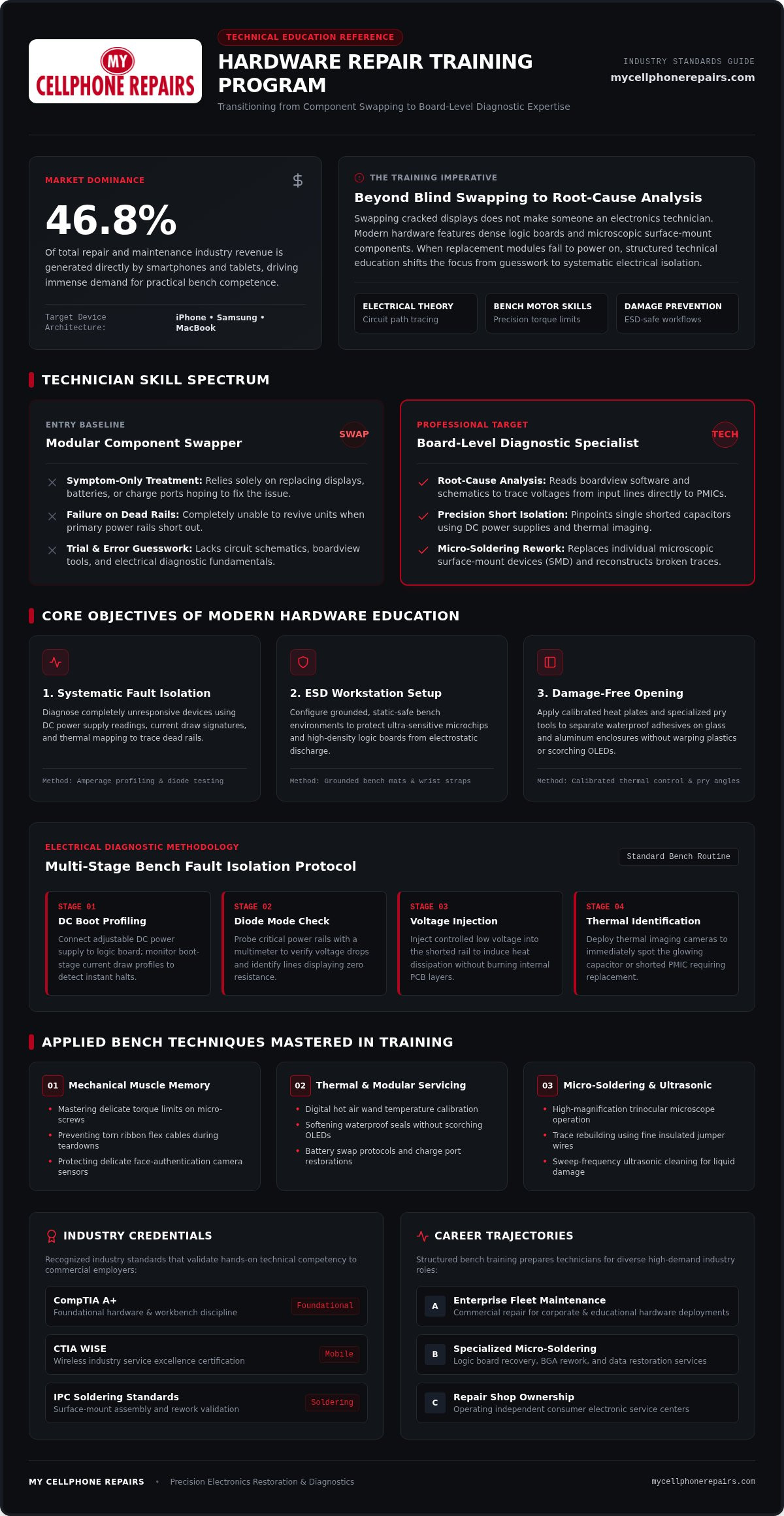
- Systematic fault isolation: Diagnose completely unresponsive devices using DC power supply readings, current draw signatures, and thermal mapping.
- ESD workstation management: Configure grounded, static-safe bench environments to protect sensitive microchips during teardown and testing.
- Damage-free opening techniques: Apply controlled heat and specialized pry tools to open adhesive-sealed glass and aluminum enclosures safely.
Component Swapping vs. Board-Level Diagnostic Expertise
Many novice technicians rely strictly on modular swaps. They install fresh batteries, display panels, or charge ports, hoping to resolve the symptom. When a primary power rail shorts out, new modules will not revive the device. A quality hardware repair training program teaches root-cause electrical analysis.
Students learn to read boardview software and schematics, tracing voltages directly from input charging lines to power management integrated circuits (PMICs). This diagnostic logic separates basic assemblers from elite bench technicians who can locate and replace a single shorted capacitor.
Essential Skills Covered in Professional Hardware Repair Courses
Mastering modern electronics requires moving past abstract physics into applied bench techniques. Today’s consumer market runs heavily on portable devices, with smartphones and tablets generating 46.8% of total repair and maintenance industry revenue. A comprehensive hardware repair training program bridges basic electrical fundamentals with intricate multi-device architecture, giving technicians the practical workflows needed to troubleshoot complex hardware reliably.
Before touching customer-owned hardware, technicians build mechanical muscle memory on specialized test fixtures. They learn to feel delicate torque limits on micro-screws, prevent torn ribbon flexes, and avoid damaging hidden face-authentication sensors. Aligning these practical habits with recognized standards, such as foundational CompTIA A+ certification requirements, builds the discipline required for commercial shop environments.
Precision Diagnostics and Multimeter Troubleshooting
Top-tier diagnostics depend on systematic electrical measurement. Students connect adjustable DC power supplies to logic boards, using boot-stage current draw profiles to pinpoint system halts. When a rail shows zero resistance, technicians use diode mode testing, low-voltage injection, and thermal imaging cameras to identify the exact glowing capacitor causing the short.
Modular Disassembly and Component Replacement
Modular servicing requires precise temperature management. Technicians calibrate heat plates and digital hot air wands to soften waterproof adhesives without scorching organic light-emitting diode (OLED) layers or warping frame plastics. Training covers charging port assemblies, tactile power buttons, battery swap protocols, and complex displays, mirroring standard procedures like iPhone screen repair.
Micro-Soldering, Rework, and Liquid Damage Restoration
Circuit-level repair demands steady hand-eye coordination under high-magnification trinocular microscopes. Technicians master surface-mount device (SMD) rework, trace rebuilding using insulated jumper wire, and connector replacements without melting adjacent plastic housings. For liquid-damaged electronics, students run corroded boards through sweep-frequency ultrasonic cleaner tanks filled with specialized de-oxidation solvents to eliminate mineral buildup under surface chips.
Developing these tactile micro-soldering and diagnostic skills through a career-focused technician training program gives you the real-world bench capabilities employers look for across consumer electronics depots.
Evaluating Hardware Training Programs: Key Criteria and Formats
Choosing the right hardware repair training program determines how quickly you transition from a beginner to an employable technician. Many online schools advertise complete courses, yet they rely entirely on pre-recorded video lectures and software simulators. Electronics repair is tactile. You cannot master microscopic soldering, safe battery prying, or delicate glass separation by simply clicking through slides.
Strong programs combine structured lectures with supervised workbench practice. This practical foundation prepares you for roles tracked in the Bureau of Labor Statistics occupational outlook for support specialists, where real troubleshooting speed and physical repair accuracy directly influence earning potential. When vetting schools, examine their hands-on lab structure, workbench tooling, and breadth of device coverage.
In-Person Workbench Labs vs. Virtual Online Training
Virtual classes teach baseline electronics terminology, but they cannot provide physical touch feedback. You need to feel the exact resistance of an adhesive strip before it snaps. You must also experience how quickly heat transfers through a multi-layer logic board. In an in-person or hybrid workbench lab, experienced instructors watch your iron handling, pointing out cold solder joints and correcting poor posture before bad habits take root.
Tooling and Workstation Standards to Look For
A reputable training facility mirrors an active commercial repair lab. Each student station should include dedicated, professional-grade diagnostic gear:
- Optical inspection: Trinocular stereo microscopes with high-definition digital camera outputs for live instructor review.
- Thermal control: Temperature-controlled soldering stations fitted with interchangeable micro-pencil tips and hot tweezers.
- Bench safety: Regulated DC bench power supplies, grounded anti-static mats meeting ANSI/ESD S20.20 requirements, and active fume extraction units.
Multi-Platform Coverage: Smartphones, Laptops, and Tablets
Avoid courses that limit instruction to a single device family. A high-value hardware repair training program covers diverse operating systems and physical layouts. Students need practical experience dealing with compact Android charging sub-boards, dense Apple multi-board sandwiches, and complex laptop power delivery.
Look for coursework addressing multi-cell battery safety and thermal adhesive release, following proven steps like those in standard battery replacement protocols. The curriculum should also cover larger logic boards, incorporating complex workflows modeled on advanced MacBook liquid damage repair procedures.
Step-by-Step Pathway: From Enrolled Student to Certified Technician
Transitioning from an electronics novice to a qualified bench technician requires an organized progression. You don’t jump directly into repairing customer devices on day one. A structured hardware repair training program breaks your bench education into progressive phases. This sequence ensures you master safety and diagnostics before tackling time-sensitive production repairs.
Every milestone builds the speed and technical accuracy required to protect sensitive personal electronics. By hitting these practical benchmarks, you minimize costly part damage and eliminate post-repair rework.
Phase 1: Diagnostic Fundamentals and Tool Mastery
Training starts with safety fundamentals and baseline diagnostics. Students learn safe lithium-ion battery extraction to prevent thermal runaway fires caused by punctured cells. You’ll master screw-mapping trays, ensuring every fastener returns to its exact threaded standoff. Driving a screw half a millimeter too deep cuts internal PCB traces and ruins motherboards permanently. Students also practice using specialized diagnostic software to check charging cycles and verify display serial communications.
Phase 2: Complex Assemblies and Multi-Device Servicing
Once safety habits are locked in, technicians progress to complex hardware teardowns. This phase focuses on curved displays, mid-frame transfers, and fragile sensor arrays. You’ll perform precision multi-step restorations, including multi-layer Samsung phone repair procedures.
Instruction also covers sensitive biometrics. Technicians learn to safely transfer ambient light sensors, front-facing flood illuminators, and under-display optical fingerprint scanners without disabling security pairings. You’ll also diagnose charging failures by testing accessory lines with precision bench multimeters.
Phase 3: Speed, Quality Control, and Final Certification
Technical skill means little if jobs take four hours or fail immediately after handoff. The final phase turns technical knowledge into production speed:
- Intake checklists: Test front and rear cameras, cellular basebands, speakers, and wireless charging before unfastening a single bracket.
- Timed teardowns: Run repetitive assembly drills to reach standard retail turnaround benchmarks without snapping flex cables.
- Post-repair sign-off: Verify touch digitizer linearity, proximity sensor cutoffs, and thermal levels under full processor loads.
- Credential evaluation: Pass practical diagnostic tests that validate your skills for commercial repair centers.
Ready to build verified bench competency under experienced technicians? Apply today to enroll in our hands-on technician training program and launch your career in modern hardware restoration.
Career Opportunities and Business Growth in Hardware Repair
Hardware repair delivers long-term career stability that purely software-based IT roles often lack. You cannot patch a cracked display or replace a fried charging port through a remote desktop connection. Physical electronics restoration requires hands-on craftsmanship. Completing a dedicated hardware repair training program positions you to enter a resilient industry with varied career trajectories, whether you want steady employment or direct business ownership.
Demand for qualified technicians spans several distinct commercial sectors. As device lifespans stretch and repair legislation expands, organizations actively seek specialists capable of maintaining high-density hardware portfolios without relying on expensive whole-unit replacements.
Employment Pathways: Retail, Fleet, and Corporate Service
Skilled graduates step into immediate, practical bench roles across multiple tech-driven industries:
- Commercial service facilities: Work as a frontline diagnostic specialist in high-volume electronics restoration centers handling complex multi-device triage.
- Enterprise fleet maintenance: Manage in-house hardware repairs for corporate deployments, logistics fleets, and educational systems carrying thousands of mobile devices.
- Depot and warranty operations: Run parts verification, vendor inventory pipelines, and returns processing for certified third-party service providers.
When preparing to apply for technician positions across enterprise organizations and major tech firms, consulting the Job Hunt Mode Blog can help candidates navigate company-specific hiring processes and interview expectations.
Launching an Independent Repair Business or Refurbishment Shop
Mastering component diagnostics creates a direct path to profitable shop ownership. Walk-in screen swaps and battery replacements generate dependable daily cash flow, but secondary electronics sales provide massive upside. Technicians buy broken or locked trade-ins, repair logic faults, swap worn cells, and offer certified refurbished iPhone for sale inventory at attractive margins.
Independent shop owners succeed by keeping parts distributor accounts reliable and scrap rates low. Delivering consistent, warrantied repairs builds lasting local trust that retail chains cannot match.
Accelerate Your Technical Career with My Cellphone Repairs
Launching a career in hardware repair requires learning from experienced professionals actively working on modern tech. The nationwide curriculum at My Cellphone Repairs covers Apple, Samsung, and MacBook ecosystems, taking you through hands-on board diagnosis, liquid damage recovery, and component-level rework.
Investing in a structured hardware repair training program gives you the diagnostic skills and commercial bench habits needed to excel in this trade. Take command of your professional path today, master modern device engineering, and build an enduring technical career.
Master the Bench and Build Your Technical Future
Becoming an elite hardware technician takes more than watching teardown videos. Real trade success relies on isolating electrical shorts, reading circuit schematics, and executing clean micro-soldering repairs under a microscope. Choosing the right hardware repair training program equips you with the tactile skills, ESD safety habits, and diagnostic workflows that high-volume depots and corporate employers demand.
Hands-on practice across iPhone, Samsung, and MacBook ecosystems gives you the practical foundation needed to troubleshoot complex hardware without guesswork. Whether your goal is managing enterprise device fleets, mastering board restoration, or launching a profitable independent repair business, verified technical proficiency sets you apart from casual parts swappers.
You don’t have to navigate modern board repair alone. Learn from active specialists who understand daily bench challenges and commercial quality standards. Step up to professional industry workflows today. Enroll in the Technician Training Program at My Cellphone Repairs and turn your technical passion into a rewarding, future-proof career.
Frequently Asked Questions
Do I need prior electrical engineering experience to enroll in a hardware repair training program?
No, you don’t need an engineering degree or prior circuit design background. Most students start with basic computer literacy. A quality hardware repair training program begins with electrical safety, basic multimeter usage, and tool fundamentals before advancing. Instructors teach you how to read schematics and trace circuits step by step. You’ll build the necessary electrical foundation directly on the bench.
What specific tools should a beginner technician purchase for hands-on practice?
Start with a calibrated digital multimeter, a grounded anti-static mat, and a precision driver set. Add fine curved tweezers, plastic pry shims, and a temperature-controlled silicone heating pad for softening display adhesives. If you plan to practice board work at home, invest in an entry-level digital soldering station and brass tip cleaner. High-end tools like stereo microscopes and thermal cameras are typically provided during in-person lab training.
How long does it take to become fully proficient in smartphone and laptop hardware repair?
Most dedicated students gain strong baseline proficiency within several weeks of intensive hands-on lab training. Basic modular repairs like battery and screen replacements can be mastered quickly. Achieving true speed, reliable diagnostic intuition, and clean micro-soldering technique usually takes three to six months of regular bench practice. Repeated teardowns across varied device architectures help cement muscle memory and reduce turnaround times.
Will this training program teach micro-soldering and motherboard component repairs?
Yes, advanced component diagnostics and micro-soldering form the core of comprehensive technical instruction. You’ll learn to handle surface-mount device rework, replace melted charge ports, and repair broken logic board traces under a trinocular microscope. Training also covers hot-air rework profiles, flux selection, and clearing shorted lines. These advanced skills ensure you can fix complex board failures instead of discarding expensive logic boards.
What types of devices and operating systems are covered during the course curriculum?
The curriculum covers modern mobile and personal computing ecosystems across Apple, Samsung, and MacBook platforms. You’ll work on iOS, Android, and macOS hardware architectures. This multi-brand exposure teaches you how internal layouts differ between curved-screen smartphones, compact tablets, and high-density laptops. Understanding different enclosure styles, ribbon cable routing, and proprietary fasteners prepares you to repair almost any consumer device that crosses your bench.
Can completing a hardware repair course help me start my own electronic repair business?
Yes, structured hardware training provides the technical foundation and operational discipline needed to run an independent repair shop. Beyond bench triage, a professional hardware repair training program teaches quality control checklists, intake inspections, and part-sourcing principles. These operational habits help keep rework low and customer satisfaction high. Many graduates use their repair skills to buy damaged devices, restore them, and resell certified refurbished electronics for strong retail margins.
What is the difference between learning from online video tutorials and formal technician training?
Online videos show idealized repairs without providing tactile touch feedback or real-time instructor corrections. Free streaming clips rarely explain underlying electrical fault theory. When a device refuses to boot, generic videos won’t help you troubleshoot a custom circuit short. Formal training puts you behind a professional bench with commercial instruments. Instructors immediately correct your heat gun angles, iron pressure, and teardown habits before costly mistakes occur.