
A pristine, scratch-free screen is often the most deceptive detail in certified pre-owned iPhone sales. Marketplace sellers routinely buff an outer frame or install cheap third-party glass to make an abused phone look fresh out of the box. True certification requires bench-tested internal hardware integrity, not just polished cosmetic exteriors. You want the reliable performance of an Apple flagship without paying inflated retail prices or locking into multi-year carrier agreements. Still, justified worries about degraded battery health, aftermarket parts, and hidden carrier locks can turn a smart upgrade into an expensive headache.
You don’t need a repair bench to protect your investment, but you do need to know what professional technicians look for. In this 2026 hardware guide, you’ll discover how to evaluate certified pre-owned iPhones, avoid critical hardware risks, and secure high-performance devices with technician-level confidence. We walk you through the essential diagnostic steps, from verifying battery longevity to identifying genuine internal components, so you can choose a dependable, fully unlocked device without the guesswork.
Key Takeaways
- Navigate certified pre-owned iPhone sales with confidence by distinguishing superficial cosmetic repairs from bench-tested internal hardware.
- Learn simple diagnostic methods to confirm genuine display parts, active True Tone functionality, and authentic battery health.
- Compare sourcing channels to bypass restrictive carrier bill credits and avoid blacklisted, network-locked devices.
- Evaluate device release generations against Apple software update lifecycles to guarantee long-term operating system support.
- Apply technician-approved daily habits to protect delicate logic board traces, battery chemistry, and charging port connections.
Understanding Certified Pre-Owned iPhone Standards in 2026
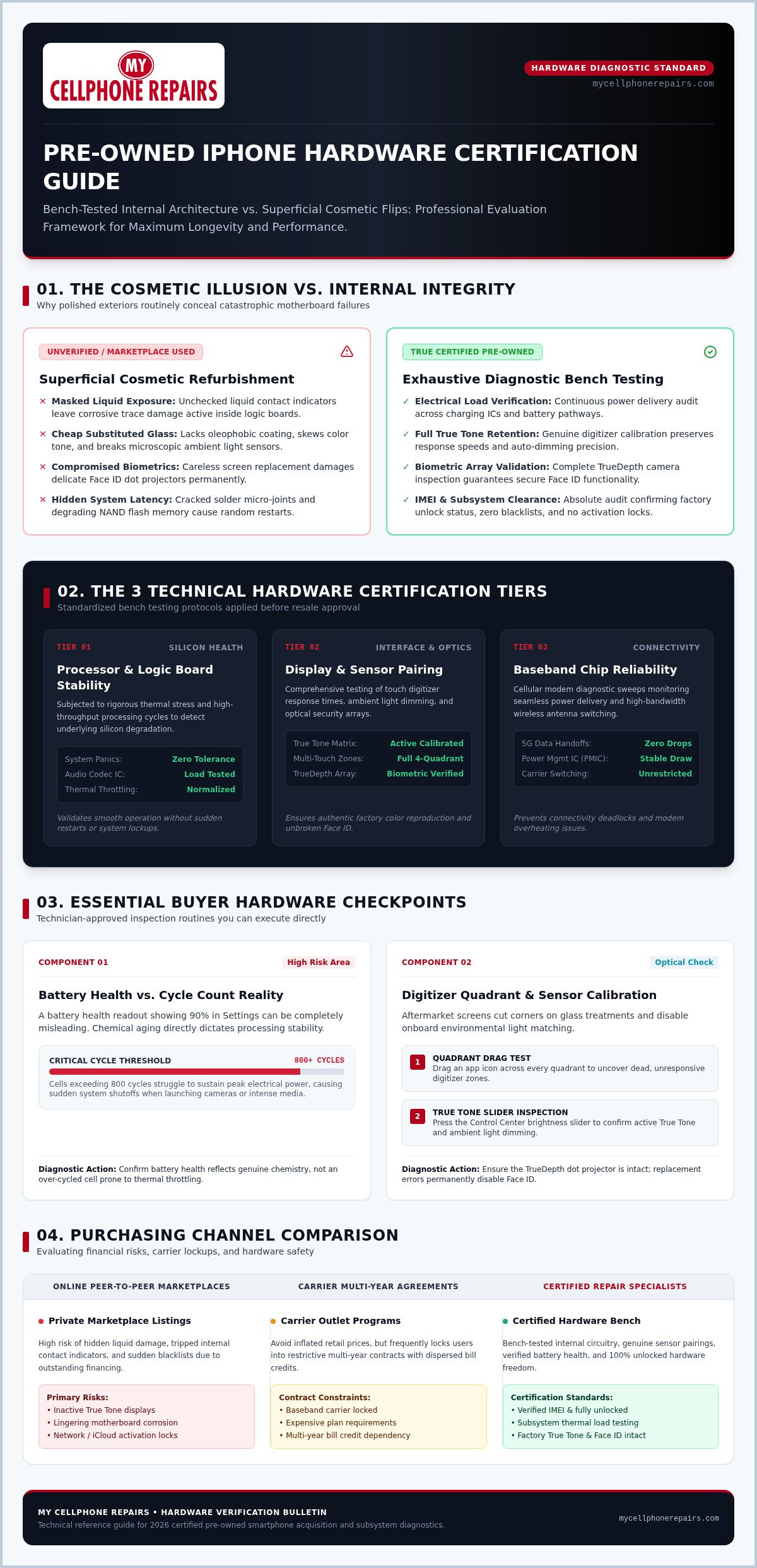
A certified pre-owned iPhone doesn’t simply mean a used handset wiped down with microfiber cloth. True certification means the device has undergone exhaustive diagnostic bench testing, electrical load verification, and complete component restoration to match original operating tolerances. Many shoppers mistakenly assume that a spotless aluminum frame equals internal reliability. In reality, repair technicians frequently see pristine cosmetic housings concealing severe logic board corrosion, cracked solder joints, or failing memory chips. Reliable certified pre-owned iPhone sales eliminate these costly gambles by pairing physical component validation with an IMEI audit, confirming the hardware is fully unlocked and cleared of activation locks.
Certified Pre-Owned vs Standard Used Devices
Buying from a peer-to-peer online marketplace exposes you to hidden hardware defects that basic visual checks cannot catch. Private used listings routinely carry lingering liquid damage. Internal liquid contact indicators often reveal past moisture exposure that slowly corrodes motherboard traces weeks after a transaction. Under established industry standards for the refurbishment of electronics, trained technicians inspect, clean, and test each subsystem. Professional diagnostic testing validates multi-band wireless antennas, TrueDepth camera arrays for Face ID, and continuous power delivery across the charging circuit before approving any device for resale.
The Core Technical Standards of Genuine Certification
Rigorous hardware certification checks how internal components perform together under sustained real-world loads. Standardized testing routines evaluate three primary hardware tiers:
- Processor and Logic Board Stability: Technicians run thermal and processing stress routines to ensure the main silicon operates without system panics, unexpected restarts, or audio codec failures.
- Display and Sensor Pairing: Testing confirms genuine screen response times, proper ambient light sensor dimming, and active True Tone calibration across the entire touch digitizer.
- Baseband Chip Reliability: Diagnostic sweeps monitor the cellular modem and power management ICs to guarantee uninterrupted carrier signal switching and reliable 5G data handoffs.
Essential Hardware Checkpoints Before Purchasing a Pre-Owned iPhone
A hands-on physical inspection tells you everything about a device that cosmetic grading systems leave out. When shopping certified pre-owned iPhone sales, testing internal components yourself guarantees that the phone performs reliably under heavy daily demands. Financial guidance from Consumers Credit Union emphasizes that buyers must carefully evaluate a seller and their products to avoid paying premium rates for subpar parts. Skipping these direct hardware checks leaves you vulnerable to hidden motherboard strain, failing sensors, and early component collapse.
Battery Health and Power Management Verification
Never rely solely on the battery health percentage shown in Settings. A lithium-ion cell reporting 90% capacity might still crash if its charge cycle count exceeds 800 cycles. Chemically aged batteries struggle to supply peak power, causing sudden shutdowns when launching demanding camera apps or playing high-frame-rate media. You can review the ultimate guide to phone battery replacement to understand how cycle counts directly dictate processing stability and thermal throttling under load.
Display Quality, Touch Response, and Face ID Integrity
Inspect the display glass and digitizer immediately. Cheap third-party screens often lack oleophobic coatings, produce inaccurate color casts, and fail to support multi-touch gestures correctly. Drag an app icon across every quadrant of the screen to identify unresponsive dead zones. Open the Control Center and press the brightness slider to confirm active True Tone calibration. Low-grade replacements disable this feature and can disrupt the ambient light sensor. Worse, sloppy screen installations often damage the microscopic Face ID dot projector, permanently breaking biometric security. High-end bench work, such as that seen in expert iPhone screen repair, preserves these precise sensor pairings.
Port Connectivity and Audio Component Testing
Check the bottom edge of the phone with a strong flashlight. Look directly into the Lightning or USB-C charging port to confirm that the internal pins are straight, clean, and free of green corrosion or compacted lint. Test audio functionality by recording a brief voice memo and playing it back against your ear. This simple test confirms both the primary bottom microphone and the top ear speaker work crisply. Finally, check the SIM tray slot for the Liquid Contact Indicator (LCI); if the white strip shows bright pink or red, internal moisture has entered the chassis. If you want verified hardware without conducting bench tests alone, you can find technician-vetted devices through My Cellphone Repairs.
Sourcing Channels: Carriers vs Online Marketplaces vs Repair Specialists
Where you purchase your device matters just as much as what you inspect on the bench. Certified pre-owned iPhone sales split across three primary channels: wireless network carriers, high-volume online marketplaces, and dedicated hardware repair centers. Each path offers entirely different trade-offs regarding real hardware condition, freedom from restrictive carrier contracts, and long-term diagnostic accountability. Choosing the right channel protects your budget from hidden ownership fees and prevents post-purchase technical headaches.
Carrier Financing Pitfalls and Locked Network Restrictions
Network carriers often market pre-owned phones using monthly payment structures and enticing bill credits. These credits require a 24- to 36-month network commitment to realize any advertised discount. If you cancel service or switch carriers early, the remaining device balance becomes due immediately. Carrier hardware is typically network-locked out of the box, preventing you from swapping in a lower-cost prepaid SIM or using travel eSIMs abroad—if you want flexible international data coverage once your device is unlocked, check out Always Mobile. Surcharges and activation fees also quickly inflate the total cost of ownership well beyond the phone’s true open-market value.
High-Volume Online Marketplaces and Quality Discrepancies
Massive e-commerce platforms process thousands of returned units every week through rapid, automated warehouse sorting. This assembly-line grading focuses heavily on surface scratches while missing intermittent internal issues, such as micro-fractured camera image stabilization or subtle audio dropouts. If a defect emerges after arrival, resolving the problem means dealing with slow return logistics, restocking policies, and third-party warehouse disputes. You may also receive a device with unbranded charging cables that fail to regulate voltage safely.
The Advantage of Dedicated Hardware Repair Providers
Buying from an active hardware repair facility gives you direct access to bench-tested reliability. Dedicated repair specialists evaluate motherboards under physical inspection, testing power rails, sensor lines, and component integrity by hand rather than rushing through automated scans. Technicians trained in programs like cell phone repair technician training understand how delicate internal connections behave over time. This technical rigor provides distinct advantages:
- Transparent Component Lineage: Technicians openly disclose whether components are factory original or premium aftermarket replacements.
- Contract-Free Freedom: Devices arrive factory unlocked, ready for immediate activation on any carrier network without locked payment terms.
- Direct Accountability: You speak with hardware professionals who diagnose and repair phones every day, ensuring reliable support if questions arise.
How to Choose the Right Certified Pre-Owned iPhone Model
Selecting the right hardware requires matching technical specs directly to your workflow. Finding success in certified pre-owned iPhone sales isn’t about buying the most expensive device available; it’s about choosing an iPhone generation with the right balance of processor lifespan, storage capacity, and genuine component verification. Following a systematic five-step framework keeps you from overpaying for features you don’t need or purchasing hardware on the brink of obsolescence.
Assessing Software Lifecycles and Chipset Performance
Every pre-owned purchase depends on software update longevity. Apple’s iOS 27 release in September 2026 establishes a strict cutoff: models older than the iPhone 11 no longer receive major operating system upgrades or vital security patches. The iPhone 12 generation is rapidly approaching the end of its mainline support cycle. To secure three to four years of reliable daily utility, target generations equipped with the A16 Bionic chip or newer silicon. These chipsets deliver plenty of thermal headroom, efficient power draw, and consistent app responsiveness.
Storage Requirements and Camera Capabilities
Storage demands expand quickly with modern software updates and media files. Skip legacy 64GB capacities entirely. Opt for at least 128GB to hold system resources, cache files, and regular video captures comfortably. When evaluating cameras, consider your actual use case:
- Dual-Lens Base Models: Deliver exceptional wide and ultra-wide shots for casual photography, daily video calls, and social posting without extra bulk.
- Triple-Lens Pro Editions: Provide dedicated telephoto zoom lenses, LiDAR depth mapping, and RAW photo capture for professional workflows and detailed low-light imaging.
- Form Factor Benefits: Plus and Pro Max models house significantly larger internal battery packs, giving power users extensive screen-on time between charges.
Validating Device Authenticity and Carrier Unlock Status
Inspect the device’s software menus before finalizing any transaction. Go to Settings > General > About. Look at the Carrier Lock line to confirm it reads “No SIM restrictions.” A device tied to a specific carrier limits your network choices and complicates travel. Next, examine the Parts and Service History section just below the serial number. An authentic handset clearly lists genuine parts, whereas inferior third-party components trigger persistent “Unknown Part” system warnings. Finally, check the 15-digit IMEI against public blacklist registries to guarantee the phone isn’t reported lost, stolen, or tied to an unpaid balance. To bypass the stress of manual hardware auditing, you can shop technician-inspected refurbished iPhones that come fully unlocked and diagnostics-certified.
Maximizing Longevity: Post-Purchase Care and Hardware Support
Securing a high-performing handset is only the first step. Long-term reliability depends heavily on how you maintain internal hardware components after taking delivery. Certified pre-owned iPhone sales offer substantial value over retail pricing, but real-world lifespan is determined by daily thermal habits, charging discipline, and structural protection. A few intentional maintenance routines will keep your device running cleanly for years without untimely hardware degradation. For broader market trends and model-by-model comparisons, consult the national refurbished iPhone buying guide.
Preventative Maintenance for Pre-Owned Hardware
Heat is the primary enemy of lithium-ion battery chemistry and internal solder joints. Avoid streaming high-resolution video or playing graphically intensive games while fast-charging on a power delivery brick. High ambient temperatures combined with fast current input accelerate chemical wear on the battery cathode. Use these practical preventative routines:
- Manage Charge Thresholds: Enable the 80% charging limit in iOS settings if your model supports it, or unplug shortly after reaching full capacity rather than leaving the handset charging on a pillow overnight.
- Clean Charging Ports Safely: Use a non-conductive wooden or anti-static plastic toothpick to gently clear pocket lint from the port recess. Never use metallic needles or safety pins that can short the data pins.
- Protect Structural Integrity: Install a dual-layer shock-absorbing case with reinforced corners. Corner impacts don’t just crack outer glass; they flex the chassis, causing microscopic fractures along delicate logic board traces.
- Apply Quality Screen Protection: Use high-density tempered glass to absorb blunt surface impacts, preventing costly OLED digitizer damage and micro-fractures.
Securing Trusted Repair Backing for Pre-Owned Devices
No consumer electronics device remains indestructible indefinitely. When your device eventually needs a fresh cell or accidental impact restoration, relying on certified repair specialists protects your initial investment. Anonymous online marketplaces disappear once their return windows close, leaving you stranded if hardware issues arise later. Establishing a relationship with professional technicians who handle component-level servicing ensures fast, reliable repairs down the line. Whether completing display replacements, water damage repairs, or routine port maintenance, experienced bench technicians keep your pre-owned hardware running at peak performance without forcing premature device upgrades.
Upgrade Smarter with Verified Hardware Confidence
Investing in pre-owned Apple hardware shouldn’t feel like an expensive gamble. Finding lasting value in certified pre-owned iPhone sales comes down to prioritizing internal diagnostic benchmarks over superficial exterior polish. Once you verify genuine display calibration, true battery cycle wear, and clean carrier unlock status, you secure premium mobile performance while bypassing restrictive multi-year financing agreements.
You don’t have to evaluate delicate logic boards or test microscopic sensor lines on your own. Skip the uncertainty of anonymous marketplace sellers and high-volume liquidation warehouses. Every handset from My Cellphone Repairs undergoes comprehensive multi-point functional diagnostics, fully inspected and bench-tested by trained mobile hardware technicians. Backed by nationwide service and dedicated hardware repair support, you get dependable mobile power built for the long haul. Explore technician-certified pre-owned iPhones at My Cellphone Repairs and secure your next device with total confidence.
Frequently Asked Questions
What is the main difference between a used iPhone and a certified pre-owned iPhone?
A standard used iPhone is sold as-is with unknown internal wear, while a certified pre-owned device undergoes comprehensive diagnostic testing and hardware restoration. In certified pre-owned iPhone sales, technicians test the logic board, battery load, display calibration, and wireless connectivity before listing the handset. Private marketplace sellers simply wipe their personal data and hand over the phone, leaving you vulnerable to hidden liquid exposure, degrading cells, or latent motherboard defects.
How high should the battery health percentage be on a certified pre-owned iPhone?
Aim for a maximum battery capacity of at least 85% to 90%, but always verify the cycle count alongside that number. Apple operating systems flag batteries below 80% capacity for immediate service. However, a battery showing 86% with more than 800 cycles can still suffer voltage drops and throttle processing performance during peak usage. Reputable sellers install a fresh battery replacement if the original cell fails dynamic load tests.
Will a certified pre-owned iPhone work with any cellular carrier?
Yes, as long as the device is sold as factory unlocked rather than carrier-locked. Unlocked hardware lets you insert a SIM card or activate an eSIM from any major network or discount carrier immediately. Always check Settings, tap General, open About, and confirm the Carrier Lock status displays “No SIM restrictions.” Avoid carrier-subsidized pre-owned listings that require multi-year billing commitments or lock you into a single cellular provider.
Do certified pre-owned iPhones still receive official iOS software updates?
Yes, certified pre-owned iPhones receive official Apple operating system updates as long as the specific hardware generation remains supported. For example, iOS 27 supports devices starting with the iPhone 11 series, giving newer generations years of security patches and feature updates. Certification doesn’t affect software eligibility. As long as the device has a clean motherboard and genuine internal chips, it downloads updates directly from Apple just like a brand-new retail unit.
Can I tell if a pre-owned iPhone has aftermarket replacement parts installed?
Yes, you can check directly inside the iOS software menus. Navigate to Settings, select General, and open the About screen to view the Parts and Service History section. If a previous owner installed non-genuine components without proper calibration, you’ll see an “Unknown Part” notice for the display, battery, or rear camera. Legitimate certified pre-owned iPhone sales clearly note whether original or premium technician-installed parts are present, avoiding surprise system alerts.
What should I do first after receiving a certified pre-owned iPhone?
Inspect the physical casing and test the internal hardware before restoring your personal backup. Connect the handset to Wi-Fi, run a test phone call to verify both microphones and the earpiece, and drag an app icon across the screen to detect touch digitizer dead spots. Plug in a charging cable to ensure the port grips firmly. Finally, check the IMEI against a public blacklist database to confirm the device has clean carrier status.
Why is buying from a certified repair facility safer than an online auction site?
Auction sites rely on automated sorting or private seller claims, offering zero hands-on hardware accountability once the sale concludes. A dedicated repair facility employs trained technicians who diagnose power rails, test logic boards, and clean charging ports on a professional bench. If you encounter an unexpected component failure down the road, an established repair shop has the diagnostic equipment and replacement parts on hand to keep your device operational.