
What if you don’t need to choose your entire career before you pick up a screwdriver? The Electronics repair career path can start with a focused specialty, from phones and laptops to other electronics, then grow as you build practical skills. The first decision is often more specific: which devices do you want to learn, and what training or experience will help you get started?
That uncertainty is normal. Repair work has several routes, and the right starting point depends on what you enjoy troubleshooting, how you learn best, and where you want the work to lead. Formal education may suit some roles, while focused training and hands-on practice can help you test your interest and develop core skills. My Cellphone Repairs offers hands-on instruction in hardware components and diagnostic techniques for people interested in mobile device repair.
This guide compares common repair specialties and career roles, explains the skills and training that can prepare you, and shows how to choose a practical first step. You’ll be able to connect your interests with a realistic route into the field, without treating one credential or training path as right for everyone.
Key Takeaways
- The Electronics repair career path varies by device, workplace, and experience, so compare roles before choosing a specialty.
- Build technical skills alongside patience, accuracy, and clear communication. A step-by-step diagnosis helps avoid replacing parts by guesswork.
- Compare self-study, structured courses, and supervised workplace experience. Look for hands-on practice, diagnostic exercises, and safety instruction.
- Choose a focus by considering the devices you enjoy, the work setting you prefer, and the learning opportunities you can access.
- Start with a practical plan: learn the fundamentals, practice safely, and check whether your training is moving you toward your goal.
What Does an Electronics Repair Career Involve?
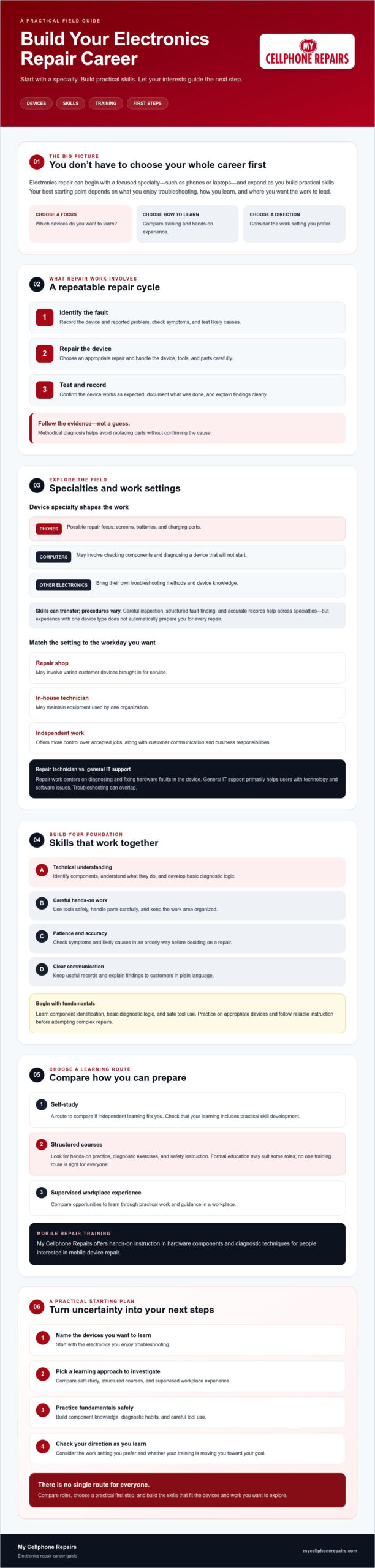
Electronics repair work follows a practical cycle: identify a fault, repair the device, then test it to confirm it operates as expected. The specific work depends on the device, employer, customer needs, and technician experience. A repair-shop technician may handle devices brought in by customers, while an in-house technician may maintain equipment used by one organization. Independent work offers more control over the jobs accepted, but also involves customer communication and the day-to-day responsibilities of running a business.
An electronics repair technician finds and fixes hardware faults in electronic devices; general IT support primarily helps users resolve technology and software issues. The roles can overlap, especially during troubleshooting, but repair work centers on the device itself. For background on the broader occupation, see the overview of the Electronics Technician role.
Which electronics repair specialties can you explore?
Mobile phones, computers, and other consumer electronics each bring different repair challenges. A phone specialist might work on screens, batteries, or charging ports. Computer repair may involve checking components and diagnosing a device that won’t start. Other consumer electronics call for their own troubleshooting methods. Tools, repair procedures, and device knowledge vary by specialty, so experience with one type of device doesn’t automatically prepare you for every repair.
Some skills transfer across specialties. Careful inspection, structured fault-finding, and accurate records help with many device types. These habits make it easier to learn new equipment and take on more complex diagnostics over time, without assuming there’s one standard promotion ladder.
What does a repair technician do during a typical workday?
A repair job often begins with intake: recording the device and the customer’s description of the problem. The technician checks the symptoms, tests likely causes, and decides what repair is appropriate. After the repair, they test the device again and record what was done. The exact workflow varies by workplace and role. Some technicians focus on diagnosis, while others carry out repairs or communicate directly with customers.
Good work depends on more than the repair itself. Keep clear records, handle parts carefully, and explain findings in plain language. If testing points to a different cause than the customer first suspected, describe what you found before moving forward. This process helps avoid guesswork and keeps the customer informed.
Use the work setting to assess your fit. A repair shop can expose you to varied customer devices, in-house service may focus on one organization’s equipment, and independent work combines technical repairs with business responsibilities. The best starting point for your Electronics repair career path is the setting that matches the devices you want to learn and the kind of workday you prefer.
Which Skills Help You Build an Electronics Repair Career?
Strong repair work combines technical knowledge with habits developed through practice. Understanding components helps you test possible causes. Patience and accuracy help you work carefully, while clear communication keeps customers informed. As the Electronics repair career path develops, these abilities work together: a sound repair depends on a reliable diagnosis, careful hands-on work, and a clear record of what was found and done.
A capable repair technician diagnoses methodically, handles devices and tools with care, and explains findings in language customers can understand. Replacing a part based on a guess can miss the actual fault, waste time, or introduce a new problem. Follow the evidence instead: check the symptoms, test likely causes, and confirm the result.
Which technical skills should a beginner develop first?
Start with component identification, basic diagnostic logic, and safe tool use. Learn to recognize common phone and laptop parts, understand what they do, and follow an orderly process when a device behaves unexpectedly. For example, a phone that won’t charge needs careful checks before assuming the port is the cause. A laptop that won’t start also calls for diagnosis, not an immediate part swap.
Build experience on appropriate practice devices and use reliable instruction, especially before attempting complex repairs. Safe handling includes keeping the work area organized, protecting parts from damage, and following relevant device procedures. A course can introduce these foundations, but skill develops through repeated practice and feedback, not a single class.
Why do troubleshooting and customer communication matter?
Ask focused questions before opening a device. When did the problem begin? Does it happen every time? Has the device been repaired before? The answers establish symptoms and repair history, giving you a stronger starting point. Record the reported issue, test results, and work performed so another technician, or you later, can follow the reasoning.
Then explain what you found and outline appropriate repair options in plain language. Avoid promising a fix before the diagnosis supports it. After the work, test the device against the original complaint. If a phone was reported as not charging, confirm its charging behavior rather than assuming the repair resolved the issue. The BLS Occupational Outlook Handbook offers additional context on technician work and related occupations.
Structured, hands-on learning can help you practice hardware knowledge and diagnostic techniques. If you’re comparing that kind of starting point, explore the Technician Training Program and review its current curriculum and format before enrolling.
What Training and Credentials Can Prepare You for Electronics Repair?
There’s no single training route that fits every repair role. You can study independently, take a structured course, or learn through supervised workplace experience. Each has trade-offs: self-study offers flexibility, a course can provide a planned sequence of topics, and workplace learning connects instruction to real repair workflows. The right choice depends on your target specialty, how you learn, and what employers expect for the roles you’re considering.
How can you compare electronics repair training options?
Look beyond the course title. Check whether it gives you practice diagnosing faults and working with hardware, not just reading about components. Before enrolling, find out:
- Which devices and repair procedures the training covers.
- Whether it includes hands-on practice and diagnostic exercises.
- How instructors support learners and whether there are prerequisites.
- What safety instruction is included and what outcomes the provider actually states.
These details show whether the training matches your goal. If you want to work on phones or laptops, look for instruction relevant to those devices rather than assuming a broad electronics course covers every repair procedure. My Cellphone Repairs offers a Technician Training Program with hands-on instruction in hardware components and diagnostic techniques. Check the current curriculum, delivery format, eligibility, and any credentials awarded before deciding whether it suits you.
When might a certification or formal education help?
Some employers may ask for relevant education or credentials, while others may prioritize practical ability or experience. Requirements vary by role, so review current job listings for the specialty you’re considering. The U.S. Bureau of Labor Statistics Occupational Outlook Handbook provides information about duties and typical education for electrical and electronics installers and repairers. Check how closely that occupation matches the job you want.
A general technical credential may demonstrate broad knowledge, but it isn’t the same as device-specific repair practice. Formal education can provide a wider technical foundation; focused training may target particular hardware and diagnostic tasks. Neither guarantees competence or employment. For your Electronics repair career path, choose a credential only if it supports a clear requirement or skill gap, and verify its current recognition with the employers you hope to approach.
How Can You Choose a Specialty and Progress in Electronics Repair?
Your best specialty is a practical match between the devices you enjoy, the work setting you want, and the training you can access. You don’t have to map out an entire career at once. Use a few concrete checks to narrow your options, then test your choice through study or supervised practice.
How do you choose the right repair specialty?
Start by noticing which devices you’re curious about. Do you want to understand phone hardware, work with laptops, or explore other electronics? Then compare the work settings available to you. A customer-facing repair shop may involve explaining findings and helping with a range of device issues; other employers may focus on equipment used within one organization. Neither setting suits everyone.
- Pick devices to explore. Identify the types you’d be willing to learn about in depth, such as phones or computers.
- Compare work settings. Consider how much customer contact, variety, or focused equipment work you prefer.
- Review current job descriptions. Look for repeated skills, experience, and education requirements. Check current openings rather than assuming every employer hires for the same background.
- Match the route to your access. Compare available courses, practice opportunities, and supervised experience against the tasks you want to learn.
What can career progression look like over time?
Early work may center on defined repairs and basic checks, while more challenging roles can involve tracing less obvious faults, carrying out deeper diagnostics, or checking repair quality. With experience, some technicians may take on training or team responsibilities if those opportunities exist. These are possible directions, not guaranteed job titles or steps on a universal ladder.
Progress depends on the skills you can demonstrate, the experience you gain, and the roles available where you work. Keep a record of device types, tasks performed, diagnostic methods used, and whether the work was supervised. That log can help you spot strengths, identify gaps, and explain your experience when reviewing new openings. For your Electronics repair career path, use real job requirements to decide which skill to build next.
If phone or laptop repair interests you, explore the hands-on technician training program as one possible way to develop hardware and diagnostic skills. Check the current program details and compare them with the roles you’re targeting before you enroll.
How to Start Your Electronics Repair Career: A Practical Plan
You don’t need to settle your whole future before you begin. Use your first month to test one area of interest, learn the basics, and find out what employers expect. Keep the steps small and specific. That makes the Electronics repair career path easier to assess before you commit to a longer course or a particular specialty.
What should you do in your first 30 days?
Choose one device category, such as phones or laptops, and research the common entry-level tasks in that area. Then review current job descriptions for related roles. Note the skills and experience employers mention, and use that list to guide your learning instead of guessing what matters.
- Choose a focus. Pick one device type that you’re motivated to understand.
- Study the work. Read about common repairs and compare relevant job requirements.
- Set a safe learning routine. Make time for fundamentals, tool familiarity, and guided practice. Don’t take on complex repairs without appropriate training and supervision.
- Review your progress. Track what you’ve learned, where you need help, and whether the specialty still interests you.
Use practice devices and supervised opportunities where available. The goal at this stage isn’t to claim expertise. It’s to build a reliable foundation and make an informed next choice.
How can hands-on training support your next step?
Hands-on instruction can connect technical concepts to actual hardware and diagnostic tasks. My Cellphone Repairs’ Technician Training Program focuses on hardware components and diagnostic techniques. It may be a practical starting point if phone repair interests you, but it shouldn’t be treated as preparation for every electronics specialty. Compare the course with your goals, and confirm its current curriculum, delivery format, eligibility, and any credentials awarded before enrolling.
After training, keep building through practice and feedback. Record the devices and tasks you’ve worked on, the diagnostic steps you used, and what you’d do differently next time. Use that record to compare your skills against job descriptions and identify a sensible next step, such as more supervised practice or learning a related device category.
If phone repair fits your interests, explore the Cell Phone Repair Technician Training details as one possible route into hands-on learning. Check that the current program meets your needs before deciding whether to enroll.
Take Your First Practical Step
The right Electronics repair career path starts with a specialty that interests you, not a decision to learn every device at once. Compare repair roles and employer requirements, then build core skills through safe practice, structured training, or supervised experience. Focus on methodical diagnosis and keep track of what you can do confidently and where you need more practice.
Hands-on learning can help connect theory to repair tasks. My Cellphone Repairs’ Technician Training Program includes instruction in hardware components and diagnostic techniques. The business also repairs iPhones, Samsung phones, and MacBooks, offering concrete examples of devices technicians may work on. Training is one possible starting point, not a guarantee of employment or preparation for every specialty. Check current course details, including curriculum and outcomes, before enrolling.
Ready to explore a practical learning option? Explore My Cellphone Repairs’ technician training options and compare them with your goals. Start with one focused step, build experience steadily, and let your progress guide what comes next.
Frequently Asked Questions
Is electronics repair a good career path?
It can be a good fit if you enjoy hands-on troubleshooting, careful work, and learning how different devices function. Repair roles vary, so consider the devices and work settings that interest you, then review current job openings to understand employer needs. The Electronics repair career path may suit people who like solving practical problems, but prospects and day-to-day duties depend on the specialty, employer, and available roles.
Do you need a degree to become an electronics repair technician?
No single education route applies to every electronics repair role. Some employers may ask for formal education, while others may value relevant skills, training, or supervised experience. Check job descriptions for the specialty you want and note their stated requirements. A certificate or degree can provide structured learning, but compare its subjects and practical work with the actual tasks you hope to perform.
How do I start an electronics repair career with no experience?
Choose one device category, learn basic component and diagnostic concepts, and look for safe, supervised ways to practice. Review job descriptions to see which skills employers request, then compare training options against those needs. A hands-on course can help you build familiarity with hardware and diagnostic techniques. For example, My Cellphone Repairs offers a Technician Training Program, but check its current curriculum and outcomes before enrolling.
What skills do electronics repair technicians need?
Technicians need basic electronics knowledge, safe tool handling, and a methodical approach to diagnosis. Patience and accuracy help prevent avoidable mistakes, while clear communication helps customers understand findings and repair options. Good records also matter: document reported symptoms, tests, and work completed. Instead of replacing a part based on a guess, check likely causes in a logical order and test the device after the repair.
Can you specialize in phone or laptop repair?
Yes. Phone and laptop repair are distinct specialties, and you can focus on one device category as you develop your skills. Phone work may involve learning about screens, batteries, and charging ports; laptop repair calls for knowledge of computer components and device-specific diagnostic steps. The tools and procedures differ, so build experience with appropriate devices and training before attempting unfamiliar or complex repairs.
Are electronics repair certifications required?
Certifications aren’t a universal requirement for every electronics repair job. Their value depends on the role and employer. Some positions may request a particular credential or formal education, while others may focus on practical ability and experience. Check current job listings before paying for a certification. Also confirm what the credential covers, since general technical knowledge may not equal hands-on preparation for repairing a specific phone or laptop.
What can you do after becoming an electronics repair technician?
With experience, you may pursue more complex diagnostics, quality checks, training responsibilities, or team duties, if those roles are available. Some technicians deepen their expertise in a particular device category; others build broader repair experience. Progress depends on demonstrated skills, practical experience, and employer needs, not a guaranteed promotion ladder. Keep track of devices repaired, diagnostic methods used, and supervised work to identify and show your growing strengths.