
Are refurbished iPhones reliable? They can be, but the word “refurbished” alone doesn’t tell you how carefully a phone was inspected or restored. Properly restored iPhones can last 6 to 9 years on average, so the quality of the work and the warranty matter as much as the price.
It’s reasonable to be cautious: a used phone may be sold as-is, while a refurbished one should have been tested and repaired. But sellers use “refurbished” in different ways, so the label alone doesn’t guarantee a particular condition.
This guide explains what refurbishment can mean, how inspection details affect reliability, and why warranty and return terms matter. It also compares refurbished and new iPhones, outlines risks to consider, and offers a practical decision guide. Focus on the phone’s restoration, battery condition, software support, and the protection included with the purchase.
Key Takeaways
- Look beyond the “refurbished” label and focus on the seller’s inspection and repair process.
- Compare condition grades by what they say about cosmetic wear, not just the device’s price.
- Read warranty terms and return coverage to understand what protection applies after purchase.
- Use battery health, functional testing, and signs of prior repair to assess a phone’s condition.
- Weigh the savings against software support and the longer warranty typically included with a new iPhone.
Should You Buy a Refurbished Phone?
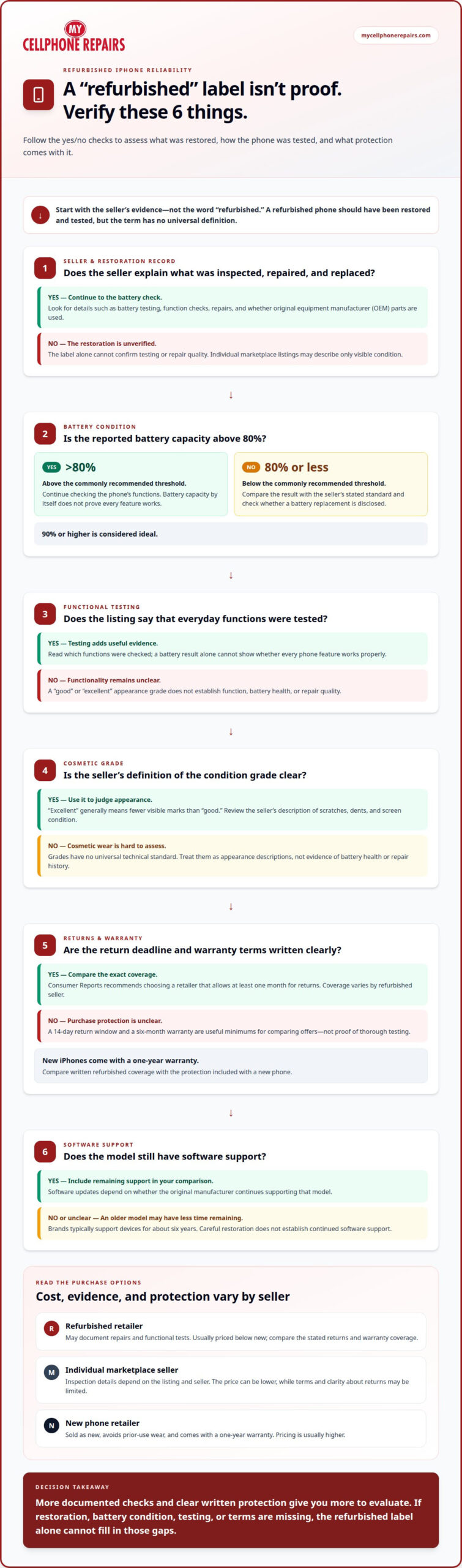
Refurbished phones generally cost less than new models; used listings may cost less still, but offer less assurance of restoration. Before buying, review the inspection process, battery, cosmetic grade, return terms, and warranty.
The “refurbished” label has no universal definition, so focus on the seller’s specific tests and repairs.
Seller Reputation and Return Policies
A retailer with a documented inspection process differs from an individual marketplace seller whose listing may describe only visible condition. Compare customer reviews, return terms, and warranty coverage together. Consumer Reports recommends choosing a retailer that allows at least one month for returns. A 14-day return window and a six-month warranty are useful minimums for comparing offers, not proof that every phone passed thorough testing.
Look for details about battery testing, function checks, and whether the seller uses original equipment manufacturer (OEM) parts. A clear explanation gives you more to evaluate than the “refurbished” label alone.
| Option | Inspection details | Returns and warranty | Typical value |
|---|---|---|---|
| Refurbished retailer | May document repairs and functional tests | Compare stated coverage | Below new pricing |
| Individual marketplace seller | Depends on the listing and seller | Terms may be limited | Can be lower |
| New phone retailer | Sold as new | New iPhones come with a one-year warranty | Usually higher |
Choose a seller that explains its testing, provides clear return terms, and states the phone’s warranty coverage.
Refurbished and New iPhones
A refurbished iPhone can cost less than a new model, but its reliability depends on the inspection and repair quality. A new iPhone avoids prior-use wear and comes with a one-year warranty. Refurbished coverage varies by seller, so compare its written terms with the protection included with a new phone.
Compare the same model, storage, and cosmetic grade. A refurbished phone graded “good” may show more visible wear than one graded “excellent.” These labels describe appearance, not necessarily battery health or repair quality. Before weighing appearance against savings, check how the seller tests everyday functions.
Risks When Buying Refurbished
Risks include an untested device sold as refurbished, a worn battery, undisclosed repairs, and cosmetic damage beyond the listing’s description. Individual marketplace sales may provide less clarity about return protections than retailer sales. Before buying, check the inspection steps, battery condition, parts policy, and return deadline.
For battery health, compare the reported capacity with the seller’s stated standard. Refurbished-phone guidance commonly recommends capacity above 80%, with 90% or higher considered ideal. Full-function testing matters too: a battery result alone cannot show whether every phone feature works properly.
What is a refurbished iPhone?
A refurbished iPhone is a previously used device that has been restored and tested. The label alone doesn’t explain its cosmetic condition, replacement parts, or testing process.
Device Condition Grades
Condition grades describe appearance, not a universal technical standard. “Excellent” generally means fewer visible marks than “good,” but phones in either grade can have different battery health or repair histories. Compare the seller’s written definition for each grade, including its description of scratches, dents, and screen condition. Treat the grade as a cosmetic description and assess functionality separately.
For example, a “good” grade may suit someone who uses a case and prioritizes function over appearance. An “excellent” grade may suit someone who cares more about visible wear. Neither label tells you whether original parts remain installed or whether testing covered every feature.
Manufacturer Certified and Other Refurbished Devices
Manufacturer-certified refurbished devices often come with a new battery and outer shell, giving buyers a defined replacement standard for those parts. Other refurbished phones may be restored by different sellers, with processes and parts that vary. Compare each listing’s details about replacements, functional testing, battery health, and cosmetic grade rather than assuming all refurbished devices are equivalent.
Third-party refurbished iPhones typically lack extended manufacturer warranty coverage. Carrier financing follows the carrier’s terms, so refurbished status alone doesn’t establish eligibility. Software updates depend on whether the original manufacturer continues supporting the model; brands typically support devices for about six years.
Refurbished and Used Devices
A used iPhone is commonly sold as-is, without a promise that repairs or testing have taken place. A refurbished phone should have undergone restoration, such as replacing defective parts, followed by function testing. However, the term has no universal meaning. Check the seller’s description for the actual repair and testing steps instead of relying on the label.
A used device might still work well, but its history and battery health may be less clear. A refurbished device offers more information only if the seller explains what was done. Look for details such as battery replacement, screen repair, and function testing. Each helps distinguish documented restoration from a simple resale.
Before buying, compare the model, grade, replacement parts, and testing record side by side. A refurbished label alone can’t confirm that a particular iPhone meets your needs. Software support matters too: an older phone may have less time remaining for updates than a newer one, even after careful restoration.
For a refurbished iPhone, focus on three separate questions: what was replaced, what was tested, and what condition grade describes the exterior? Those answers clarify what the seller means by “refurbished” and help you compare devices on more than appearance alone. You can review refurbished iPhone options as part of that comparison.
Warranty coverage
A warranty provides a defined period of protection for a refurbished iPhone purchase. New iPhones come with a one-year warranty, while refurbished coverage depends on the seller. Compare the written terms, not just the warranty label. A longer term may give you more time to address covered problems, but it doesn’t explain which problems the seller covers.
What the Warranty Actually Covers
Read the warranty document before buying. Check its length, which functional problems qualify, how to start a claim, and what exclusions apply. Find out whether the remedy involves repair, replacement, or something else. These details help distinguish useful coverage from a vague statement that a phone is “warranted.”
For example, if a refurbished iPhone stops charging, the warranty document should explain whether that fault qualifies and how to request service. A tested phone can still develop a problem later, so coverage terms matter beyond the initial inspection. Keep the warranty and purchase records together so you have the details needed to follow the seller’s claim process.
Compare Term, Returns, and Condition
A six-month warranty is a practical minimum when comparing refurbished phones. Treat it as a benchmark, not proof that two sellers offer equal protection. One warranty may cover functional faults under clear conditions, while another may have different exclusions or claim steps. Compare the coverage with the phone’s condition and the seller’s description.
A return window and a warranty serve different purposes. The return period gives you time to assess the phone after delivery; warranty coverage applies under the seller’s written terms. A retailer return period of at least one month is recommended by Consumer Reports. A 14-day return period is another useful minimum for comparing offers.
Marketplace Purchases and Seller Terms
On a marketplace, the warranty may come from the individual seller or follow the platform’s stated terms. Read the listing and warranty document together. Confirm that both identify the same device condition, seller, and coverage period. If a listing says “tested” but provides no clear warranty terms, testing and post-purchase protection remain separate issues.
Before buying, compare each offer using the same checklist:
- Warranty length and covered functional faults.
- Exclusions, claim steps, and repair or replacement options.
- Return period and any stated conditions.
- Whether the terms match the phone’s advertised condition.
Choose coverage you can understand and use. A refurbished iPhone with a clearly written warranty and return policy is easier to assess than one backed only by a vague promise.
Refurbished iPhone inspection and restoration
An inspection should cover the battery, replaced parts, core functions, and device status. Battery health and parts guarantees depend on the seller’s written terms, so distinguish a tested condition from a guaranteed standard.
Battery Health and Parts Guarantees
Refurbished iPhone batteries are tested to at least 80% capacity and/or replaced. Apple recommends replacing an iPhone battery when capacity reaches 80% of its original capacity. A seller’s guarantee should state whether the battery meets a specific threshold or has been replaced, and which parts the warranty covers.
Battery health above 80% is acceptable, while 90% or higher is ideal when buying refurbished. In Settings, open Battery, then Battery Health & Charging to view maximum capacity. A value below 100% can indicate prior use, but it doesn’t identify every repair or confirm the condition of other parts.
Battery, Parts, and Status Checks
Check the battery under Settings > Battery > Battery Health & Charging. Review parts and service information in Settings, then confirm the phone has no Activation Lock and shows the expected carrier status in its device information. These checks help you assess battery, repair history, ownership access, and network compatibility before buying.
A complete inspection goes beyond menus. Sellers should test calls, speakers, microphones, cameras, buttons, charging, and screen response. Ask for a clear account of previous repairs and whether original or replacement parts were used. Compare that record with the listing and written warranty.
- Confirm battery maximum capacity and any stated replacement.
- Review parts information and disclosed repair history.
- Check that Activation Lock is removed and carrier status suits your needs.
- Test core functions and compare results with the seller’s inspection record.
Water resistance needs separate consideration. Opening an iPhone can compromise its water resistance, so a previous repair may affect protection even if the device works normally. Don’t treat an exterior inspection or successful function test as proof of water resistance.
When buying refurbished, compare the seller’s claims with the phone itself. A battery reading describes battery capacity, not overall reliability. Parts information can identify replacements, while function testing checks whether key features work. The strongest inspection record connects all three with the device’s stated condition and warranty terms.
Refurbishment can include professional repair and replacement of defective parts, such as installing a new battery. A battery replacement is one specific intervention; it doesn’t mean every part was replaced or that the device has no other repair history. Treat the restoration account as a description of work performed, not a substitute for checking the phone’s current condition.
Ask the seller which defective parts were replaced and whether a new battery was installed. Compare those details with the parts information, function checks, listing, and written warranty. If the account mentions a battery replacement, check the displayed maximum capacity too; that reading and the repair description answer different questions. Keeping these distinctions clear helps you assess what was restored and what still needs inspection.
Are refurbished iPhones reliable compared with new iPhones?
A refurbished iPhone can be reliable when its restoration, battery condition, and software support meet your needs. A new model offers a fresh device history, while refurbished phones trade that certainty for lower cost. Refurbished iPhones are listed at 20-40% less than new models, but savings alone don’t establish reliability.
Properly restored iPhones can last 6 to 9 years on average. That figure depends on both hardware condition and continued access to software updates. A phone may still function while no longer receiving the updates you want, so consider model age alongside inspection results.
Compare Reliability Factors
| Factor | Refurbished iPhone | New iPhone |
|---|---|---|
| Device history | Previously used, then restored | New device with no prior use |
| Inspection | Depends on the seller’s testing and repairs | Not previously used or refurbished |
| Warranty | Coverage depends on the seller | Comes with a one-year warranty |
| Price | Typically 20-40% less than new | Higher upfront cost |
| Software support | Depends on the model’s remaining support | Newer models generally have more support time ahead |
Compare the same model and storage capacity, then consider its condition, battery, warranty, and update support together.
Model Age and Software Support
Choose a model expected to receive iOS updates for at least 3 years. New iPhones are estimated to receive iOS updates for 5 to 7 years, while Apple tends to support its iPhones for about six years. These figures make model age a practical reliability factor, not just a performance preference.
The iPhone 13, released in 2021, can illustrate the trade-off: it may cost less refurbished than a newer model, but it has fewer years since release. Its 6.1-inch display and 12-megapixel camera may still suit someone who doesn’t need newer-model features. Focus on whether the model’s remaining software support fits your intended ownership period.
Which Option Fits Your Priorities?
Choose new if you prioritize an unused device, the included warranty, and the longest runway for updates. Choose refurbished if documented testing, a suitable battery, and clear warranty terms make the purchase worthwhile to you. Don’t judge reliability by cosmetic grade alone; appearance doesn’t establish how well the phone functions.
If a refurbished model fits your budget and needs, explore refurbished iPhone sales as a purchase option. If software support is your main concern, compare newer models before deciding. The best choice balances condition, protection, and expected updates against the upfront savings.
My Cellphone Repairs: Refurbished iPhone Sales
My Cellphone Repairs sells certified refurbished iPhones tested for performance and reliability. If you’re weighing a restored device against a new phone, use this guide’s inspection, battery, condition, software support, and warranty points to identify what matters most to you.
If you already own an iPhone with a cracked display, iPhone Screen Repair can address that specific issue without replacing the device. For a purchase decision, focus on whether a refurbished model suits your needs and budget, then review the details available for the phone you’re considering.
Contact My Cellphone Repairs to discuss refurbished iPhone sales.
Choose the Next Step That Fits Your Phone
Before replacing your current phone, decide whether the problem affects the device as a whole or one repairable part. A cracked screen, for example, doesn’t automatically mean the phone needs replacing. My Cellphone Repairs offers iPhone Screen Repair, which may suit you if your current iPhone still meets your needs apart from its display.
If you’re considering a refurbished model, make your decision based on what you need the phone to do, how long you plan to keep it, and how much protection you want after purchase. So, are refurbished iPhones reliable? A well-inspected device with clear condition details can be a practical choice, while a new phone may better suit someone who prefers an unused device.
Take the next step with the option that matches your situation. Contact My Cellphone Repairs to discuss your iPhone needs, whether you’re considering a refurbished phone or a screen repair. Make a clear, informed choice and move forward with confidence.
Frequently Asked Questions
What does it mean to buy refurbished?
Buying refurbished means choosing a previously owned device that has been inspected, tested, or repaired before resale. The exact work varies by seller, so the label doesn’t tell you which parts were replaced. One phone, for example, may have a replacement battery, while another may only have had its functions tested. Use the product description to understand what restoration the seller actually performed.
What does refurbished mean for an iPhone, and how is it different from used?
A refurbished iPhone has undergone some restoration or testing before resale; a used iPhone may simply be resold in its existing condition. This distinction matters when a listing gives no repair or inspection history. A used phone, for example, can work fully without ever having been refurbished. Look for the specific work performed rather than assuming every seller uses these labels in the same way.
How reliable are Apple Certified Refurbished iPhones?
Apple Certified Refurbished iPhones come with a new battery and outer shell, a defined restoration detail for those parts. Whether refurbished iPhones are reliable still depends on the individual device and its ongoing software support. A new battery and shell clarify the condition of those components, but don’t describe every part or determine how long the model will continue receiving updates.
What warranty and return policy should I expect when buying a refurbished iPhone in the US?
Compare the return window separately from the warranty, since they serve different purposes. Consumer Reports recommends choosing a retailer that allows at least one month for returns. For comparing offers, use at least 14 days for returns and a six-month warranty as practical benchmarks. Read the written terms for covered faults, exclusions, and claim steps; coverage can differ between sellers.
Which refurbished iPhone sellers are trustworthy in the United States?
Look for sellers with clear inspection descriptions, full-function testing, stated parts policies, customer reviews, and readable return and warranty terms. My Cellphone Repairs sells certified refurbished iPhones tested for performance and reliability. These details help you assess the seller’s process rather than rely on a label alone. A listing that explains its testing and restoration gives you more useful information when comparing devices.
Get it fixed at My Cellphone Repairs: most repairs are done the same day. Walk in or book online.
Book NowPhone frozen or acting up? See our step-by-step restart & reset guides →
Our locations
- Towson Mall825 Dulaney Valley Rd, Second Level, Towson, MD 21204
(410) 828-4404 - Grand Rapids3077 28th St SE, Grand Rapids, MI 49512
(616) 799-6996 - PG Plaza Mall (Hyattsville)3500 East-West Hwy, Mall at Prince George's, Target Entrance, Hyattsville, MD 20782
(301) 559-1105 - Bowie Town Center15630 Emerald Way, Bowie, MD 20716
(240) 614-3600 - Capital City Mall (Camp Hill / Harrisburg area)3604 Capital City Mall Dr, Camp Hill, PA 17011
(717) 919-7868 - Cumberland Mall (Vineland)3849 S Delsea Dr, next to Boost Mobile, Dick's Sporting Goods entrance, Vineland, NJ 08360
(856) 765-5049 - Mondawmin Mall2401 Liberty Heights Ave, Lower Level, Baltimore, MD 21215
(443) 826-7711 - Baltimore Inner Harbor100 East Pratt St, Suite 101, Baltimore, MD 21202
(443) 838-8989 - St Charles Mall (Waldorf)11110 Mall Cir, Waldorf, MD 20603
(301) 645-7755 - Alexandria7650 Richmond Hwy, Alexandria, VA 22306
(703) 341-6789