
Theoretical IT knowledge fixes nothing when you’re staring at a cracked flagship screen; only physical repetition on real hardware builds a high-income career. You might feel overwhelmed by the complexity of newer iPhone and Samsung models or confused about which professional-grade tools are actually worth the investment. It’s a common hurdle, but it shouldn’t stop your progress. Enrolling in an expert phone repair skills course is the fastest way to bridge the gap between watching YouTube tutorials and performing professional board-level diagnostics.
We understand the fear of damaging an expensive customer device. It’s a valid concern that every professional has faced. That’s why we’ve developed a structured training framework that moves you past the guesswork. You’ll learn the high-income technical skills needed to repair the latest smartphones and MacBooks with total confidence. This guide explores how our Technician Training Program helps you master screen and battery swaps while earning a recognized certification. We’ll also break down the essential tool list you need to build a professional bench and succeed in the 2026 repair market.
Key Takeaways
- Learn how the circular economy is driving demand for certified technicians who can handle the complexity of 2026 flagship devices.
- Discover how an expert phone repair skills course provides the precision needed for OLED screen replacements and safe battery swaps on modern iPhones and Samsungs.
- Understand why hands-on, instructor-led training remains the gold standard for mastering delicate micro-soldering and hardware diagnostics.
- Identify the essential professional-grade tools required to build a high-performance repair bench, from digital microscopes to DC power supplies.
- Explore our comprehensive Technician Training Program designed to turn technical curiosity into a profitable career through real-world hardware experience.
Why Pursue an Expert Phone Repair Skills Course in 2026?
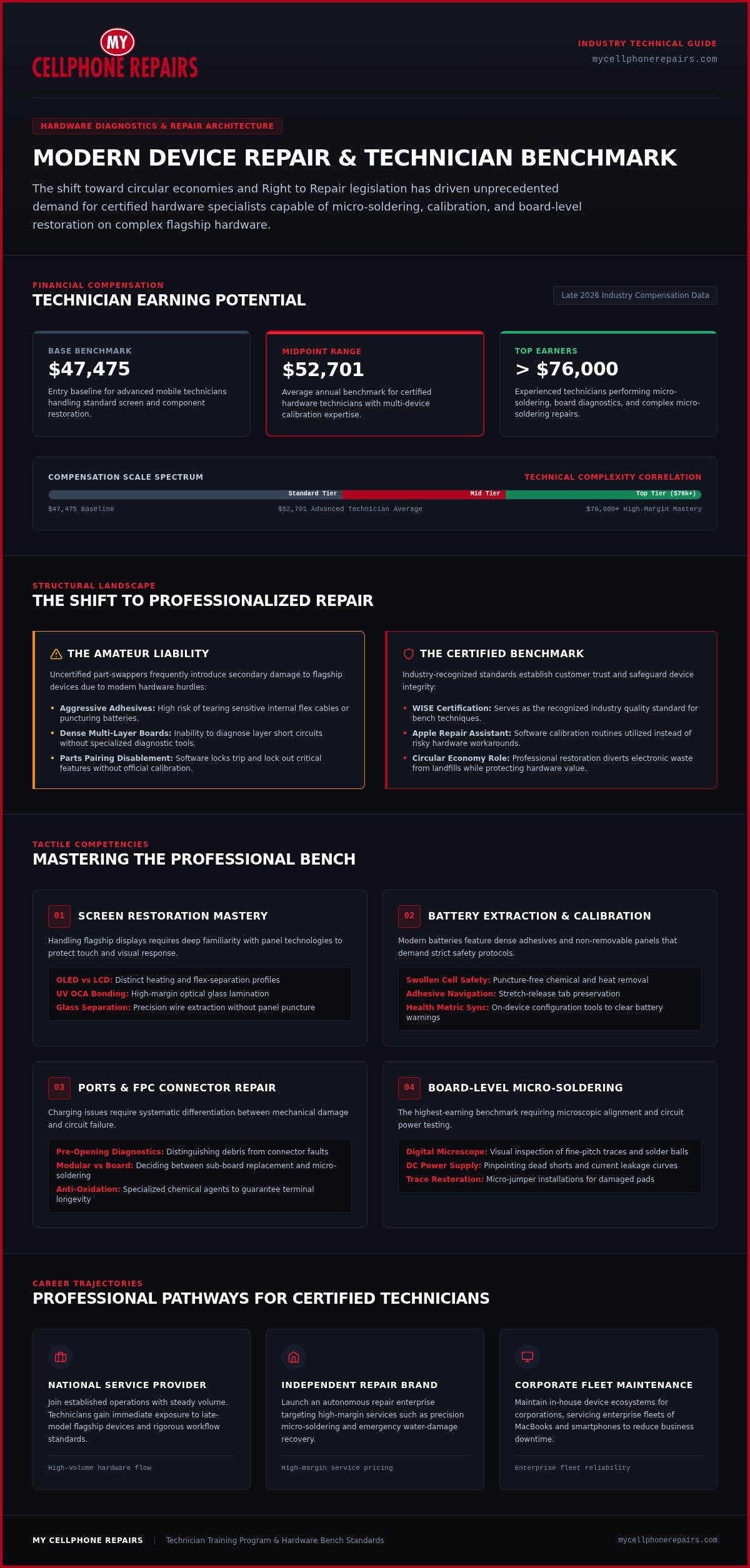
The mobile technology landscape has changed. In 2026, flagship devices are more expensive and harder to fix than ever before. This creates a massive demand for technicians who can do more than just swap a screen. An expert phone repair skills course prepares you for a vital role in the circular economy, where restoration is preferred over replacement. As the Right to Repair movement gains legislative ground across the United States, manufacturers are finally providing better access to parts and manuals. However, the hardware remains incredibly complex.
Modern smartphones use dense, multi-layer logic boards and proprietary software locks. You can’t learn to navigate these hurdles by watching a five-minute video. Specialized hardware technicians are seeing significant income growth because of this complexity. Industry data from late 2026 shows that advanced mobile technicians can earn between $47,475 and $52,701 annually. Top earners in the field can exceed $76,000. Professional restoration isn’t just about technical skill; it’s a sustainability effort that keeps electronic waste out of landfills while saving consumers money.
The Shift Toward Professionalized Repair
DIY repairs are becoming a liability. Modern iPhones and Samsung devices use aggressive adhesives and software “parts pairing” that can disable features if handled incorrectly. Amateur “part-swappers” often cause more damage than they fix. Industry-recognized standards, such as WISE certification, have become the benchmark for quality. Completing an expert phone repair skills course ensures you follow these professional protocols. You’ll learn to use software calibration routines, like Apple’s Repair Assistant, instead of relying on risky workarounds. This expertise builds trust with customers who are wary of amateur fixes.
Career Pathways for Certified Technicians
Mastering the Bench: Essential Hardware Repair Skills
Hardware mastery separates the hobbyist from the professional. While many digital programs focus on software or basic IT networking, an expert phone repair skills course prioritizes the physical precision required at the workbench. You need to understand how to handle delicate components without causing secondary damage. According to the Bureau of Labor Statistics occupational guide, technical proficiency in electronic equipment repair is the foundation for a stable career in this evolving field. Our training focuses on the tactile reality of modern devices.
Smartphone Screen and Battery Mastery
Precision is the core of iPhone screen repair. You must learn the specific nuances between OLED and LCD panels, especially when handling modern flagship devices. Glass separation and UV OCA bonding are high-level skills that increase your profit margins. Similarly, a professional battery replacement involves navigating non-removable back panels and heavy adhesives. Safety is paramount. You’ll learn to remove swollen or stubborn cells without puncturing them. After the physical swap, you must calibrate the new hardware using on-device configuration tools to maintain full software functionality and battery health metrics.
Critical Port and Connector Repairs
Charging issues are among the most common customer complaints. A skilled technician can often diagnose a faulty port before even opening the device. You’ll learn to differentiate between a simple debris blockage and a failed FPC connector. Sometimes a modular swap is enough. In other cases, micro-soldering is required to restore a connection to the logic board. Maintaining internal connectors with specialized cleaning agents prevents future oxidation and ensures longevity. If you want to build these skills in a professional environment, consider exploring our Technician Training Program offered by industry specialists.
Water damage restoration is another high-value service covered in an expert phone repair skills course. It involves more than just drying a device. You’ll use ultrasonic cleaners and specialized chemicals to remove corrosion from under BGA chips. Advanced diagnostics, such as using a DC power supply to find short circuits, allow you to recover data from devices that others might consider “dead.” These hardware-focused techniques ensure you can handle any technical crisis that walks through your door. Every step is designed to build your confidence and your income potential.
Comparing Training Models: Online vs. Hands-On Learning
Choosing how to learn is just as important as the decision to start. You’ll generally find two main paths: self-paced digital modules or instructor-led lab environments. While online courses offer convenience and foundational theory, they often fall short when it’s time to pick up a screwdriver. An expert phone repair skills course should prioritize the physical reality of the workbench. You need to develop muscle memory that a video screen simply can’t provide. Theoretical knowledge is a start; physical repetition is what builds a career.
The Limitations of Digital-Only Learning
Digital learning can’t teach you “feel.” You won’t know the exact tactile pressure required to separate a glass panel or the resistance of a stubborn adhesive without physical practice. In a physical lab, you get live feedback from an expert. This prevents costly hardware mistakes that occur when you’re practicing alone on expensive customer devices. Training labs also provide a variety of real-world devices, from legacy models to the latest 2026 flagships. This exposure is critical for safety and compliance. Following EPA guidelines on electronics and battery handling requires hands-on precision to avoid thermal events or environmental hazards during the repair process.
What to Look for in a Certification Program
Don’t settle for an outdated curriculum. Technology moves fast. Ensure your chosen program includes modules for the latest hardware releases and the newest calibration software. It must cover specialized techniques for both iOS and Android ecosystems. For instance, verify that the training includes detailed Samsung phone repair protocols. This should include handling curved displays and calibrating ultrasonic fingerprint sensors. Check the credentials of the lead instructors to ensure they have real-world experience in national service centers. Their background in a high-volume environment is an invaluable asset to your learning.
Mentorship is the final piece of the puzzle. Mastering complex diagnostic logic requires more than just following a basic checklist. You need an instructor who can explain the “why” behind a failing circuit or a power rail issue. Their expertise helps you develop a methodical troubleshooting flow that works across different brands. This mentorship ensures you can solve problems that aren’t covered in a standard tutorial. Investing in an expert phone repair skills course with a heavy hands-on component is the fastest way to achieve professional proficiency and long-term success.
Building Your Professional Repair Workshop
Setting up a professional bench is the physical manifestation of your training. It’s where your technical knowledge meets high-quality tools to produce reliable results. An expert phone repair skills course teaches you not just how to fix devices, but how to select the right gear for the job. You don’t need every tool on the market to start. You need a curated selection of professional-grade equipment that ensures speed and precision. A well-equipped workshop reduces the risk of accidental damage and increases your daily repair volume.
The Technician’s Essential Toolkit
Advanced Equipment for Precision Work
Level 3 repairs require a closer look. A trinocular stereo microscope is essential for micro-soldering and inspecting FPC connectors for damage. It provides the clarity needed to bridge tiny traces or reball chips. Pair this with a regulated DC power supply. This tool helps you diagnose “no power” issues by injecting voltage and monitoring current draw to find shorted capacitors. If you want to master these advanced tools in a real-world environment, enroll in our Technician Training Program to get hands-on experience before you buy your own gear.
Workshop Safety and Efficiency
Safety is a priority, not an afterthought. Create an ESD-safe environment by using grounded mats and wrist straps to protect sensitive integrated circuits from static discharge. Proper ventilation is also mandatory. Use a fume extractor to remove lead and flux vapors during soldering. Organization is the key to a fast workflow. Use magnetic screw mats to keep track of every tiny component. Finally, establish a strict protocol for handling swollen phone batteries. Keep a fireproof bag or a bucket of sand nearby for immediate containment.
The My Cellphone Repairs Technician Training Program
Choosing an expert phone repair skills course is a career-defining decision. At My Cellphone Repairs, we’ve distilled years of real-world experience from our national service centers into a professional cell phone repair technician training program. You won’t just sit in a classroom. You’ll work directly with industry-leading hardware specialists who manage high-volume repairs every day. Our curriculum covers the full spectrum of modern mobile technology, including iPhone, Samsung, and MacBook diagnostics. We focus on the high-income skills that the 2026 market demands.
Our training isn’t just about passing a test. It’s about building the confidence to handle any device that crosses your bench. We provide a direct path to employment or business ownership by teaching you the exact methods used in professional repair environments. You’ll gain access to hands-on diagnostic techniques that go far beyond basic part-swapping. After you complete the program, we offer post-training support and career guidance to help you navigate the industry. We want you to succeed as a specialized authority in your field.
From Beginner to Bench-Ready
Success in this industry requires a methodical approach. Our program uses a step-by-step progression through modular repair levels. You’ll start with basic assembly and move rapidly into advanced hardware troubleshooting. You’ll perform practical exams on real flagship hardware, ensuring you can replicate professional results under pressure. A major focus of the advanced modules is MacBook liquid damage repair and logic board restoration. These services represent some of the highest margins in the business. Mastering micro-soldering and board reflow techniques allows you to fix devices that other shops simply replace.
Enroll in the Path to Career Mastery
Take the first step toward a high-income technical career today. Our expert phone repair skills course is designed for individuals who are serious about technical excellence. To apply for the next training cohort, visit our official portal and submit your application. We look for candidates with a strong attention to detail and a passion for problem-solving. There are no strict prerequisites for our introductory levels, but our professional technician course requires a commitment to hands-on lab time. When you join our program, you become part of a national network of repair experts. This community provides ongoing insights into the latest hardware trends and repair protocols as they emerge in 2026. Apply now and start mastering the bench.
Master the Bench and Secure Your Future
Mobile technology isn’t slowing down, and the demand for skilled technicians has never been higher. Mastering the physical repetition of hardware repair is the only way to move from an amateur hobbyist to a high-earning professional. You’ve seen how hands-on training with the latest flagship devices provides the tactile experience that digital videos simply can’t replicate. By choosing a comprehensive curriculum that covers iPhone, Samsung, and MacBook diagnostics, you position yourself as a versatile expert in a competitive market.
Success in this field comes down to precision, safety, and the right mentorship. Enrolling in an expert phone repair skills course allows you to learn directly from national repair experts who understand the daily challenges of the shop floor. You’ll gain the confidence to handle complex logic board issues and delicate screen swaps with ease. It’s time to stop guessing and start building your career with a professional foundation. Enroll in the My Cellphone Repairs Technician Training Program Today and take control of your professional path. Your journey toward technical mastery starts at the workbench.
Frequently Asked Questions
What are the most important skills learned in a phone repair course?
Practical hardware mastery is the core of any expert phone repair skills course. You’ll learn precision screen replacements for OLED and LCD panels, safe battery swap protocols, and advanced charging port repair. The training also emphasizes water damage restoration and the use of ultrasonic cleaners to save corroded logic boards. Beyond physical repairs, you’ll develop methodical diagnostic logic to identify power rail failures and short circuits across various flagship models.
Do I need a license to work as a cell phone repair technician?
There is no mandatory federal license required to work as a technician in the United States. However, most professional service centers require industry-recognized certifications to prove your technical proficiency. Obtaining a certification or completing a recognized Technician Training Program demonstrates your ability to handle expensive hardware safely. These credentials significantly improve your employability and help you stand out to national repair chains or corporate IT departments looking for hardware specialists.
How long does it take to complete a professional repair training program?
A comprehensive professional repair training program typically takes about 40 hours of hands-on instruction to complete. For example, a Master Technician course is often structured as a five-day intensive boot camp. This accelerated format allows you to transition from a beginner to a bench-ready professional in a single week. While theory can be studied online, the physical lab time is essential for mastering the delicate pressure and dexterity required for micro-soldering.
Can I learn to fix both iPhones and Android devices in one course?
Yes, a well-rounded training program covers both iOS and Android ecosystems to ensure you’re versatile in the 2026 market. You’ll learn the specific hardware nuances of iPhone screen repair alongside Samsung phone repair techniques, such as handling curved displays and ultrasonic fingerprint sensors. Understanding the unique software calibration requirements for both platforms is also a critical part of the curriculum, ensuring that replaced components maintain full manufacturer functionality and battery health metrics.
What is the difference between Level 1 and Level 2 technician certification?
The primary difference lies in the complexity of the repairs you’re qualified to perform. Level 1 certification focuses on modular component swaps, such as replacing batteries, screens, and cameras. Level 2 certification advances into deeper hardware diagnostics and basic soldering. By the time you reach Level 3, you’re performing micro-soldering and board-level restoration. Progressing through these levels builds the foundation needed to handle the increasingly dense hardware found in modern flagship devices.
Is board-level soldering covered in an expert skills course?
Board-level micro-soldering is a key component of an expert phone repair skills course. You’ll move beyond simple parts-swapping to learn advanced techniques like BGA chip reballing and FPC connector replacement. This involves using trinocular microscopes and hot air rework stations to restore connections on multi-layer logic boards. Mastering these high-margin skills allows you to perform device preservation and data recovery on hardware that other shops might consider beyond repair.
What kind of salary can a certified phone repair technician expect in 2026?
In September 2026, specialized mobile technicians earn an average salary between $47,475 and $52,701 per year. Entry-level technicians typically start around $36,219, while those in the top 10% of the industry can reach over $76,000 annually. Your income potential depends heavily on your ability to perform advanced board-level repairs and your certification status. Specialized hardware expertise remains a high-demand asset that allows for significant career growth in national service providers.
Do I need to buy my own tools before starting the training program?
You don’t need to purchase a professional toolset before starting our Technician Training Program. We provide all the necessary precision drivers, heat guns, and microscopes during your hands-on lab sessions. This allows you to test different brands and equipment types before making a financial commitment. Once you’ve completed the course, our instructors provide a clear list of professional-grade tools to help you set up your own high-performance repair bench with total confidence.