
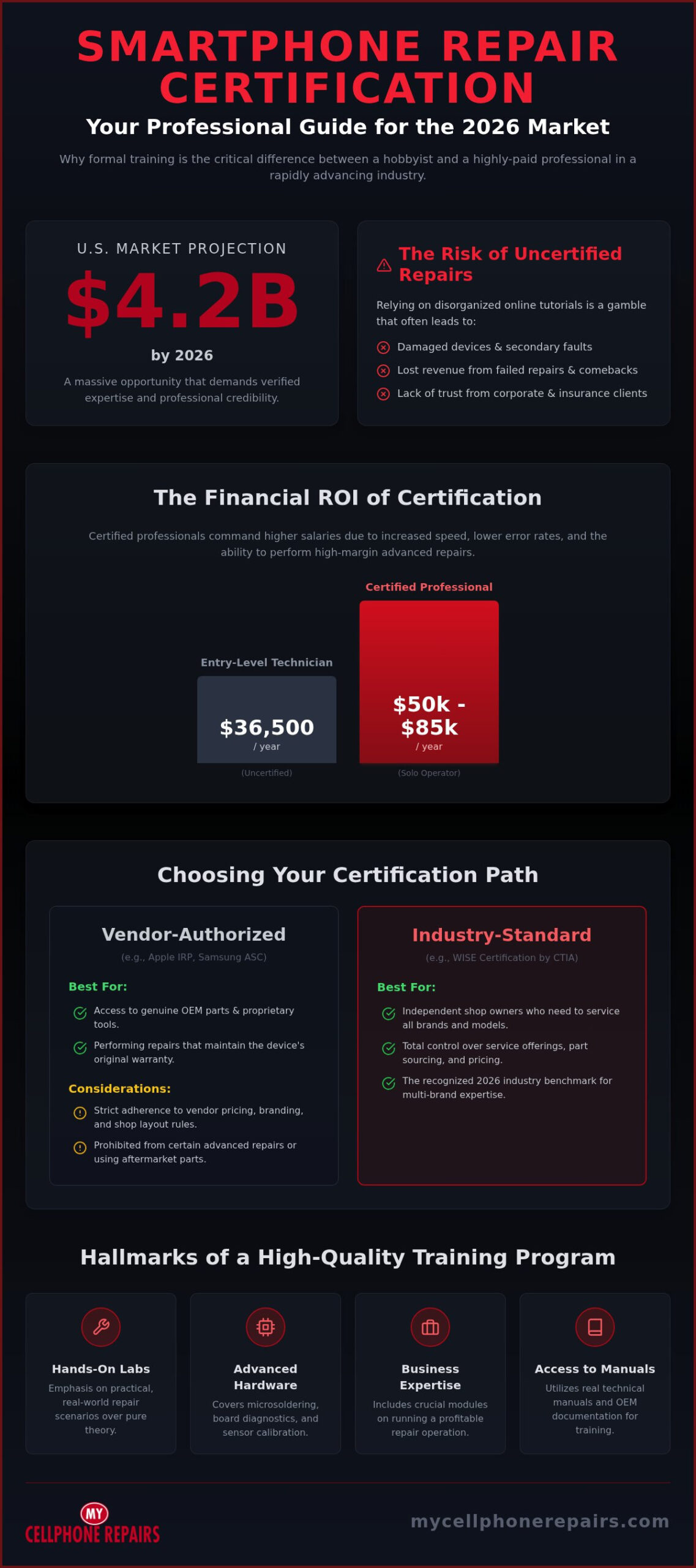
The U.S. cell phone repair market is projected to reach $4.2 billion in 2026. Despite this massive opportunity, many aspiring technicians still rely on disorganized video tutorials that often lead to damaged devices and lost revenue. If you want to move beyond hobbyist fixes and secure a professional future, enrolling in a legitimate smartphone repair certification program is the only way to build real authority. It’s the difference between guessing on a board-level repair and knowing exactly how to restore a device to factory standards.
It’s frustrating to sift through endless online information only to feel more confused about which credentials actually matter to employers. You want a clear path that leads to a recognized credential and the confidence to handle expensive hardware without hesitation. This guide cuts through the noise to help you choose a training path that delivers hands-on diagnostic skills and business expertise. You’ll learn which certifications are worth your time, how to master complex repairs like microsoldering, and what it takes to launch a profitable career in the 2026 repair market.
Key Takeaways
- Understand why the 2026 market demands a shift from basic part swapping to advanced diagnostic expertise.
- Compare vendor-specific programs with industry-standard credentials to find the right fit for your career path.
- Learn to evaluate a smartphone repair certification program based on its hands-on lab requirements and advanced hardware coverage.
- Master your exams by setting up a professional practice bench and utilizing real-world technical manuals.
- Explore how specialized training in iPhone, Samsung, and MacBook repair provides a direct route to professional repair environments.
Why a Smartphone Repair Certification Program is Essential in 2026
The mobile industry has moved past simple screen swaps and battery changes. Modern devices now feature integrated security chips, complex motherboards, and delicate internal sensors that require a diagnostic expert rather than a basic “screw-turner.” In 2026, a smartphone repair certification program is the baseline for professional credibility. It proves you understand the delicate balance of hardware and software required to keep these high-value devices functional.
Corporate clients and insurance providers now demand certified labor. They won’t risk their fleets or policyholders on unverified technicians. Certification also grants you better standing when accessing restricted OEM parts and proprietary diagnostic software. As the Right to Repair movement continues to gain ground, states like Colorado, Washington, Connecticut, and Texas have implemented laws in 2026 that force manufacturers to provide tools and manuals. However, these laws don’t replace the need for skill. They simply make it more critical to have a formal education so you can utilize those resources safely and effectively.
Validating Your Technical Expertise
Modern smartphones often cost well over $1,000. One slip of a pry tool can cause secondary damage to a FaceID sensor or a logic board, turning a simple fix into a total loss. Professional training standardizes your repair process. It ensures you follow a repeatable, safe methodology that minimizes risk. This consistency builds immediate trust with customers. When you can show a recognized credential, you remove the skepticism that often follows independent repair shops. You’re no longer just someone who watched a video; you’re a verified specialist.
The Financial ROI of Professional Training
The numbers back up the investment in education. Data from 2026 shows that entry-level smartphone repair technicians earn an average of $36,500 per year, or about $16.79 per hour. However, technicians who complete a smartphone repair certification program and operate as solo professionals can generate between $50,000 and $85,000 annually. This jump in income happens because certified pros work faster and make fewer mistakes. Understanding exactly how certification affects your phone repair technician salary can help you set realistic income goals and choose the right training path.
- Reduced Comeback Rates: Proper diagnostics mean you fix the device right the first time.
- Minimized Waste: You’ll stop breaking expensive replacement screens or stripping tiny screws during assembly.
- Premium Labor Rates: Customers are willing to pay more for the peace of mind that comes with a certified technician.
Certification isn’t just about a piece of paper. It’s about protecting your bottom line and ensuring your business remains profitable in a highly competitive market.
Comparing Vendor-Specific vs. Industry-Standard Certifications
Selecting the right smartphone repair certification program requires a clear understanding of your long-term career goals. You essentially have two paths: becoming a brand specialist or a multi-brand expert. Each has distinct advantages depending on whether you plan to work for a major corporation or run your own independent shop. In 2026, the market is large enough to support both models, but your choice will dictate your daily workflow and profit potential.
Vendor-Authorized Certification Paths
Brand-specific programs like Apple’s Independent Repair Provider (IRP) or Samsung’s Authorized Service Center network offer direct access to genuine parts and proprietary diagnostic tools. For example, obtaining the Apple Certified iOS Technician (ACiT) credential allows you to perform repairs that maintain the device’s original warranty status. This is a powerful marketing tool if you want to position yourself as an official alternative to the manufacturer’s own retail stores.
However, these paths come with strict limitations. You must often adhere to rigid pricing structures and specific shop layouts. You might also be prohibited from performing certain advanced tasks like microsoldering or using high-quality aftermarket parts. This can limit your profit margins on older devices where OEM parts are too expensive for the customer. If you want total control over your service offerings, a brand-specific contract might feel restrictive.
Independent and Industry-Wide Credentials
If you want to handle every device that walks through your door, industry-standard certifications are superior. The WISE (Wireless Industry Service Excellence) certification, administered by CTIA, has become the 2026 benchmark for independent shops. It validates your skills across multiple platforms without the restrictive contracts of a single manufacturer. It’s the preferred credential for technicians working in carrier-adjacent roles or high-volume independent labs.
There are strong economic and environmental reasons why independent repair is surging. Keeping devices in use longer reduces electronic waste and saves consumers money. Independent certifications like CompTIA A+ provide a solid technical foundation, but specialized hardware training is where the real money is made. These programs focus on diagnostic logic and physical repair skills rather than just following a brand’s specific manual.
Choosing a platform-agnostic path gives you the freedom to pivot as new technology emerges. You aren’t tied to one company’s ecosystem. To build a truly versatile skill set, look for a technician training program that provides hands-on experience with iPhone, Samsung, and MacBook hardware. This approach ensures you can solve any technical crisis, regardless of the logo on the back of the device.
What to Look for in a High-Quality Repair Curriculum
A high-quality curriculum isn’t just a stack of manuals. It must bridge the gap between reading a guide and executing a flawless repair. In 2026, a smartphone repair certification program must prioritize hands-on labs. You can’t learn the tactile feel of a logic board or the specific tension of a display cable through a screen. Look for programs that offer a minimum of 40 hours of supervised bench time to ensure you’ve mastered the physical nuances of the craft.
Advanced topics are no longer optional. Your training should cover microsoldering, board-level diagnostics, and professional water damage restoration. These skills allow you to save devices that other shops would declare “totaled.” Beyond the hardware, a professional curriculum must address the business side of the industry. This includes inventory management, customer intake procedures, and effective warranty handling. Mastering these operations ensures your technical skills actually translate into a profitable career rather than just a hobby.
Mastering Modern Hardware Challenges
Modern device designs are increasingly difficult to penetrate. Foldable screen technology and intricate hinge assemblies are now standard in 2026, requiring specialized opening tools and high-precision reassembly techniques. Your training must also include safe battery replacement protocols for the latest adhesive-heavy chassis designs. All technicians must adhere to the ANSI/ESD S20.20-2026 standard to prevent invisible damage to sensitive semiconductor components during every stage of the repair process. Learning these safety standards protects both the device and your professional reputation.
The Importance of Diagnostic Skills
Stop guessing and start measuring. High-quality training moves you beyond simple part-swapping to true component-level troubleshooting. You must learn to find the “why” before the “how.” This involves utilizing thermal cameras to locate heat blooms from short circuits and multimeters to verify power rails. By identifying the root cause of a failure, you reduce part wastage and avoid the “comeback” repairs that kill shop reputation.
For a comprehensive breakdown of these technical modules, review our Cell Phone Repair Course Curriculum. Learning to diagnose effectively is the fastest way to elevate your status from a hobbyist to a professional authority. It allows you to charge for your expertise, not just your labor, which is the key to maximizing your earning potential in the 2026 market.
How to Prepare and Pass Your Certification Exam
Passing a smartphone repair certification program requires a transition from hobbyist habits to professional discipline. You need a methodical approach to both theoretical knowledge and physical repair tasks. Muscle memory is your greatest asset during a timed practical exam. It’s developed through hundreds of repetitive movements on scrap hardware before you ever sit for the actual test. Don’t underestimate the mental fatigue that comes with high-precision work under a deadline.
Utilize official technical manuals and schematics rather than relying on community forums or unverified videos. Professional exams often test your ability to follow specific manufacturer protocols exactly. Practice exams help you identify gaps in your diagnostic logic, especially when dealing with power rails or integrated security components. Set a timer for every practice repair to simulate the pressure of the testing environment. If you can’t complete a standard screen replacement in under 45 minutes with perfect cable routing, you aren’t ready for the exam yet.
Building Your Technical Tool Kit
Your results are only as good as your equipment. Invest in high-quality precision drivers, anti-static spudgers, and digital heat stations with accurate temperature sensors. Cheap, unbranded tools often have poor tolerances that strip tiny screws or melt delicate plastic frames. This leads to immediate failure in a professional setting. Maintain a clean, organized workspace with dedicated zones for parts and tools. A cluttered bench leads to lost components and increased stress. Organize your station so every tool has a fixed home where you can reach it without looking.
The Practical Exam: Common Pitfalls
Improper cable management is the primary reason students fail the practical portion. Forcing a display connector or misrouting a Wi-Fi antenna cable can cause permanent damage to the device. Use magnetic screw mats to track every fastener during the teardown. Mixing up a 1.2mm screw with a 1.5mm screw can pierce a logic board, a mistake known as long-screw damage. If a diagnostic step doesn’t go as planned, don’t panic. Take a breath and re-trace your steps logically using your multimeter. Panic leads to rushed decisions and broken hardware, while a calm technician finds the fault.
Prepare for success by enrolling in a technician training program that mirrors the rigor of professional certification exams. Master the physical skills required to handle any device with confidence.
Elevate Your Career with the My Cellphone Repairs Technician Training Program
The My Cellphone Repairs Technician Training Program provides a direct path to professional mastery. Unlike online-only courses that lack physical interaction, our smartphone repair certification program places you at a professional bench with real hardware. You’ll work on the same iPhone, Samsung, and MacBook models that dominate the 2026 market. Our curriculum isn’t static. Active technicians who face real-world hardware failures every day design every module. This ensures you learn to fix current problems rather than outdated technology.
Direct mentorship is the cornerstone of our approach. You’ll learn from industry veterans who have performed thousands of successful repairs. They guide your hands during delicate board-level work and help you refine your diagnostic logic. This environment mirrors a high-volume professional shop. It prepares you for the speed and precision required in the field. Graduates don’t just leave with a certificate. They leave with the ability to launch their own business or join a professional repair environment immediately.
Comprehensive Skill Development
Our training starts with the fundamentals but rapidly scales to expert-level tasks. You’ll master everything from basic screen swaps to advanced water damage restoration. We teach the “My Cellphone Repairs” standard of excellence. This standard prioritizes long-term device health over quick, temporary fixes. You’ll learn proper adhesive application, internal cleaning, and rigorous post-repair testing. Following these protocols ensures every device leaves your bench in factory-equivalent condition.
For a deeper look at how we prepare you for the field, explore our Cell Phone Repair Technician Training. This path is designed for those who want to move beyond basic part-swapping and become true diagnostic experts. You’ll build the confidence to handle $1,000 devices without hesitation.
Join a National Network of Experts
Earning our certification means joining a recognized national network. Employers in the professional repair industry value our graduates because they know they have survived a rigorous, hands-on evaluation. You also gain access to ongoing support and technical updates. As hardware evolves throughout 2026 and beyond, you’ll stay informed about new repair techniques and common failure points. This continuous learning loop keeps your skills sharp and your business competitive.
Stop relying on disorganized video tutorials. Get the professional training you need to secure your future in this multi-billion dollar industry. Enroll in the My Cellphone Repairs Technician Training Program today and take the first step toward a high-earning career in mobile device repair.
Take Control of Your Career in the 2026 Repair Market
The mobile landscape is evolving at a breakneck pace. Success in 2026 requires more than just basic tool skills. You need a structured smartphone repair certification program that balances deep diagnostic logic with hands-on hardware mastery. We’ve explored the differences between vendor-specific paths and industry-wide credentials. You now understand the importance of practicing on modern 2026 hardware like foldables and complex MacBook logic boards to avoid expensive mistakes. Precision and methodology are what separate high-earners from hobbyists.
My Cellphone Repairs has already trained thousands of successful technicians who now lead the professional repair industry. Our curriculum focuses on total iPhone, Samsung, and MacBook mastery using actual 2026 hardware. We provide the mentorship you need to move from basic part swapping to advanced board-level diagnostics. Don’t leave your professional future to chance or unverified online guides. Build the skills that employers actually value and customers trust. It’s time to turn your technical interest into a stable, high-earning career.
Start Your Professional Repair Career with Our Training Program today. Your future as a certified expert is just one step away. We’re ready to help you master the craft.
Frequently Asked Questions
How long does it take to complete a smartphone repair certification program?
Most professional programs range from five days to several weeks depending on the depth of the curriculum. A professional smartphone repair certification program often follows a 40-hour intensive format to cover essential diagnostics and hardware swaps. This allows you to gain a recognized credential quickly without sacrificing technical quality. Some advanced courses for microsoldering or board-level repair might add an extra week to your training schedule to ensure total mastery.
Do I need a college degree to become a certified phone repair technician?
You don’t need a college degree to enter the professional repair field. Most employers and certification bodies prioritize hands-on skill and technical logic over formal academic backgrounds. A specialized certification proves you can handle expensive customer devices like iPhones and MacBooks safely. This career path focuses on your ability to diagnose faults and execute clean repairs, making it an excellent option for those who prefer practical, technical work.
Is an online smartphone repair course as good as in-person training?
Online courses provide a decent theoretical foundation but can’t replace in-person training for hardware mastery. You need to feel the tension of a display cable and the heat of a soldering iron under professional supervision. In-person programs allow mentors to correct your physical technique in real time, which prevents you from causing secondary damage to expensive devices. Mastering the physical nuances of a complex repair requires a dedicated bench and expert feedback.
What is the average cost of a professional repair certification in 2026?
Professional certification costs in 2026 depend heavily on the depth of the curriculum and the specific hardware covered. Programs that include advanced diagnostic training and hands-on lab time generally require a higher investment than basic online-only courses. You should also consider the cost of professional-grade tools if they aren’t included in the tuition. A high-quality smartphone repair certification program is a strategic investment that helps you secure higher labor rates and professional opportunities.
Can I get certified specifically for iPhone or Samsung repairs?
Yes, you can pursue brand-specific certifications or broader industry credentials. Many technicians choose to become an Apple Certified iOS Technician or a Samsung Authorized specialist to gain access to OEM parts. However, a platform-agnostic certification often provides more flexibility if you plan to work in an independent shop. Most professional programs cover iPhone, Samsung, and MacBook hardware to ensure you can handle the most common devices found in the 2026 market.
Will a repair certification help me start my own business?
Certification is a critical step for anyone looking to launch an independent repair business. It provides the technical credibility needed to secure small business insurance and build trust with your first customers. Many programs also include modules on inventory management and customer service, which are vital for daily operations. Having a recognized credential makes it much easier to market your services and justify premium labor rates in a competitive national market.
What tools are required to begin a certification program?
Most hands-on programs provide the necessary tools during the lab sessions, but you’ll eventually need your own professional kit. This includes high-quality precision drivers, anti-static spudgers, and a digital heat station with accurate temperature control. A multimeter and a DC power supply are also essential for advanced diagnostic work. Starting with professional-grade equipment prevents screw stripping and internal frame damage, ensuring your repairs meet the standards required by the professional repair industry.
Are there any prerequisites for enrolling in advanced microsoldering courses?
Most advanced courses require you to have a solid foundation in basic hardware repair first. You should be comfortable with device teardowns and standard part replacements before attempting board-level work. Microsoldering involves high-precision tasks under a microscope, so steady hands and a basic understanding of circuit logic are helpful. Completing a foundational technician training program ensures you have the prerequisite skills to succeed when you move on to complex board-level diagnostics. If you want to understand how mastering these advanced skills can impact your phone repair technician salary in 2026, reviewing current earnings data will help you set clear financial benchmarks for your career growth.