
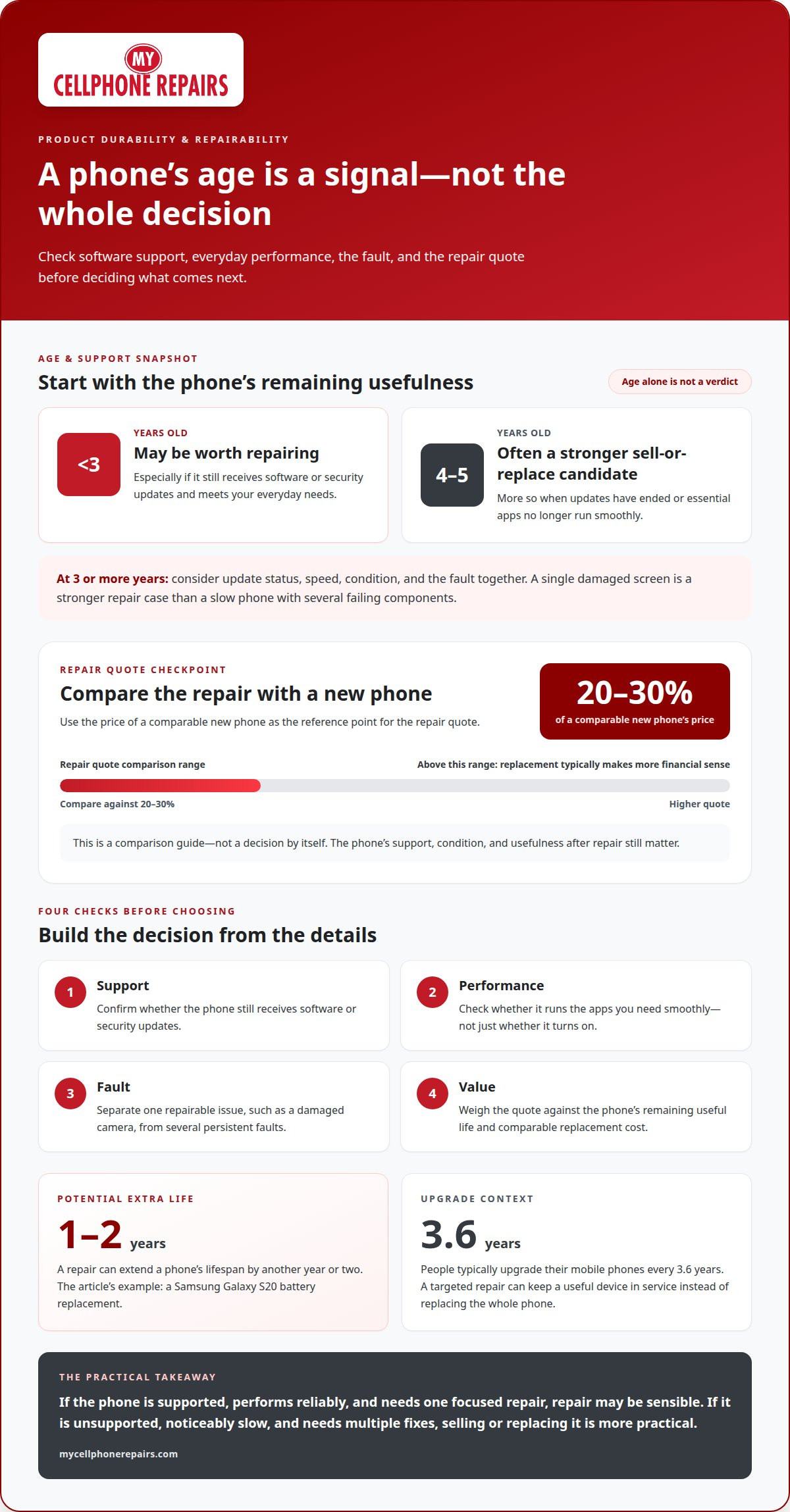
Phone repair isn’t dead, but repairing every phone isn’t the right call. So, is phone repair a dying trade? Not necessarily: a phone under 3 years old that still gets software or security updates may be worth repairing, while a 4-5-year-old phone that no longer gets updates or runs essential apps smoothly is usually a stronger candidate to sell or replace.
It’s easy to assume a damaged or aging phone has reached the end of its useful life. But the right choice depends on more than the fault: software support, repairability, durability, and the value of keeping the device in use all matter. This guide helps you weigh repair against selling or replacing your phone. You’ll learn how age and updates affect the decision, which common repairs may restore everyday use, and how electronic waste and right-to-repair shape the bigger picture. Then use the decision guide to choose your next step.
Key Takeaways
- Use your phone’s age, software support, and ability to run essential apps to judge whether repair is likely to keep it useful.
- Weigh the repair against selling or replacing the phone, including how the fault affects its value and everyday reliability.
- Consider how extending a phone’s life can reduce electronic waste, while parts restrictions may affect which repairs are practical.
- Understand why repair businesses face challenges such as repair costs, parts access, and differences in local demand and competition.
- When a Samsung phone needs repair, Samsung Phone Repair can help address the fault and restore the device for continued use.
Product durability and repairability
A phone’s age is a useful starting point, but software support matters just as much. A device under 3 years old that still receives software or security updates may be worth repairing. Updates help keep essential apps usable and address security issues. A newer phone with one failed part can still meet daily needs after a focused repair. So, is phone repair a dying trade? The answer depends partly on whether repairs keep useful devices working.
By contrast, a phone that is 4-5 years old, no longer receives updates, or struggles with essential apps is usually a poor repair candidate. At 3 or more years, age alone doesn’t settle the question. Combine it with update status, speed, condition, and the fault. A slow phone with several failing components has a weaker case for repair than one with a single damaged screen.
Repairability means more than whether a part can be replaced. Consider whether the fault is isolated, whether the phone will remain useful afterward, and whether the repair makes practical sense. A battery replacement may restore everyday use, while a camera fault matters most if you rely on taking photos. If several functions are failing, replacing the phone may be a better long-term choice than spending time and money for only a short extension.
Use these checks to compare repair and replacement:
- Support: Confirm whether the phone still receives software or security updates.
- Performance: Decide whether it runs the apps you need smoothly, not just whether it turns on.
- Fault: Separate one repairable problem, such as a damaged camera, from several persistent faults.
- Value: Compare the repair quote with 20-30% of a comparable new phone’s price. Above that range, replacement typically makes more financial sense.
A repair can extend a phone’s lifespan by another year or two. For example, a Samsung Galaxy S20 battery replacement can extend its life by 1-2 years. That extra time matters when the phone remains supported and performs reliably. It matters less if the device has already lost updates or can’t run essential apps smoothly.
Make the decision in order: check support, identify the fault, then compare the repair quote with the phone’s remaining usefulness. Don’t treat a 3-year-old phone as automatically disposable, or an older phone as automatically worth saving. If it is supported, works well, and needs one repair, repair may be sensible. If it is unsupported, noticeably slow, and needs multiple fixes, selling or replacing it is more practical.
Together, these checks answer the practical question: is phone repair a dying trade? Not while a focused repair can keep a useful phone in service. If software updates have ended and several faults affect everyday use, replacement may be the more sensible path.
Repairing phones to reduce electronic waste
People typically upgrade their mobile phones every 3.6 years. Each upgrade can leave a working device unused or send a repairable one toward disposal. Repair offers another option: fix the damaged component and keep using the phone. A cracked screen, worn battery, or faulty charging port may not mean the entire device has reached the end of its useful life.
Repair can reduce waste by avoiding a premature replacement. A phone contains multiple components, so replacing the whole device for one fault discards parts that may still work. A screen repair can preserve a phone with a functioning battery and reliable performance. A battery replacement may make sense when the display, camera, and other essential functions remain usable.
Start with the specific fault, then consider whether the phone will meet your daily needs after the repair. Replacing a battery, for example, won’t solve a phone that can’t run essential apps. Fixing a cracked screen won’t restore a device with several other failing components. Repair reduces waste most effectively when it returns a useful device to service, rather than briefly postponing disposal.
Use this practical check before deciding:
- Identify the fault: Separate a single issue, such as a cracked screen, from several unrelated problems.
- Assess the remaining functions: Consider whether the battery, camera, charging port, and apps you rely on still work.
- Think about continued use: Decide whether the repaired phone can serve your needs, rather than becoming an unused backup.
- Choose an end-of-use route: If repair won’t make the phone useful, look into responsible recycling options in your area.
Repair and recycling address different stages of a phone’s life. Repair keeps a usable device in circulation; recycling becomes relevant when damage or poor performance makes continued use impractical. A phone set aside after a screen failure may still have functioning parts, while a device with multiple faults may be difficult to restore. The right choice depends on the phone’s overall condition, not just the visible damage.
A phone with a cracked screen and a dependable battery, for instance, may be suitable for continued everyday use after repair. If its battery also fails and its apps no longer work properly, repair may not prevent a near-term replacement. Consider each component as part of the decision. The goal isn’t to repair every phone at any cost; it’s to avoid discarding one that a targeted fix can keep useful.
Repair can help reduce electronic waste, but it isn’t the answer in every case. Match the repair to the phone’s remaining functions, then decide whether continued use is realistic. If it isn’t, move from repair planning to responsible end-of-life handling.
How do manufacturer repair restrictions and parts pairing affect independent phone repair shops?
An independent shop may replace a damaged component, but the phone’s software can also affect whether that part works as intended. Parts pairing describes a system in which a device recognizes or configures certain replacement components. If a repair depends on manufacturer-controlled tools, parts, or software steps, the shop may face additional limits after completing the physical repair.
Consider a replacement display. It may fit and connect, yet the phone could require a configuration step before all functions operate normally. The process varies by device and component, so the outcome is not the same for every phone. For a repair shop, that uncertainty affects diagnosis, workflow, and the explanation customers need before approving work.
Restrictions can shape a repair in several practical ways:
- Parts access: A shop’s options depend on whether compatible parts are available through its supply channels.
- Tool access: Some repair processes may require software or equipment beyond standard hand tools.
- Configuration: A replacement component may need a device-specific setup step to operate correctly.
- Customer expectations: The shop must explain possible feature limitations before work begins, rather than treating every part swap as identical.
These factors can add time and cost to a job, even when the original fault seems simple. A technician may need to identify the exact model, source a suitable component, and determine whether calibration is part of the repair process. If a step depends on restricted access, the shop may need another compatible repair route or explain why it cannot promise a particular outcome. That’s a business constraint, not proof that demand for repairs has disappeared.
Parts pairing can also affect which repairs are practical for a business. A shop must account for parts availability, labor, diagnostic time, and the likelihood of completing the work successfully. A display replacement with a clear procedure may be manageable, while a similar repair requiring unavailable configuration access could involve more uncertainty. The customer’s decision then depends on the phone’s condition and the likely result.
For independent technicians, a consistent intake process helps: record the phone model and fault, inspect the affected function, identify the required part, and determine whether setup or calibration applies. Explain the repair scope plainly before proceeding. This helps distinguish a broken component from a software or compatibility issue and reduces surprises after reassembly.
Manufacturer restrictions can make some repairs harder, but they don’t make every repair impossible. Independent shops remain useful for faults with accessible parts and workable procedures. The trade’s challenge is adapting tools, sourcing, and diagnostics to each device, then clearly explaining what the repair can restore.
Common phone repairs, including screen, battery, and charging-port fixes, can take 1-3 days depending on parts availability. That timing can complicate scheduling and customer updates.
What are the main risks and challenges of running a phone repair business?
A repair shop’s main challenge is balancing reliable work with parts, labor, and customer expectations. A screen replacement may look straightforward, yet the phone could have hidden damage or need additional setup. If the repair takes longer or requires another part, the shop’s time and costs rise. A clear diagnosis before work begins helps set expectations.
Repair economics can also be tight. These figures illustrate how a repair’s cost and the device’s value can leave little financial room. They describe those repair outcomes, not the overall profitability of every shop.
Parts create another operational risk. A shop needs compatible components, dependable supply, and a process for identifying the correct model. Manufacturer restrictions or parts pairing can add software steps to physical repairs. A delayed part can hold up a job, while a compatibility issue may affect the result. Shops must account for these constraints when setting expectations and planning work.
Quality control matters because rushed diagnosis or reassembly can introduce new problems. A useful workflow includes these steps:
- Record the fault: Note the customer’s reported issue, such as a broken screen or charging problem.
- Inspect before opening: Check visible damage and test relevant functions where possible.
- Confirm the repair scope: Identify the part and any software configuration the device may require.
- Test after repair: Recheck the affected function and related features before returning the phone.
Customer trust is another business concern. A phone may arrive with more than one fault, or an existing issue may become clearer during diagnosis. Replacing a screen, for example, won’t resolve a separate camera problem. Explaining what the repair addresses helps prevent confusion and keeps the agreed work specific.
Demand can shift as phone models age and repair options change. A shop that depends heavily on one device type may be more exposed when parts become harder to source or customers replace that model. Training, careful inventory choices, and a mix of common repairs can help a business adapt, but each requires time and resources.
Running a repair business involves more than technical skill. Shops must manage diagnosis, parts, repair quality, customer communication, and narrow margins. The trade remains viable for businesses that manage these risks and select work carefully. A job with uncertain parts, extensive damage, or poor economics may not be a sound one to accept.
How does demand for phone repair vary by location and local competition?
Repair demand depends on who lives nearby, how they use phones, and how easily they can reach a shop. A dense neighborhood may bring more potential customers within a short distance. A spread-out rural area may have fewer nearby customers, but residents may value a dependable local repair option. These differences shape customer volume, travel patterns, and the repairs people seek.
Local phone use also influences which jobs come up most often. A busy commuter district may see requests for screen, battery, or charging-port repairs because phones get daily use. In a community where residents keep older devices, shops may handle repairs across different models. These are examples, not fixed rules: local customer habits and phone models matter more than a location label alone.
Competition affects how a shop attracts and keeps customers. Where several repair businesses serve the same area, customers may compare convenience, repair options, communication, and confidence in the work. A shop that handles a range of phone models can serve customers whose devices fall outside a narrow specialty. Clear explanations and consistent repair quality can help distinguish a business without unsupported promises.
For a local business, assess demand using specific signals rather than guesses:
- Map the service area: Note neighborhoods and travel routes that customers can realistically use.
- Track repair requests: Record device models, faults, and inquiries that don’t become completed repairs.
- Review the repair mix: Compare screen, battery, charging, and other repair requests over time.
- Watch customer friction: Note whether distance, parts availability, or repair timing affects a customer’s decision.
Repeated requests for a particular phone model, for example, may indicate local demand, while frequent inquiries that cannot proceed may point to a parts or service gap. A shop should distinguish these patterns from isolated requests. Reviewing records regularly helps identify which repairs call for technician training, parts planning, or clearer customer information.
Competition can also create opportunities. If nearby shops focus on common screen replacements, customers with battery or charging issues may still need a convenient option. But adding a repair type makes sense only when the business can source suitable parts, perform the work, and support the completed repair. Local demand must align with technical capacity and sound operating costs.
There’s no single national pattern that predicts whether a repair shop will thrive in every neighborhood. A practical assessment combines local customer requests, nearby alternatives, device mix, travel access, and the shop’s repair capabilities. Location matters for customers, too: a nearby, suitable repair may be more convenient than replacing a phone, while a long trip or unavailable repair can change the calculation. Track these factors, then adapt services to the needs customers actually bring through the door.
My Cellphone Repairs: Samsung Phone Repair
My Cellphone Repairs provides Samsung Phone Repair for customers weighing whether to fix a damaged device or move on. A targeted repair may make sense when the phone still meets your needs and the fault is limited. If it’s unsupported, slow, or affected by several problems, replacement may be more practical.
For Samsung phones, start the repair decision with the fault and the device’s overall condition. A damaged screen, weak battery, or charging issue can each affect daily use differently. My Cellphone Repairs also offers iPhone Screen Repair, MacBook Repair, and Battery Replacement.
If your Samsung phone needs attention, contact My Cellphone Repairs to discuss a repair.
Make the Next Move with Confidence
Whether phone repair is a dying trade depends less on the label than on how well repairs meet changing needs. For your own phone, focus on the practical outcome: will a repair make it useful and reliable for you? If so, restoring it may be the next step. If not, choose another option without treating repair as the default.
For help with a specific fault, My Cellphone Repairs offers Samsung Phone Repair, iPhone Screen Repair, and MacBook Repair. A technician can help address the repair need so you can make an informed decision about your device.
Contact My Cellphone Repairs for help with your repair decision. Take the next step that fits your device and keep moving forward with confidence.
Frequently Asked Questions
Repair or sell?
Repair if one fix can restore the phone’s everyday usefulness; sell or replace it if the device no longer suits your needs. Before deciding, consider what you could realistically receive for it in its current condition and whether a repair would make it easier to use or resell. A phone with one damaged component and otherwise reliable functions, for example, may be a better repair candidate than one you already plan to upgrade.
Is demand for phone repair increasing or declining in the United States?
Demand varies by local market, so it isn’t accurate to assume every part of the United States follows the same trend. Device mix, access to repair, and nearby competition all affect customer demand. Repair needs around Towson, Baltimore County, Hyattsville, College Park, Cumberland, Vineland, Harrisburg, Kentwood, and Bowie may differ. A repair business can assess local demand by tracking inquiries, requested repairs, and completed work.
How have phone durability, longer replacement cycles, and refurbished phones affected repair demand?
These factors change why people seek repairs rather than eliminate the need for them. A durable phone may stay in use longer, creating demand for fixes that address wear or accidental damage. Refurbished phones offer another way to replace a device, while repairs can help owners keep a familiar phone working. Someone choosing a refurbished iPhone, for instance, may still need a repair for a device they already own.
Get it fixed at My Cellphone Repairs: most repairs are done the same day. Walk in or book online.
Book NowPhone frozen or acting up? See our step-by-step restart & reset guides →
Our locations
- Towson Mall825 Dulaney Valley Rd, Second Level, Towson, MD 21204
(410) 828-4404 - Grand Rapids3077 28th St SE, Grand Rapids, MI 49512
(616) 799-6996 - PG Plaza Mall (Hyattsville)3500 East-West Hwy, Mall at Prince George's, Target Entrance, Hyattsville, MD 20782
(301) 559-1105 - Bowie Town Center15630 Emerald Way, Bowie, MD 20716
(240) 614-3600 - Capital City Mall (Camp Hill / Harrisburg area)3604 Capital City Mall Dr, Camp Hill, PA 17011
(717) 919-7868 - Cumberland Mall (Vineland)3849 S Delsea Dr, next to Boost Mobile, Dick's Sporting Goods entrance, Vineland, NJ 08360
(856) 765-5049 - Mondawmin Mall2401 Liberty Heights Ave, Lower Level, Baltimore, MD 21215
(443) 826-7711 - Baltimore Inner Harbor100 East Pratt St, Suite 101, Baltimore, MD 21202
(443) 838-8989 - St Charles Mall (Waldorf)11110 Mall Cir, Waldorf, MD 20603
(301) 645-7755 - Alexandria7650 Richmond Hwy, Alexandria, VA 22306
(703) 341-6789