
Paying Apple’s premium out-of-warranty prices isn’t your only path to a perfect screen. Dropping your device is a heart-stopping moment that immediately leads to one frustrating question: how much does iPhone screen repair cost? It’s natural to feel anxious about high repair fees or the fear of losing Face ID and True Tone functionality with the wrong fix. You want a reliable solution that restores your phone without costing more than the device is actually worth.
We understand that technical frustrations need fast, professional answers. As a national leader in technician training and hardware restoration, we provide a clear, honest breakdown of iPhone screen repair costs across all models in this 2026 guide. You’ll learn the truth about OEM versus aftermarket parts and see how professional third-party repairs offer a high-quality alternative to the Apple Store. We’ll also explore when a repair makes sense and when a certified refurbished iPhone might be the smarter financial move. Get the facts you need to choose the best fix for your budget and get your phone back to like-new condition quickly.
Key Takeaways
- Discover exactly how much does iPhone screen repair cost in 2026 across different generations to plan your budget effectively.
- Compare Apple Store service with professional third-party repairs to find the best balance of speed, cost, and part quality.
- Learn to spot hidden factors like frame damage or water exposure that can unexpectedly inflate your total repair bill.
- Use the 50% Rule to decide if a screen replacement is a smart investment or if upgrading to a refurbished iPhone is better.
- Understand why sensor complexity and OLED supply chains drive the pricing for the latest iPhone 16 and 17 series.
The Baseline: iPhone Screen Repair Costs in 2026
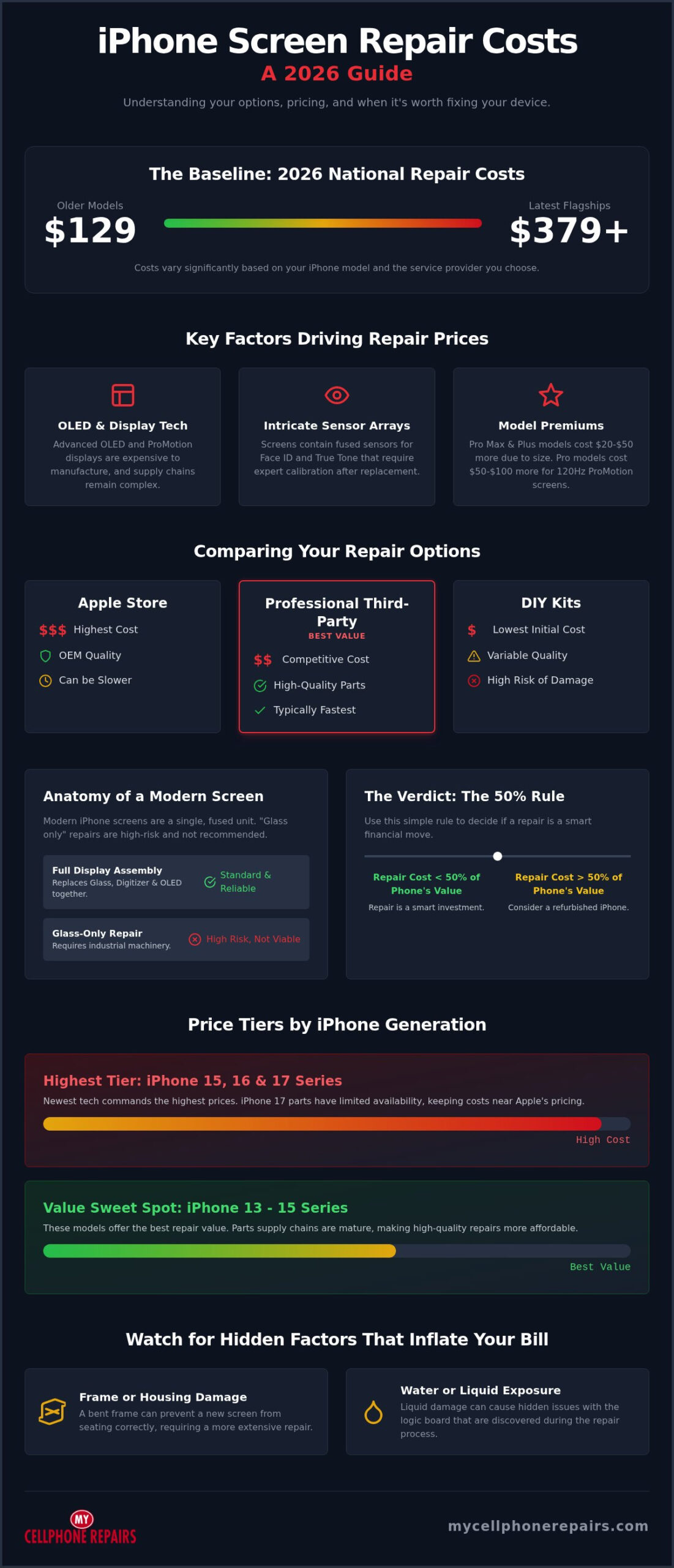
Determining how much does iPhone screen repair cost starts with understanding the current market landscape. In 2026, national prices typically fall between $129 and $379 or more. This wide range depends on your specific model and the service provider you choose. High-end flagship models sit at the top of this scale due to advanced display technology. It’s a significant investment, but it’s often cheaper than buying a brand-new device.
Several factors drive these current costs. OLED supply chains remain complex and expensive. Modern screens aren’t just pieces of glass. They contain intricate sensor arrays for Face ID and True Tone. If these sensors are damaged during the break, the repair becomes more difficult and costly. You generally have three paths for a fix: the Apple Store, DIY repair kits, or professional independent shops. Each choice impacts your final bill and the overall quality of the result.
Glass Only vs. Full Display Assembly
You might wonder if you can simply replace the cracked top layer of glass to save money. While this sounds like a logical fix, it’s rarely a viable option for modern iPhones. Apple bonds the glass, the touch-sensitive digitizer, and the OLED or LCD panel into a single fused unit. It’s one solid piece of hardware designed for slimness and clarity.
Attempting a glass-only repair is a high-risk procedure that requires specialized industrial machinery. Most professional technicians replace the entire display assembly instead. This method ensures that your touch functionality and color accuracy remain perfect. If your screen has black spots, vertical lines, or doesn’t respond to your fingers, a full assembly replacement is your only reliable solution. It’s the standard for a high-quality restoration.
The ‘Apple Tax’ on Out-of-Warranty Repairs
Official Apple repair prices are designed to encourage the purchase of AppleCare+. Without that protection plan, you’ll face the highest quotes in the industry. Apple often uses “parts pairing” software to link your screen to your phone’s logic board. This can make repairs more expensive if you don’t use their specific channels. They position their service as the only premium option, but the market is changing.
The right to repair movement continues to push for better consumer options and better access to parts. Professional third-party shops now have access to the tools needed for proper calibration. These experts provide high-quality hardware and professional installation at a much lower price point than the Apple Store. As a national authority that trains the technicians other shops hire, we see how professional alternatives offer the best value for out-of-warranty devices. You get a phone that looks and feels like new without the inflated manufacturer markup.
Price Breakdown by iPhone Generation and Model
The model year of your device is the single most important factor in determining how much does iPhone screen repair cost. Newer technology always carries a higher price tag. Large-format devices like the Pro Max and Plus models also command a consistent $20 to $50 premium over their standard-sized counterparts. This extra cost covers the larger OLED material and the increased complexity of handling a bigger glass surface. If you own a Pro Max, expect to pay more for the sheer size of the replacement hardware.
Latest Models: iPhone 15, 16, and 17 Series
The newest flagship phones represent the highest tier of repair expenses. Features like Ceramic Shield glass and ProMotion high-refresh-rate displays are expensive to manufacture and replace. Standard iPhone 16 and 17 models use 60Hz panels, while the Pro versions utilize 120Hz ProMotion tech. This technical difference often creates a $50 to $100 gap in repair quotes between a standard model and a Pro model. The sophisticated sensors embedded in these displays also require expert calibration to maintain functionality.
By 2026, parts for the iPhone 15 and 16 series are widely available in the third-party market. However, iPhone 17 components remain in shorter supply, which keeps prices closer to the manufacturer’s ceiling. Legislation like the Digital Fair Repair Act has improved this situation by ensuring independent shops can access the same parts and diagnostic tools as the manufacturer. This access allows professional technicians to offer high-quality restorations for the latest hardware at more accessible rates than the official store.
Legacy Models: When Does the Price Drop?
The “sweet spot” for repairs currently sits with the iPhone 13 through iPhone 15 generations. These models have been on the market long enough for part production to reach maximum efficiency. You get the best value here because the hardware is still modern, but the supply chain for OLED panels is fully mature. Understanding how much does iPhone screen repair cost for these mid-range generations helps you see that a fix is usually much cheaper than a replacement.
Once a model passes the three-year mark, prices stabilize significantly. The iPhone 12 was the first standard model to adopt OLED, which keeps its repair cost slightly higher than the older iPhone 11. The legacy tier includes models like the iPhone 11 and SE where repair costs typically drop below $150. If you find that fixing a very old device isn’t worth the investment, you might prefer to check available refurbished iPhones instead. This approach often provides a newer, working device for a price comparable to a complex repair on an aging model.
Apple Store vs. DIY vs. Third-Party Professional Repair
Choosing a repair path requires balancing safety, speed, and your budget. Apple Authorized Service Providers (AASPs) offer the highest level of security for your manufacturer warranty. They use official parts and proprietary software to ensure your phone remains exactly as intended. This peace of mind comes with a high price tag. For many users, finding a balance between quality and expense is the priority when asking how much does iPhone screen repair cost in 2026.
Professional third-party shops represent the middle ground. They offer significantly lower prices than Apple while providing much better hardware than typical home repair kits. For a deeper look at the technical process, see our iPhone Screen Repair: The Complete 2026 Guide to Restoration. These experts bridge the gap between expensive official service and risky self-repair.
The Hidden Risks of DIY Screen Fixes
DIY repair kits often seem like the cheapest route. You might find parts and tools online for a fraction of a professional quote. But the true cost includes the risk of permanent damage. Modern iPhones are incredibly fragile inside. One slip of a plastic pry tool can tear the Face ID ribbon cable. If this happens, your biometric security is gone forever. It cannot be fixed without a full logic board replacement.
Waterproofing is another major hurdle. Manufacturers use industrial-grade adhesives to seal the chassis. Replicating this seal at home is nearly impossible without professional presses and heat plates. Additionally, “cheap” screens from auction sites frequently suffer from ghost touching. This is where the phone registers taps you didn’t make. You end up spending more money to fix the mistakes of a failed DIY attempt than you would have spent at a shop.
Why Professional Third-Party Shops Win on Value
A professional shop provides the best overall value for out-of-warranty devices. You get access to high-quality aftermarket displays or refurbished OEM screens that perform exactly like the original. Most shops offer same-day service. This is a massive advantage over mail-in options that leave you without a phone for a week or more. You walk in with a broken phone and walk out with a restored one in about an hour.
Quality standards in these shops are higher than ever. Top-tier providers employ experts with formal cell phone repair technician training. This ensures your device is handled by someone who understands sensor calibration and proper adhesive application. When you calculate how much does iPhone screen repair cost, remember to factor in the value of a professional warranty. A reliable shop stands behind their work, giving you the confidence that your phone will function perfectly for years to come.
Factors That Inflate Your Final Repair Bill
Most people look at the base price when asking how much does iPhone screen repair cost, but hidden issues often change the final quote. A simple screen swap can quickly turn into a more complex project if the phone’s structure is compromised or if internal components show signs of wear. Understanding these variables helps you avoid surprise charges when you drop off your device for service.
The choice of parts also impacts the bill. Budget-friendly “Hard OLED” panels are common in the industry because they’re cheaper to produce, but they’re more prone to cracking from minor impacts. Premium “Soft OLED” displays mirror the original manufacturer’s flexibility and durability. Choosing the higher-quality part increases the upfront cost but prevents another break shortly after the repair. It’s a smart investment for anyone planning to keep their phone for another year or more.
Frame and Housing Damage
A new screen is a flat, rigid piece of glass. If your iPhone’s metal frame is bent or dented at the corners, the new display won’t sit flush. Forcing a screen into a warped housing creates immediate pressure points. These pressure points can cause the new glass to crack again within days of the repair. It’s a common issue after a hard drop on a concrete surface.
Skilled technicians spend extra time straightening the frame or filing down burrs in the aluminum. This additional labor is necessary for a professional finish. If the housing is severely mangled, you may need a full chassis replacement. This extra work is a primary reason why the total price can rise above the initial estimate. If you suspect your phone has more than just a broken screen, it’s best to get a professional diagnostic to identify all structural issues before the work begins.
Software Locks and Sensor Recalibration
Modern iPhones use “Serialization” to link the screen to the logic board. Simply swapping parts from another iPhone won’t work perfectly. Without proper recalibration, you’ll lose features like True Tone, which adjusts the screen’s color temperature based on your environment. This software-level complexity is a major factor in how much does iPhone screen repair cost for newer generations.
Professional shops use specialized programmers to transfer this data from your old screen to the new one. Face ID is even more sensitive. The original sensor array must be moved with extreme precision to the new display. If this step is rushed or handled by an amateur, your biometric security will fail. Expert technicians ensure these sensors are calibrated correctly so your phone remains as secure as the day you bought it.
Water exposure further complicates the process. Liquid can corrode internal connectors or damage the backlight, making a simple screen replacement impossible without addressing the moisture. Always mention any liquid contact to your technician. They’ll need to perform a full cleaning to ensure the new screen doesn’t short out due to existing corrosion.
The Verdict: Is It Worth Fixing Your iPhone Screen?
Deciding whether to invest in a repair depends on the age and condition of your device. We recommend following the “50% Rule” for all hardware decisions. If the total bill exceeds half of the phone’s current resale value, a repair is usually not the best financial choice. For example, spending $200 on an aging model worth only $350 is a poor investment. In these cases, it’s often smarter to browse refurbished iPhones for sale to get a newer, fully functional device for a similar price.
Understanding how much does iPhone screen repair cost helps you see that a fix is often about protecting your asset’s future value. A functional screen is the primary difference between a high-value trade-in and a piece of electronic waste. If you plan to upgrade soon, skipping the repair could cost you hundreds in potential credit. A professional restoration ensures you get the maximum possible return on your original investment.
Evaluating Trade-In Value vs. Repair Cost
A cracked screen can reduce your device’s trade-in value by up to 80% at most major retailers. Many carriers won’t even accept a phone with a broken display for their best promotion deals. Fixing the screen before you sell often results in a net profit because the increase in trade-in value significantly outweighs the repair expense. It’s a strategic move to prepare your device for the secondary market.
Consider the overall health of the phone. If your device also has power issues or a short runtime, combining a screen fix with a battery replacement can make an old device feel brand new. This dual restoration is much more affordable than the monthly payments on a 2026 flagship model. It extends the life of your hardware and keeps perfectly good technology out of the landfill.
Choosing a Reliable Repair Partner
Trust is the most important factor when you research how much does iPhone screen repair cost. Look for a shop that offers a clear warranty on both parts and labor. A shop’s technical range is a strong indicator of quality. A provider that handles complex MacBook liquid damage repair or Samsung hardware demonstrates a high level of expertise. This broad knowledge ensures they have the precision tools and training needed for delicate iPhone sensor calibration.
Call a professional when you want a fast, guaranteed fix that preserves your phone’s essential features. Upgrade when the repair cost no longer makes financial sense based on the 50% Rule. Trust experts who value transparency and use high-quality components to get your digital life back on track quickly. Precision and honesty are the hallmarks of a repair that lasts.
Restore Your Device with Confidence
A cracked screen doesn’t have to mean the end of your phone’s life. Understanding how much does iPhone screen repair cost in 2026 allows you to choose a solution that fits your budget and timeline perfectly. Whether you’re dealing with the latest iPhone 17 or a reliable legacy model, professional restoration is often the fastest way to get back to your routine. Remember to apply the 50% rule to ensure your repair is a sound financial investment compared to your device’s resale value.
Our expert technicians are trained in-house to maintain strict national service standards. This ensures your hardware is handled with the precision it deserves. We specialize in seamless fixes that protect your phone’s essential features like True Tone and Face ID. If a repair isn’t the right choice for your aging device, we also offer certified refurbished alternatives as a cost-effective upgrade. Don’t let a broken display or technical frustration slow you down any longer. Get a Professional iPhone Screen Repair Quote Today and see how easy it is to bring your device back to peak condition. You deserve a phone that looks and performs like new.
Frequently Asked Questions
Will fixing my iPhone screen myself void my warranty?
Performing a DIY repair can void your manufacturer warranty if you cause additional damage to the internal components during the process. Federal laws generally protect your right to use third-party services for out-of-warranty issues. However, if you attempt a fix and break a sensitive ribbon cable, Apple may refuse future service on that device. It’s safer to trust a professional who understands the specific hardware requirements of your model.
Why is the iPhone Pro Max screen repair so much more expensive?
The Pro Max series carries a higher price because of its 6.7-inch display size and advanced ProMotion technology. These screens require more OLED material and support a 120Hz refresh rate for smoother scrolling. The increased surface area also makes the glass more expensive to manufacture and ship. When calculating how much does iPhone screen repair cost, the Pro Max models consistently sit at the top of the price scale.
What is the difference between an OEM screen and an aftermarket screen?
OEM screens come from the same factories used by the original manufacturer, ensuring perfect color accuracy and brightness. Aftermarket screens are produced by third-party manufacturers and offer a more affordable alternative. High-quality aftermarket displays provide excellent performance for daily use, but they may have slightly different contrast levels compared to original parts. Most professional shops offer both options to help you balance your budget and your performance needs.
Will I lose my data during an iPhone screen repair?
You typically won’t lose any data during a standard screen replacement. The repair involves hardware components that are separate from your phone’s storage chips. However, we always recommend performing a full iCloud or computer backup before any service. Unforeseen technical issues or deep-seated logic board damage can occasionally complicate the process. Taking this simple precaution ensures your photos and messages remain safe during the professional restoration of your device.
How long does a professional iPhone screen replacement take?
A professional iPhone screen replacement usually takes between 45 and 60 minutes. This timeframe includes the physical part swap and the necessary sensor calibration for True Tone and Face ID. Independent shops prioritize efficiency because they understand how disruptive a broken phone can be to your day. While DIY attempts can take several hours, an expert with the right tools can finish the job quickly while you wait in the store.
Is it worth fixing an iPhone screen if the phone is water damaged?
Fixing a screen on a water-damaged device is only worth it after a full diagnostic. Liquid exposure causes internal corrosion that a new screen cannot fix. If the logic board is damaged, a new display might short out immediately. We recommend professional water damage repairs to clean the internal connectors first. This step ensures the device is stable before you invest money in a high-quality replacement screen for your device.
Can Face ID be fixed if the screen is shattered?
Face ID can be preserved if the internal sensor array remains intact. The sensors are separate from the glass but are bonded to the display assembly. A skilled technician must carefully move the original components to the new screen using specialized heat tools. If the sensors themselves were crushed during the initial impact, the biometric feature might be lost. Precision handling is required to keep your security features functional after a break.
Does AppleCare+ cover cracked screens, and what is the deductible?
AppleCare+ covers cracked screens for a flat $29 deductible. This price applies regardless of your iPhone model, making it the most affordable way to handle accidental damage. Without this coverage, you’ll pay full out-of-warranty prices that can exceed $300 for newer flagship devices. If you don’t have an active plan, a professional third-party shop is your best alternative for a high-quality fix at a fair and transparent price.