
Phone repair skills develop at the bench and need regular updating as devices and repair methods change. Continuing education for phone repair technicians combines structured instruction with supervised practice, from safe disassembly and common repairs to advanced techniques such as micro-soldering. Training may also include assessments, certificates, and support after the course.
Hands-on experience matters, along with a consistent process for diagnosing faults, protecting components, and checking repair quality. This guide explains how technician training works and what to consider at each stage. You’ll learn how classroom or online lessons can complement practical repair training, how assessments and certificates document progress, and how ongoing support can help technicians continue developing their skills. The focus is practical: course content, skill development, and choosing a next step in your repair career.
Key Takeaways
- Compare online and classroom formats to find a training structure that fits your schedule and learning style.
- See how hands-on labs build repair skills across phones, tablets, and game consoles.
- Learn why careful disassembly and component identification support accurate diagnosis and repair.
- Understand how micro-soldering and chip-level diagnostics extend a technician’s ability to address board-level faults.
- Explore how certificates, training videos, and graduate support can help you continue developing after a course.
Training materials, certificates, and technical support
Training materials help beginners prepare for repair work, while assessments can show which skills they have developed. Compare course content, certificate details, assessment requirements, and post-course support.
Certification Availability and Recognition
For mobile repair, look for credentials tied to clear skills and assessment standards. One named benchmark is the Association of Device Repair Service Excellence (ADRSE) mobility repair certification standards, Levels 1 and 2. A course taught to those standards does not automatically mean every student receives an ADRSE certificate, so distinguish instruction from certification.
MasterTech certification availability and validity depend on the issuing program’s terms. Find out whether the credential is currently offered, what training or assessment it covers, and whether it has an expiry or renewal process. A course-completion certificate records participation; a certification may also require an exam or another assessment.
Certification Prerequisites and Exams
Prerequisites for phone repair certification vary by program. Beginners can start with foundational repair training, while experienced technicians may choose advanced coursework to address gaps in diagnosis or component-level work. Review the entry requirements before enrolling, especially if a program expects prior repair experience or knowledge of device parts.
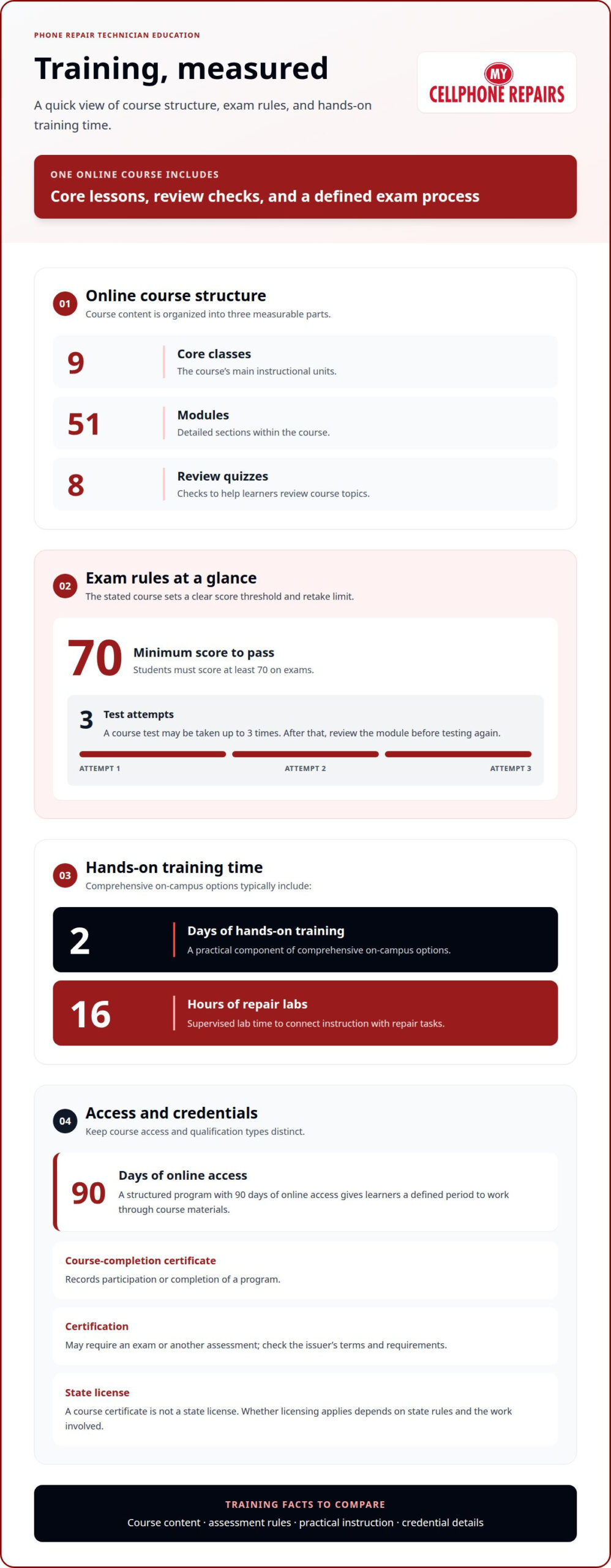
One online course includes 9 core classes, 51 modules, and 8 review quizzes. Students must score at least 70 to pass its exams. They may take a course test up to 3 times before reviewing the module before testing again. These rules give learners a clear way to prepare and identify topics that need more study.
Continuing Education and Skill Proof
Whether phone repair technicians need continuing education or a license depends on applicable state rules and the work involved. A course certificate is not the same as a state license, and completing a course alone does not establish that a licensing requirement has been met. Treat education, certification, and licensing as separate questions.
A training provider can document skills through course records, assessment results, and a certificate naming the completed program. Ask whether the provider awards continuing education credits or records course completion only. An exam result, for example, can document assessed knowledge, while a module record can show which topics the course covered.
Certification Support and Costs
A recognized certificate can help technicians present their training and assessment results to employers or customers. Its value depends on the issuer, the skills assessed, and how closely the content matches the repair work. Use the credential to support your skills record, not to replace an explanation of your hands-on experience.
Course and certification costs depend on format, included materials, exam access, and technical support. Compare those items before choosing a program, including whether retesting or post-course guidance is part of the offer. A structured program with 90 days of online access, for example, gives learners a defined period to work through course materials.
Hands-on phone, tablet, and game-console repair training
Practical instruction connects repair concepts with supervised work on devices. When choosing continuing education for phone repair technicians, consider your experience, the device types covered, and the skills you want to develop.
Manufacturer Training Programs
OEM and manufacturer programs focus on specific brands or device families. Compare the models and repair procedures covered, and how instruction balances theory with hands-on practice. Lessons for phones, tablets, and game consoles can differ because each category has distinct components and repair workflows. Manufacturer-specific training can complement broader repair education, but the course scope should match your goals.
Beginner and Device-Specific Training
A suitable beginner program starts with core repair concepts and guided practice before moving to model-specific work. Students learn how instruction applies to iPhone and Android devices, then build familiarity with their components and diagnostic approaches. Experienced technicians may prefer lessons focused on unfamiliar models or repair categories.
The best program depends on your starting skills and intended career path. Continuing education for phone repair technicians can include device diagnostics, component replacement, and repair methods for phones, tablets, or game consoles. A hands-on course can help students connect classroom learning to repair tasks; comprehensive on-campus options typically include 2 days of hands-on training and 16 hours of repair labs.
Private and Team Training
One-to-one instruction can focus on an individual technician’s goals, while team training can address procedures shared across a repair business. Guided practice helps beginners reinforce foundational skills. Experienced staff may need focused instruction on a new device category. Compare the format, instructor feedback, and practical exercises with the skills learners need.
Data extraction and recovery training can help technicians understand how to assess devices with access or data-related problems. Course content should explain diagnostic processes and the limits of recovery approaches, rather than promise a particular result. Students can then learn to distinguish a hardware repair task from a data recovery concern.
For iPhone and Android repairs, instructors can demonstrate device assessment, component identification, and repair procedures through supervised examples. Review the curriculum to see which device types and tasks it covers. My Cellphone Repairs offers a Technician Training Program for learners developing mobile repair skills.
Compare the course scope with the repairs you expect to handle. Look for practice that covers the full process, from assessing a device and identifying a fault to choosing a repair approach and checking the result. Consider how learners receive feedback and whether the exercises suit their experience. Clear information about the devices and procedures covered helps you decide whether a course complements your skills or addresses a training gap.
When reviewing upcoming training schedules, consider whether the curriculum focus matches the phone, tablet, or game-console work you want to develop. A suitable training experience should leave you better prepared to assess repair tasks, recognize when a problem falls outside your current skills, and determine what further instruction may be useful. These considerations can help individual technicians and repair teams choose practical learning that fits their goals.
Micro-soldering and chip-level diagnostics
Board-level training goes beyond replacing larger parts. It teaches technicians to investigate circuit-board faults, assess whether a component-level repair is appropriate, and evaluate the result. For experienced phone repair technicians, useful continuing education can cover micro-soldering, chip-level diagnostics, and model-specific board layouts, including those found in iPhone devices.
A strong program connects each technique to a diagnostic decision. Students learn to distinguish a board-level fault from a problem involving a replaceable assembly. For example, a phone that won’t charge may need further diagnosis before a technician can determine whether the port, board, or another component is involved. Training should explain the reasoning behind that distinction.
Micro-soldering Level I and Level II are labels for stages of instruction, but course content matters more than the label. A Level I curriculum should introduce core concepts and supervised practice with small board components. Level II should build on those fundamentals through more complex diagnostic scenarios and repair decisions. Ask what each level assesses and what prior learning it expects.
Chip-level diagnostics also requires careful fault isolation. Technicians need to interpret symptoms, connect them to possible causes, and decide which tests can narrow the problem. In a training setting, an instructor might present a case involving intermittent power and explain how evidence guides the next diagnostic step. The goal is a reasoned diagnosis, not a guess about which component has failed.
Experienced technicians can stay current by studying new board layouts, component-level fault patterns, micro-soldering methods, and diagnostic workflows. A focused learning plan can address a recurring repair-business challenge, such as identifying when board repair is suitable. Program materials should explain the skills taught and provide structured opportunities for instructor feedback.
The Microsoft Registered Refurbisher program is a separate topic from micro-soldering instruction. Its name alone is not evidence of board-repair skills. Compare the program’s stated purpose with the course curriculum, and look for explicit learning outcomes covering diagnostics, soldering, and repair assessment. This distinction helps technicians choose training that matches the work they intend to do.
Before enrolling, review the curriculum, instructor feedback, and assessment method. A useful program explains the difference between foundational and advanced learning rather than relying only on Level I or Level II labels. It should also show how practice connects to repair decisions, such as whether a damaged board can be repaired or needs another solution.
For technicians handling iPhone, Android, or other phone models, board-level learning is most useful when it builds on existing repair fundamentals. Match the program to the faults you encounter and the skills you want to develop next.
Post-training videos and graduate support
Online courses let phone repair technicians revisit lessons after class. Useful follow-up can combine focused video reviews with instructor access or structured coaching.
Online continuing education courses are available, including self-paced repair instruction. Some course formats also include weekly live virtual coaching sessions, giving graduates a scheduled opportunity to discuss repair questions.
Post-training videos work best as focused refreshers, not replacements for supervised practice. A technician can review a mobile-device disassembly lesson before handling an unfamiliar model, then revisit component identification or diagnostic reasoning in the course materials. Short, clearly organized videos are easier to find for a specific task than broad recordings without topic labels.
For example, a graduate facing a recurring charging fault could revisit relevant diagnostic material, note the symptoms, and bring a focused question to a coaching session. An instructor can help clarify the reasoning behind the next diagnostic step. Weekly live virtual coaching sessions provide a regular opportunity for follow-up, so graduates need not rely on course notes alone.
Online courses can suit technicians fitting learning around repair work. Self-paced lessons let students return to difficult topics, while live coaching offers a way to discuss questions directly. Compare the curriculum and support structure: check whether lessons cover devices and repair tasks relevant to your work and whether coaching is included.
Employers can support training by identifying skill gaps and setting aside time for study. A repair business might pair a technician with a mentor after a phone-disassembly lesson. The mentor can observe the process, review the repair record, and suggest topics for further learning. Clear goals connect course content with daily repair work.
Employer support can also help staff apply new learning. Managers can schedule practice on suitable devices, discuss common faults during team reviews, and track completed training. A technician who studies a new diagnostic method, for example, can share the steps with coworkers at a staff meeting. This keeps learning connected to the repair team’s workflow.
Choose graduate support based on its practical role. Video lessons help technicians revisit specific topics, live coaching supports discussion and feedback, and employer planning creates time to apply new skills. Together, these options can help technicians continue building knowledge after formal repair training.
The page says trainees might experience a salary increase of up to 12% after completing the Phone Repair Course. A live online course date is 22 Jan 2027.
Device disassembly and component identification
Disassembly training helps technicians understand how a device’s parts relate before starting a repair. Instructors use model-specific diagrams and supervised demonstrations to show how components fit together. A phone’s display, battery, charging assembly, and cameras, for example, each relate to different parts of the repair process. Identifying them accurately helps technicians choose the right diagnostic path.
A structured lesson starts with device recognition, then covers component locations, connection types, and repair documentation. Students learn how a particular phone’s design affects access to its internal parts. An iPhone and an Android phone may share a repair category, but their layouts and procedures can differ. Training should make those distinctions clear.
Component identification also supports fault diagnosis. If a device has a camera problem, technicians need to understand which parts and connections relate to that function. Instructors can use labeled diagrams and example devices to connect symptoms with areas to assess. This context helps reduce guesswork and keeps repair decisions tied to the reported fault.
Good training treats reassembly as part of the repair, not an afterthought. Instructors can assess whether technicians follow the model’s documented process, keep components organized, and perform appropriate checks after the work. A screen-repair lesson, for example, can show how documentation, component handling, and final function checks fit together. Procedures vary by device.
Software knowledge adds another layer. Technicians may need to distinguish a physical component issue from a software-related problem. Training should explain how diagnostic findings guide the next assessment, rather than assume every fault requires disassembly. An instructor might compare a software symptom with a damaged camera component and discuss how each affects repair planning.
Because repair work spans different devices, model-specific learning can be useful. A repair business may see Samsung phones, iPhones, tablets, and laptops with different layouts and service needs. Course materials should specify the device categories covered and how instructors demonstrate component identification. That helps technicians connect training to the devices they handle.
Use the curriculum to judge whether a course teaches more than component names. Look for demonstrations, guided practice, repair documentation, and instructor feedback. These help students understand why a part matters and how its condition affects the next repair decision. They also give experienced technicians a way to update their knowledge as device designs change.
If a device needs professional assessment, request device repair support for a clear next step.
My Cellphone Repairs: Samsung Phone Repair
My Cellphone Repairs offers a Technician Training Program for people developing repair skills, as well as Samsung Phone Repair for customers who need a device assessed and repaired. If you’re learning professional repair, the training program is the relevant next step. If your Samsung phone needs service, choose Samsung Phone Repair.
Choose the path that fits your goal: develop repair skills through training, or arrange service for a device that needs attention. My Cellphone Repairs also offers iPhone Screen Repair and MacBook Repair for those specific repair needs.
Contact My Cellphone Repairs to discuss Samsung Phone Repair or the Technician Training Program.
Make your next repair skill count
Turn continuing education for phone repair technicians into a practical development plan. Choose a skill that matches the work you want to take on, then connect each course or practice session to a clear professional goal. Keep a record of completed training and the repair tasks you’re prepared to handle. This gives you a way to track progress and decide what to learn next.
Your next step may be training, professional repair, or both. My Cellphone Repairs offers a Technician Training Program, Samsung Phone Repair, iPhone Screen Repair, and MacBook Repair. If you’re developing repair skills, choose a program that fits your experience. If a device needs service, select the repair that matches it.
Contact My Cellphone Repairs to discuss your next step. Keep building your skills with a clear goal and steady practice.
Frequently Asked Questions
How Does It Work?
Phone repair training typically combines instruction with guided practice and a way to assess progress. A learner might study how technicians identify a display fault, then apply that reasoning in a supervised repair exercise. Depending on the course, lessons may take place online, in a classroom, or in both settings. Review the assessment method to understand how it measures learning, not just attendance.
What is the Smartphone Repair Course about?
A smartphone repair course teaches skills for assessing and repairing mobile devices. Topics can include understanding hardware components, diagnosing common faults, and following repair procedures. A learner, for example, may study how a charging problem relates to device components before practicing a diagnostic process. Course content varies, so consider whether the lessons match the devices and repair tasks relevant to your goals.
Who Should Get Certified?
Certification can suit beginners seeking structured learning and experienced technicians who want to document additional skills. A new technician may use a course assessment to show completed training, while an experienced repairer might pursue instruction in a less familiar area. Before enrolling, decide what you want the credential to demonstrate, such as course completion or assessed knowledge. Its value depends on the issuer and scope.
Do phone manufacturers offer authorized repair training or certification?
Manufacturer-specific training and authorization are not interchangeable with a general repair course certificate. A program may teach procedures for a particular brand, but that alone does not establish manufacturer authorization. Check the credential’s issuer and stated status. A certificate from an independent training provider, for example, documents that provider’s course; manufacturer authorization must be explicitly granted by the manufacturer.
Get it fixed at My Cellphone Repairs: most repairs are done the same day. Walk in or book online.
Book NowPhone frozen or acting up? See our step-by-step restart & reset guides →
Our locations
- Towson Mall825 Dulaney Valley Rd, Second Level, Towson, MD 21204
(410) 828-4404 - Grand Rapids3077 28th St SE, Grand Rapids, MI 49512
(616) 799-6996 - PG Plaza Mall (Hyattsville)3500 East-West Hwy, Mall at Prince George's, Target Entrance, Hyattsville, MD 20782
(301) 559-1105 - Bowie Town Center15630 Emerald Way, Bowie, MD 20716
(240) 614-3600 - Capital City Mall (Camp Hill / Harrisburg area)3604 Capital City Mall Dr, Camp Hill, PA 17011
(717) 919-7868 - Cumberland Mall (Vineland)3849 S Delsea Dr, next to Boost Mobile, Dick's Sporting Goods entrance, Vineland, NJ 08360
(856) 765-5049 - Mondawmin Mall2401 Liberty Heights Ave, Lower Level, Baltimore, MD 21215
(443) 826-7711 - Baltimore Inner Harbor100 East Pratt St, Suite 101, Baltimore, MD 21202
(443) 838-8989 - St Charles Mall (Waldorf)11110 Mall Cir, Waldorf, MD 20603
(301) 645-7755 - Alexandria7650 Richmond Hwy, Alexandria, VA 22306
(703) 341-6789