
A college degree isn’t the only route into phone repair. Learning how to get a job as a phone repair technician starts with practical skills, careful troubleshooting, and proof that you can handle delicate components. Building hands-on repair skills can be a useful first step toward repair work.
It makes sense to wonder whether employers will take your skills seriously without a diploma. Show you’re ready by demonstrating that you can diagnose common faults, work methodically, communicate clearly with customers, and keep learning as devices change. Practice and relevant training can help you build that evidence.
This guide covers the repair skills employers look for, ways to gain experience and present it in a job application, and when an IT certification may be useful. You’ll also learn how to weigh formal training against practical experience, so you can choose a realistic path into the work without assuming you need a degree or certification first.
Key Takeaways
- Build practical repair skills and show employers how you troubleshoot, handle small components, and communicate clearly.
- IT certifications aren’t required for phone repair work. Consider whether a credential such as CompTIA A+ supports the roles you want.
- Understand the difference between a certification and a license, and learn which requirements apply to the place where you plan to work.
- Use structured practice and relevant training to develop hands-on experience you can describe in applications and interviews.
- Focus your job search on roles that match your current repair skills, then keep building experience as you learn new devices and fixes.
Whether repair technicians need IT certifications
IT certifications aren’t required to work as a phone repair technician. The value of a credential depends on the role, the employer, and how well it supports your practical repair skills.
Certification Requirements for Repair Technicians
A certification documents training or knowledge, but it isn’t a universal requirement for phone repair jobs. You can pursue the field without first earning an IT credential, then decide whether one supports the roles you’re targeting.
A relevant certification can make your application easier to assess. Pair it with specific examples, such as diagnosing a charging fault or completing a screen replacement during supervised practice. A certificate shows what you’ve learned; a clear account of your process shows how you apply it.
CompTIA A+ and Employer-Recognized Certifications
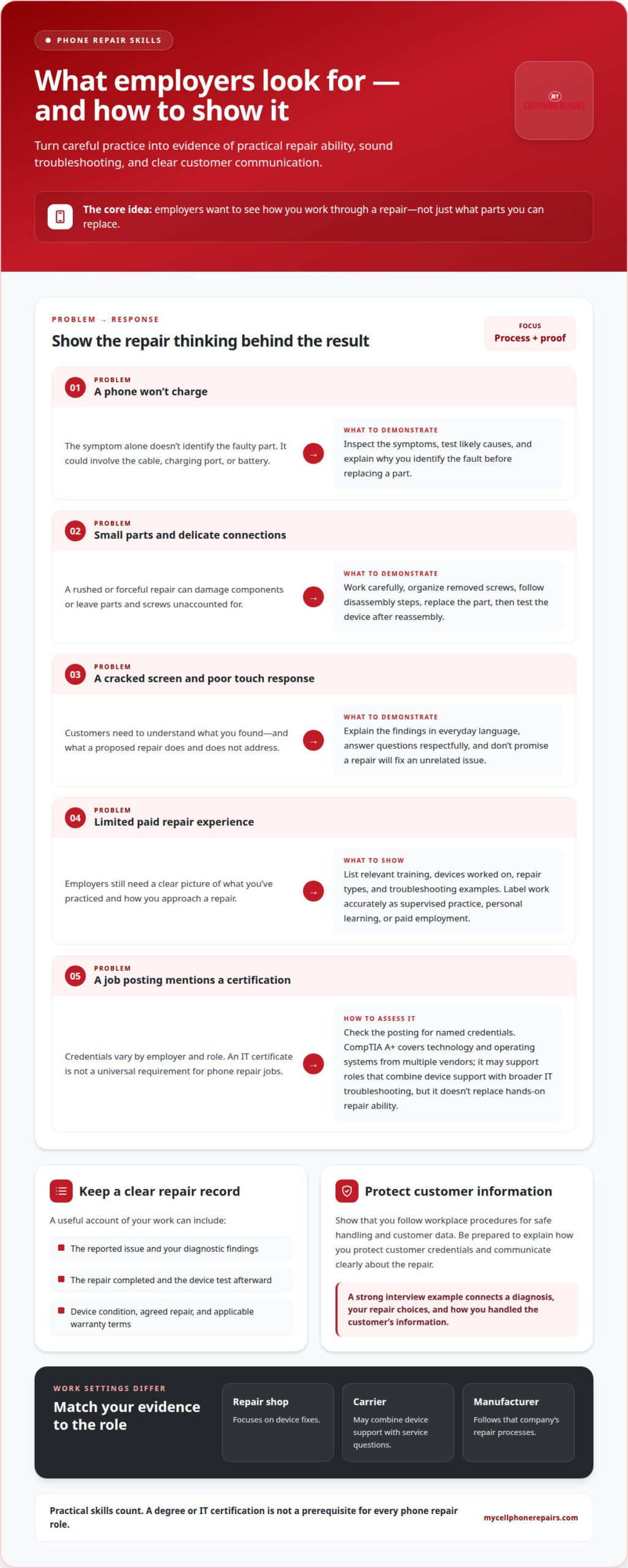
CompTIA A+ is a vendor-neutral certification covering technologies and operating systems from multiple vendors. It can demonstrate broad IT knowledge, especially for jobs that combine device support with troubleshooting beyond physical repairs.
Phone repair employers may value different credentials, depending on the job and the skills it emphasizes. Read postings for named certifications, then compare those requirements with your experience. Don’t assume CompTIA A+ replaces hands-on repair ability or that every shop requires it.
Repair shops, carriers, and manufacturers have different work settings and procedures. A repair shop focuses on device fixes; carrier roles may combine device support with service questions, while manufacturer roles follow that company’s repair processes.
Follow workplace procedures for safe handling, customer data, and warranty documentation. For example, protect customer credentials, record the device’s condition and agreed repair, and explain applicable warranty terms before work begins.
In the United States, PayScale reported an average annual salary of $38,648 for cell phone repair technicians as of June 2023. Technicians with in-demand skills and certifications can earn $50,000 or more.
A technician resume should list relevant training, devices repaired, repair types, and troubleshooting examples. Describe your role accurately, such as diagnosing a battery issue during supervised practice, rather than presenting it as paid job experience.
Interviews often explore how you diagnose faults, explain repair options, and protect customer data. Prepare a concise example, such as how you would distinguish a charging-port problem from a cable issue.
The tools and equipment you need depend on the repair and workplace. Be ready to discuss careful use of precision screwdrivers, a parts organizer, and diagnostic tools, as well as how you prevent lost screws or component damage.
Career paths can include taking on more complex repairs, training new technicians, or moving into a lead role. Strong troubleshooting, consistent documentation, and experience with a broader range of devices can support those next steps.
What qualifications and skills do employers require for phone repair technicians?
Employers look for practical repair ability, careful work habits, and clear communication. Requirements vary by role, so compare each job posting with skills you can demonstrate.
Core repair skills
Phone repairs involve small parts and delicate connections. The U.S. Bureau of Labor Statistics says general maintenance and repair workers need steady hands and good hand-eye coordination. These skills matter when positioning a connector, handling screws, or separating a screen without damaging nearby components.
Employers may assess how you diagnose problems, not just whether you can replace a part. For example, a phone that won’t charge could have a faulty cable, charging port, or battery. Explain how you would inspect the symptoms, test likely causes, and avoid replacing parts before identifying the fault.
- Careful handling: Keep components organized and avoid force when opening a device.
- Logical troubleshooting: Connect each test to a specific symptom, such as checking whether a button responds.
- Repair discipline: Follow a consistent process for disassembly, part replacement, and testing.
- Clear records: Note the reported issue, diagnostic findings, and work completed.
Communication and customer service
Repair work also involves explaining technical issues in everyday language. If a customer reports a cracked screen and poor touch response, describe what you found and what the repair addresses. Don’t promise that replacing a part will resolve an unrelated issue.
Employers value accuracy and calm communication, especially when a device contains personal information. Show that you can explain the next step, respond to questions respectfully, and follow workplace procedures to protect customer data.
How to show your qualifications
A practical plan for how to get a job as a phone repair technician starts with evidence of your skills. Use your resume or interview to describe relevant practice, devices you’ve worked on, and problems you’ve diagnosed. Be precise about whether the work was supervised practice, personal learning, or paid employment.
If you’re deciding how to get a job as a phone repair technician, prepare a specific example of your careful work. Explain how you organized removed screws, tracked disassembly steps, and tested a device after reassembly. This helps employers see how those skills apply to repair tasks.
Structured practice can help you develop and demonstrate these abilities. A phone repair technician training program offers a focused path to build repair skills.
The U.S. Bureau of Labor Statistics says general maintenance and repair workers need steady hands and good hand-eye coordination for tasks involving small devices and components. When discussing your qualifications, connect those abilities to concrete examples: describe how you handled a small part, kept nearby components undisturbed, and checked the result. Focus on what you personally did rather than making broad claims about your skill.
Prepare a clear account of how you approach a repair, from the first symptom through the final check. Explain how you choose a diagnostic step, keep track of the work, and communicate what the repair does and does not address. If your experience comes from personal learning or supervised practice, say so plainly. A specific, honest explanation helps employers understand your practical approach and how you work with customers. Emphasize habits you can demonstrate, and be ready to explain how you’d apply them to a device or problem raised in the conversation.
Do you need a license to repair phones in the US?
An IT certification is not required to work as a phone repair technician. A license is a separate matter: requirements can depend on where you work and what the role involves. Don’t treat a training certificate, employer preference, or repair experience as proof that a license is or isn’t required.
Certification and licensing are different
A certification shows that you completed training or demonstrated particular knowledge. A license is permission granted under a government requirement. An employer may value a repair course, for example, but that credential doesn’t automatically answer whether a local rule applies to the job.
Keep these questions separate when reviewing a job posting. Look for any stated credential or license, then identify whether the requirement comes from the employer or a government authority. This distinction helps you avoid paying for a course when the actual question concerns a local licensing condition.
What to check before accepting a role
Start with the exact work location, such as the state and city where the repair shop operates. Then review relevant state or local government licensing information for phone repair work. If the guidance doesn’t clearly cover the role, ask the licensing office how it applies to the duties in the posting.
Describe the work accurately. For example, distinguish repairing phones as an employee from operating a repair business. Ask whether the position involves only device repairs or additional work with separate requirements. Don’t assume another technician’s license status applies to your role or location.
When speaking with an employer, ask which credentials the job requires and whether they are company standards or legal requirements. A posting that says “certification preferred” does not, by itself, establish a licensing rule. Record the exact credential name and issuing organization so you can distinguish a certificate from a license.
How to present your status to employers
State your qualifications plainly on your resume. List completed training as training, licenses as licenses, and practical experience as experience. If a posting requires a specific license, confirm its name and applicability before claiming you hold it. Accurate wording protects your credibility during screening and interviews.
If a posting doesn’t name a license, focus your application on the repair skills the employer requests. For instance, describe the devices you’ve practiced on and repairs you can explain clearly. Keep any license question tied to the exact location and duties instead of relying on a general answer for every U.S. job.
Which phone repair certifications are recognized by employers?
There isn’t one IT certification that every phone repair employer requires. The credential an employer values depends on the role, so use job postings to identify what matters for the positions you want.
Use job postings as your guide
Look for named credentials in several phone repair job descriptions. Separate requirements from preferences. A posting that says a certification is preferred sets a different expectation from one that lists it as required. Note the exact credential name and the tasks described alongside it.
A role focused on device troubleshooting may value broader IT knowledge. A position centered on physical repairs may emphasize repair practice. Match each credential to the work described instead of assuming a familiar certificate applies to every technician job.
Where CompTIA A+ may fit
CompTIA A+ is a vendor-neutral certification covering technologies and operating systems from multiple vendors. Its broad scope can support applications for roles that combine phone repairs with general technical support. On its own, it doesn’t show an employer how you handle a particular phone repair.
Use the job description to decide whether CompTIA A+ aligns with the role. If the posting emphasizes broad troubleshooting, the credential may demonstrate relevant knowledge. If it focuses on component-level repairs, be prepared to explain practical experience with tasks such as diagnosing a charging issue or replacing a screen.
How to assess a credential’s value
Before investing time in a certification, compare its stated subject matter with the job’s duties. Check whether the credential appears as a requirement, a preference, or not at all. Then consider what it adds to your existing evidence of skill.
- Match the subject: Connect the certification’s coverage to duties named in the posting.
- Check the wording: Distinguish required credentials from preferred ones.
- Pair it with examples: Describe a relevant repair or troubleshooting process alongside the certificate.
- Keep claims precise: List the credential’s exact name and your completion status.
A certificate is most useful when you can explain its relevance. For instance, connect CompTIA A+ knowledge to a troubleshooting task, then describe how you would test a phone before recommending a repair. This gives an interviewer both a credential and a practical example to discuss.
Choose certifications based on your target roles, not on the belief that one name guarantees recognition. Phone repair jobs vary, so a focused credential can strengthen an application when it matches the employer’s stated needs. Practical evidence also helps show how you apply what you’ve learned.
the outlook can make careful preparation worthwhile: the U.S. Bureau of Labor Statistics projects employment for telecommunications equipment installers and repairers, including cell phone technicians, to grow by 6% in the United States from 2022 to 2032. This projection describes an occupation group, not a promise that every phone repair role will expand at the same pace. It also does not identify a certification that employers universally accept. Use it as context while checking current postings in your area, and keep your application focused on the specific repair duties, credentials and hands-on examples each employer names. That way, your choices remain tied to the work you are seeking.
How can you get hands-on phone repair experience without a job
Build practical skills through supervised training, personal devices, and careful documentation. Start with a device you own or one provided for practice, then work through a repair task slowly. Record what you did, what changed, and what you learned. That record can provide useful evidence during an application or interview.
Practice on devices you can learn from
Choose a device with a clear, manageable task. Before opening it, identify the model and research its layout using reliable repair instructions. Keep screws and parts organized as you remove them. Follow the same steps in reverse during reassembly, then test the functions related to the repair.
Don’t use someone else’s phone for practice without clear permission. A personal or designated practice device lets you learn without risking another person’s data or disrupting their daily use. If a repair exceeds your skill level, stop and document where you left off.
Build experience in stages. Begin by learning how device components fit together, then practice controlled disassembly and reassembly. For example, map screw locations on paper, label each removed part, and compare the device before and after reassembly. This helps you develop a repeatable process instead of relying on memory.
- Study a model: Identify its parts and note how the internal layout differs from other phones.
- Practice organization: Keep screws grouped by location and record each removal step.
- Track symptoms: Write down the original issue and the function you tested afterward.
- Review mistakes: Note a missed step or misplaced part, then explain how you corrected your process.
- Save evidence: Keep dated notes and clear photos of your practice setup and completed work.
A practice log makes informal learning easier to explain. Instead of writing “worked on phones,” describe the device model, task, troubleshooting approach, and outcome. Be honest about whether the work was self-directed or supervised. Never present a practice repair as paid employment or claim a result you can’t demonstrate.
Turn practice into interview evidence
Prepare a short example for each task you can discuss. Explain the reported problem, the steps you took, and how you checked the result. If a repair didn’t work, describe what you learned and what you would investigate next. This shows an employer your reasoning, not just a list of device names.
Keep learning structured. A training program can provide guided practice and help you build a record of repair skills. Explore hands-on repair training as a next step toward developing experience for technician roles.
My Cellphone Repairs: Samsung Phone Repair
My Cellphone Repairs offers Samsung Phone Repair for people who need help with a Samsung device, as well as a Technician Training Program for those developing repair skills. These are different next steps: choose repair service when your phone needs attention, or training when you want structured learning for technician work.
The skills in this guide, including careful handling and methodical troubleshooting, matter in both settings. Repair experience can help you understand the work, while training can support your development as you prepare for repair roles. My Cellphone Repairs also offers iPhone Screen Repair and MacBook Repair.
Contact My Cellphone Repairs to discuss Samsung Phone Repair or the Technician Training Program.
Take the Next Step Toward Repair Work
Your first technician role can start with one clear goal: become dependable at diagnosing and repairing devices. Keep building practical experience, record what you learn, and use specific examples to show employers how you approach repairs. Progress comes from consistent practice and honest evidence of your skills, not from collecting credentials without a purpose.
As you consider how to get a job as a phone repair technician, choose a next step that fits your situation. You might be preparing applications, developing your repair skills, or looking for help with a device of your own. Focus on the option that moves you forward now, then build from there.
For help with a phone repair or your next step in the field, contact My Cellphone Repairs. Keep learning, stay methodical, and give yourself room to grow into the work.
Get it fixed at My Cellphone Repairs: most repairs are done the same day. Walk in or book online.
Book NowPhone frozen or acting up? See our step-by-step restart & reset guides →
Our locations
- Towson Mall825 Dulaney Valley Rd, Second Level, Towson, MD 21204
(410) 828-4404 - Grand Rapids3077 28th St SE, Grand Rapids, MI 49512
(616) 799-6996 - PG Plaza Mall (Hyattsville)3500 East-West Hwy, Mall at Prince George's, Target Entrance, Hyattsville, MD 20782
(301) 559-1105 - Bowie Town Center15630 Emerald Way, Bowie, MD 20716
(240) 614-3600 - Capital City Mall (Camp Hill / Harrisburg area)3604 Capital City Mall Dr, Camp Hill, PA 17011
(717) 919-7868 - Cumberland Mall (Vineland)3849 S Delsea Dr, next to Boost Mobile, Dick's Sporting Goods entrance, Vineland, NJ 08360
(856) 765-5049 - Mondawmin Mall2401 Liberty Heights Ave, Lower Level, Baltimore, MD 21215
(443) 826-7711 - Baltimore Inner Harbor100 East Pratt St, Suite 101, Baltimore, MD 21202
(443) 838-8989 - St Charles Mall (Waldorf)11110 Mall Cir, Waldorf, MD 20603
(301) 645-7755 - Alexandria7650 Richmond Hwy, Alexandria, VA 22306
(703) 341-6789