
A tech career doesn’t have to start with coding. Becoming a phone technician can be a good career in 2026 if you enjoy hands-on troubleshooting, careful repair work, and learning how devices function. It’s a different path from software, cybersecurity, or data science, so the right choice depends on the work you want to do and the opportunities you’re aiming for.
It’s sensible to weigh pay and job stability against your interest in phone repair, especially when layoffs affect parts of the tech industry. This guide compares phone repair with other technology career paths, explains what salary information can and can’t tell you, and outlines practical ways to prepare. You’ll also learn how training and hands-on practice build useful skills, and why keeping those skills current matters as the job market changes.
Key Takeaways
- Compare phone repair with software, cybersecurity, and other tech paths by the kind of work you want to do, not salary alone.
- Choose a preparation route that builds practical skills alongside relevant technical knowledge.
- Use repeated hands-on practice to develop careful troubleshooting and repair habits.
- Account for layoffs by considering technology roles across a wider range of industries.
- Learn which skills and certifications can help you prepare for phone repair work.
1. In-demand technology jobs and average salaries
Technology careers differ in daily work, training, and earning potential. In the United States, computer and technology occupations are projected to grow 10.1% from 2024 to 2034, with about 317,000 openings each year. That broad outlook covers roles ranging from software development to security, but it does not mean every specialty has identical demand or pay.
Software developers build and maintain applications, while information security analysts monitor threats and help protect organizations’ systems. According to the U.S. Bureau of Labor Statistics, the median annual wage for software developers was $135,980 in May 2025. According to the U.S. Bureau of Labor Statistics, the median annual wage for information security analysts was $129,180 in May 2025. These figures show why salary comparisons should name the role and date, rather than treat all tech jobs alike.
Data science and network architecture offer other options. Data scientist jobs are expected to increase by 34 percent over the next decade, while information security analyst jobs are projected to grow by 29 percent over the next decade. Computer network architects design data communication networks. Their work differs from phone repair, which centers on diagnosing and fixing physical devices.
IT managers lead technology teams and oversee systems, projects, budgets, and service delivery. The median salary for IT managers is $171,200. This role usually involves coordination and decision-making, not just hands-on troubleshooting. Professionals who prefer practical device work may find a repair role a closer fit, while those drawn to planning teams and systems may prefer management.
Phone repair technician pay compared with other electronics repair careers depends on the employer, location, experience, and repair work performed. The available salary figures above describe software, security, and IT management, so they shouldn’t be treated as phone technician pay or as a direct comparison with other repair specialties.
A repair shop can provide established workflows, a team, and a steady stream of customer devices. The trade-off may be less control over schedules and business decisions. Starting a repair business offers more independence, but also means managing operations, customer communication, and business costs alongside repairs.
Typical duties include inspecting phones, diagnosing faults, replacing components, testing functions, and explaining repair outcomes. The work is hands-on and detail-focused, often at a bench with small parts and tools. Technicians should obtain customer authorization, protect device data, and follow applicable workplace requirements and safe handling procedures. Specific obligations depend on the work and applicable rules.
Phone repair technician earnings depend on the employer, location, experience, and types of repairs performed. As a result, pay can vary across electronics repair careers.
2. Education and preparation for technology careers
Start with the position you want, then choose training that matches its daily tasks. Phone repair focuses on device hardware, fault diagnosis, and careful component handling. Software development requires programming fundamentals, while data science uses statistics and analytical thinking. A course aimed at one path may not prepare you for another. To judge whether becoming a phone technician is a good career in 2026, look closely at the work involved.
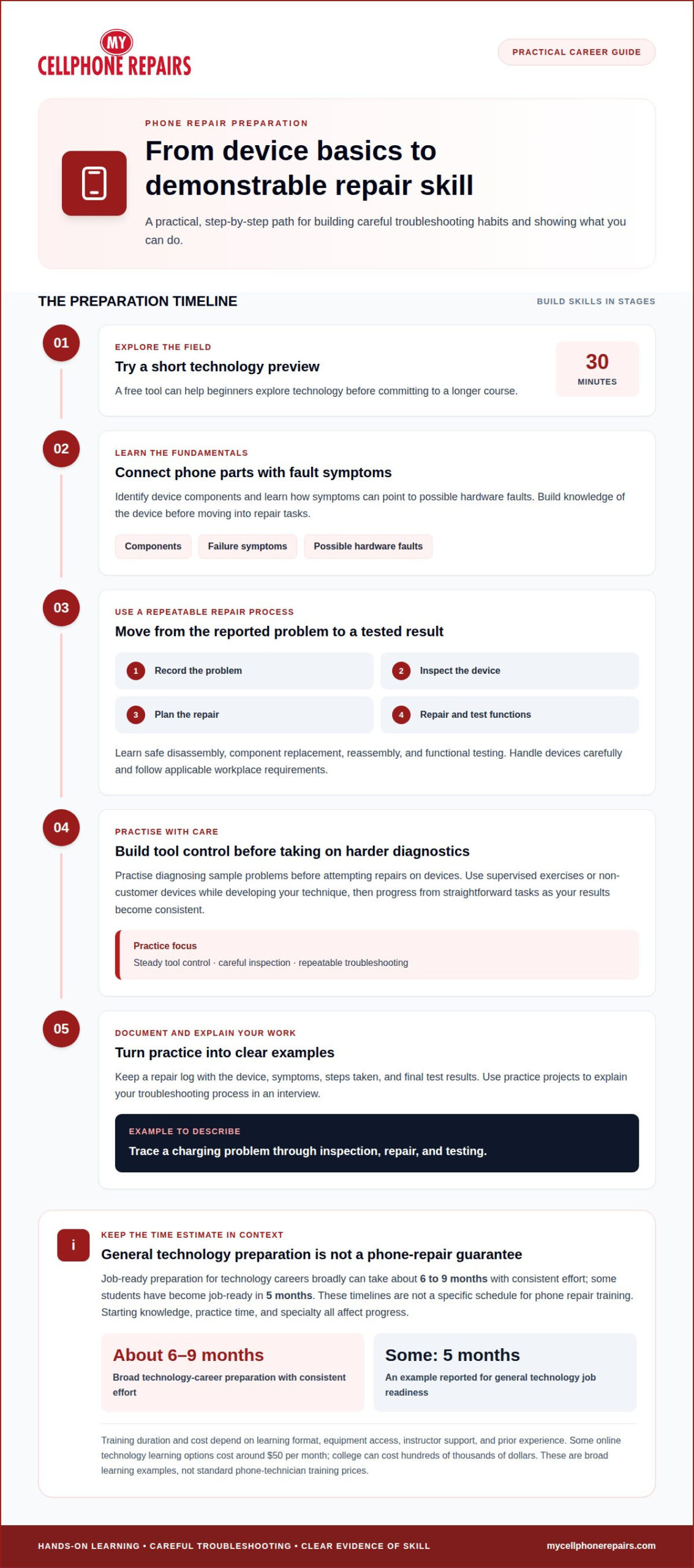
For technology careers broadly, job-ready preparation can take about 6 to 9 months with consistent effort. Some students have become job-ready in 5 months. These timelines describe technology work generally, not a guaranteed schedule for phone repair training. Your starting knowledge, practice time, and chosen specialty shape how quickly you build usable skills.
Phone repair training duration and cost depend on the learning format, equipment access, instructor support, and your previous experience. Some online technology learning options cost around $50 per month, while college can cost hundreds of thousands of dollars. Those examples cover broad learning options, not a standard price or duration for phone technician training.
Build your preparation in stages. First, learn device parts and common failure symptoms. Next, study safe disassembly, component replacement, reassembly, and functional testing. Then practise diagnosing sample problems before attempting repairs on devices. A free tool can also help beginners explore technology for 30 minutes before committing to a longer course.
- Learn the fundamentals: Identify phone components and connect symptoms with possible hardware faults.
- Practise a repeatable process: Record the problem, inspect the device, make a repair plan, and test the result.
- Keep a repair log: Note the device, symptoms, steps taken, and what the final tests showed.
- Prepare examples: Use practice projects to explain your troubleshooting process during an interview.
Hands-on learning matters because reading about a repair does not build steady tool control. Practice helps you remember the steps and notice when a component or connection needs closer inspection. Use supervised exercises or non-customer devices while developing your technique. Move from straightforward tasks to more complex diagnostics as your results become consistent.
Before applying for a position, describe your skills clearly. Give a specific example, such as tracing a charging problem through inspection, repair, and testing. Employers need to understand what you can do, how you approach faults, and where you are still learning. A focused training route, documented practice, and clear interview examples make your preparation easier to assess. This preparation can help you decide whether becoming a phone technician is a good career in 2026.
3. Learning through practice
Practice turns repair instructions into a repeatable troubleshooting method. Start with a specific fault, such as a phone that will not charge. Record the symptoms, inspect the charging port, consider likely causes, and test the device after the repair. This process builds careful thinking rather than guesswork.
Use a consistent workflow for each practice repair. Note the initial problem, inspection findings, tools used, repair steps, and final checks. If a phone still will not charge, compare the original symptoms with the results after repair. Your notes can help show whether the diagnosis was accurate or another fault remains.
Begin with low-risk practice devices and clear instructions. Learn how components fit together before attempting delicate repairs. Keep parts organized during disassembly, and note where each screw or connector belongs. Rushing can damage components or make reassembly harder. Good practice means protecting the device as well as identifying the fault.
- Inspect first: Describe the visible damage or reported symptom before opening the device.
- Work methodically: Follow the repair sequence and keep parts in their original order.
- Test the result: Check the function related to the repair and look for new issues.
- Review the process: Write down what worked and what you would change next time.
Practice also teaches you that one symptom can have multiple causes. A phone that will not power on may need more than a battery replacement. Consider the reported history, visible condition, and test results before choosing a repair. Checking evidence rather than guessing is a useful habit in other technical work, including security troubleshooting.
Practice takes different forms across the tech industry. Data science projects build skills in examining data and explaining patterns. Machine learning work involves testing a model’s performance on a task. Phone repair develops hands-on diagnosis and component handling. In each field, useful practice produces a result that can be reviewed and improved.
Some Tier 3 technology careers take months to years to become job-ready, and learning continues afterward. Labor statistics describe broad employment patterns, but they don’t show whether an individual can diagnose a device accurately. Keep building toward stronger work through repeated practice, feedback, and careful review of each outcome.
Before applying for a repair position, prepare examples that show your process. Explain the fault, the checks you made, and how you tested the result. A concise repair log gives your interview answers specific detail. It can also help you identify skill gaps and choose your next practice task.
4. Tech industry layoffs and job-market conditions
Layoffs can make technology hiring feel uncertain, particularly for developers and startup employees. Half a million tech workers have been laid off in the years since ChatGPT was released. That figure describes industry-wide disruption, not every employer or specialty. Separate headlines about large companies from hiring conditions in the role you are targeting.
The broader outlook also matters. Employment across all jobs is projected to grow around 3% the next decade. Technology roles can follow different patterns from that overall measure. Cybersecurity, software development, and device repair involve distinct work, employers, and hiring needs. A slowdown at one company does not mean every organization has stopped hiring technical professionals.
Use labor statistics as context, not as a personal forecast. A projection describes expected change across a job category, but does not show openings at a particular shop or in a specific city. One employer may need someone who can diagnose device faults, while another may hire developers to maintain software. The fit depends on the work and the skills requested.
Reduce reliance on a narrow job market by applying your technical skills across industries. Schools, healthcare organizations, retailers, and local businesses all rely on technology in their daily operations. Troubleshooting experience can transfer to different settings when you can explain the problem, the steps taken, and the result. Keep practical examples that demonstrate those skills.
- Track role-specific openings: Compare job descriptions for repair, support, cybersecurity, and development work.
- Read beyond the job title: Note the actual tasks, required tools, and experience employers request.
- Show transferable skills: Describe a real troubleshooting example and how you reached a solution.
- Keep learning: Update technical knowledge as devices, software, and workplace tools change.
Automation is another factor to consider. A machine can handle some repeated tasks, while people may still need to interpret unusual symptoms and decide what to test next. Sound judgment is useful in hands-on repair and other technical jobs. Focus on learning to diagnose, document, and explain problems, not just repeat a repair procedure.
Before choosing a career path, compare its day-to-day work with your strengths. Someone who enjoys hands-on diagnosis may prefer repair tasks; someone who likes coding may target developer roles. Cybersecurity may suit people drawn to identifying risks and protecting systems. Review labor statistics alongside current job descriptions, then build skills that match the work you want.
Consider a different route, since technical skills are not limited to startup roles or major technology companies. You can apply your skills and experience in industries beyond those employers. Think about how your previous work could support an organization with different priorities, and describe the tasks you handled and problems you solved. A broader search can connect your existing capabilities with work beyond the employers most visible in technology headlines.
5. What skills and certifications do employers require for phone repair jobs?
Phone repair employers need technicians who can diagnose faults, handle components carefully, and explain repairs clearly. A cracked screen, a phone that will not charge, and a device that will not power on each require different checks. Show that you can work through symptoms methodically rather than replace parts based on guesswork.
Build practical skills around common repair tasks. Learn to inspect devices, identify visible damage, use repair tools carefully, and test functions after reassembly. After replacing a screen, for example, check that the display responds and the device operates as expected. Employers value technicians who can explain what they tested and report unresolved issues accurately.
Troubleshooting matters as much as handling components. A charging problem might involve the port, the cable, or another fault. Develop a routine: gather the reported symptoms, inspect the device, test likely causes, and record the outcome. Clear notes help another technician understand the diagnosis and support consistent work across a repair team.
Customer communication matters, too. Explain a diagnosis in plain language, set clear expectations about the repair process, and handle personal devices with care. Practise describing repairs without technical jargon. For example, explain what you found, what work is needed, and which functions you will test afterward.
Certification requirements vary by employer and position. Moving into 2026, CompTIA A+ is among the certifications hiring managers may seek. It can support broader technical knowledge, but it doesn’t replace hands-on phone repair practice. Read each job description closely and match your training, experience, and examples to the skills it names.
- Show repair practice: Keep a record of devices, symptoms, diagnosis, steps, and test results.
- Demonstrate care: Explain how you organize parts and avoid rushed handling.
- Prepare an interview example: Describe one fault from initial report through final testing.
- Connect credentials to the role: Explain how a certification supports the specific work involved.
Employers may assess practical ability through conversation, work examples, or repair exercises. Be ready to explain why you chose a diagnostic step, what result you expected, and how you would respond if a test failed. Honest, precise answers show sound judgment. Do not claim expertise in repairs you have not performed.
Build these skills through structured practice and focused instruction. Explore phone repair career preparation as you develop the habits employers look for: careful diagnosis, controlled repair work, clear communication, and reliable testing.
Employment forecasts for other occupations should not be treated as evidence about phone-repair hiring or its credentials. Nurse practitioner employment in the United States is projected to grow 41% from 2025 to 2035. Solar photovoltaic installer employment in the United States is projected to grow 37% from 2025 to 2035. Medical and health services manager employment in the United States is projected to grow 24% from 2025 to 2035. Physical therapist assistant employment in the United States is projected to grow 23% from 2025 to 2035. Psychiatric technician employment in the United States is projected to grow 22% from 2025 to 2035. Occupational therapy assistant employment in the United States is projected to grow 21% from 2025 to 2035.
My Cellphone Repairs: Samsung Phone Repair
My Cellphone Repairs provides Samsung Phone Repair for people with damaged or malfunctioning Samsung devices. If you are considering whether is becoming a phone technician a good career 2026, its Technician Training Program is a practical next step toward developing repair skills. The program suits learners who want hands-on experience alongside technical knowledge.
For other device needs, My Cellphone Repairs also provides tablet screen repair and laptop battery replacement. Choose repair support when a device needs attention; consider training when exploring phone repair as a career. These are distinct options, depending on whether you need a repair or want to develop repair skills.
Contact My Cellphone Repairs to discuss Samsung Phone Repair or the Technician Training Program.
Turn Your Interest Into a Practical Next Step
If you’re deciding whether becoming a phone technician is a good career in 2026, focus on the work you want to do each day. Try a structured learning path, practise careful troubleshooting, and build examples that show how you approach a repair. Those steps can help turn a general interest in technology into a clearer career direction.
Hands-on learning can help you decide whether device repair suits your strengths. My Cellphone Repairs provides Samsung Phone Repair, iPhone Screen Repair, and MacBook Repair. If you are exploring repair work as a career, ask about the Technician Training Program. If you need help with a device, choose the repair service that fits its issue.
Contact My Cellphone Repairs today to discuss repair support or training. Take the next step at your pace, and keep building practical skills as you go.
Frequently Asked Questions
What’s the Next Step Toward a Tech Career?
Choose a specific role, then build skills that match its everyday tasks. For phone repair, learn device components and practise diagnosis on training devices. Keep a brief record of each exercise, including the fault, your approach, and the final test. Use these examples to explain your thinking in interviews. If comparing career paths, try a small hands-on project before committing to a longer course.
How much do entry-level phone technicians earn compared with experienced technicians?
Entry-level and experienced phone technicians may earn different amounts, but pay depends on the employer, location, repair skills, and responsibilities. Experienced technicians may take on more complex diagnosis or greater responsibility, while entry-level roles focus on building reliable repair habits. Compare postings for the same area and role. Note how employers describe experience, required skills, and duties to understand the local pay range.
What legal, safety, and data privacy rules apply to phone repair technicians in the U.S.?
Technicians should obtain customer authorization, protect device data, follow applicable workplace requirements, and use safe handling procedures. Specific obligations depend on the work and applicable rules.
What is the job outlook for phone repair technicians in the U.S.?
U.S. computer and technology occupations are projected to grow 10.1% from 2024 to 2034, with about 317,000 openings each year. This broad outlook does not establish demand specifically for phone repair technicians.
Get it fixed at My Cellphone Repairs: most repairs are done the same day. Walk in or book online.
Book NowPhone frozen or acting up? See our step-by-step restart & reset guides →
Our locations
- Towson Mall825 Dulaney Valley Rd, Second Level, Towson, MD 21204
(410) 828-4404 - Grand Rapids3077 28th St SE, Grand Rapids, MI 49512
(616) 799-6996 - PG Plaza Mall (Hyattsville)3500 East-West Hwy, Mall at Prince George's, Target Entrance, Hyattsville, MD 20782
(301) 559-1105 - Bowie Town Center15630 Emerald Way, Bowie, MD 20716
(240) 614-3600 - Capital City Mall (Camp Hill / Harrisburg area)3604 Capital City Mall Dr, Camp Hill, PA 17011
(717) 919-7868 - Cumberland Mall (Vineland)3849 S Delsea Dr, next to Boost Mobile, Dick's Sporting Goods entrance, Vineland, NJ 08360
(856) 765-5049 - Mondawmin Mall2401 Liberty Heights Ave, Lower Level, Baltimore, MD 21215
(443) 826-7711 - Baltimore Inner Harbor100 East Pratt St, Suite 101, Baltimore, MD 21202
(443) 838-8989 - St Charles Mall (Waldorf)11110 Mall Cir, Waldorf, MD 20603
(301) 645-7755 - Alexandria7650 Richmond Hwy, Alexandria, VA 22306
(703) 341-6789