
A repair shop earns trust before the first screw is turned. If you’re figuring out how to start a cell phone repair business, the first step isn’t renting a storefront or filling shelves. It’s assessing demand and building the skills and workflow to handle devices carefully.
Startup requirements, parts sourcing, and repair skills can all feel like open questions. This guide lays out a practical sequence: assess demand, choose a business model, research registration and compliance requirements, plan tools and parts, and create a consistent intake, diagnosis, repair, and handoff process. It also explains why it makes sense to begin with repairs you can perform reliably, such as screen, battery, and charging-port work, before taking on more complex jobs.
Customer trust depends on more than a successful fix. Clear communication, careful device handling, and sound data practices help customers feel confident leaving a phone in your care. If you want structured practice, My Cellphone Repairs’ technician training program includes hands-on instruction and diagnostic techniques to help you develop repair skills.
Key Takeaways
- To start a cell phone repair business, choose a clear operating model, customer group, and device focus.
- Match your service menu to repairs you can perform reliably, and document the steps before taking on more complex work.
- Build a startup budget that separates one-time setup costs from recurring expenses, then research the requirements that apply to your business.
- Use a consistent intake-to-pickup workflow, recording device details and condition to prevent misunderstandings.
- Launch with accurate service information and steady customer communication, then expand as demand and capability develop.
How to start a cell phone repair business: define the model before you launch
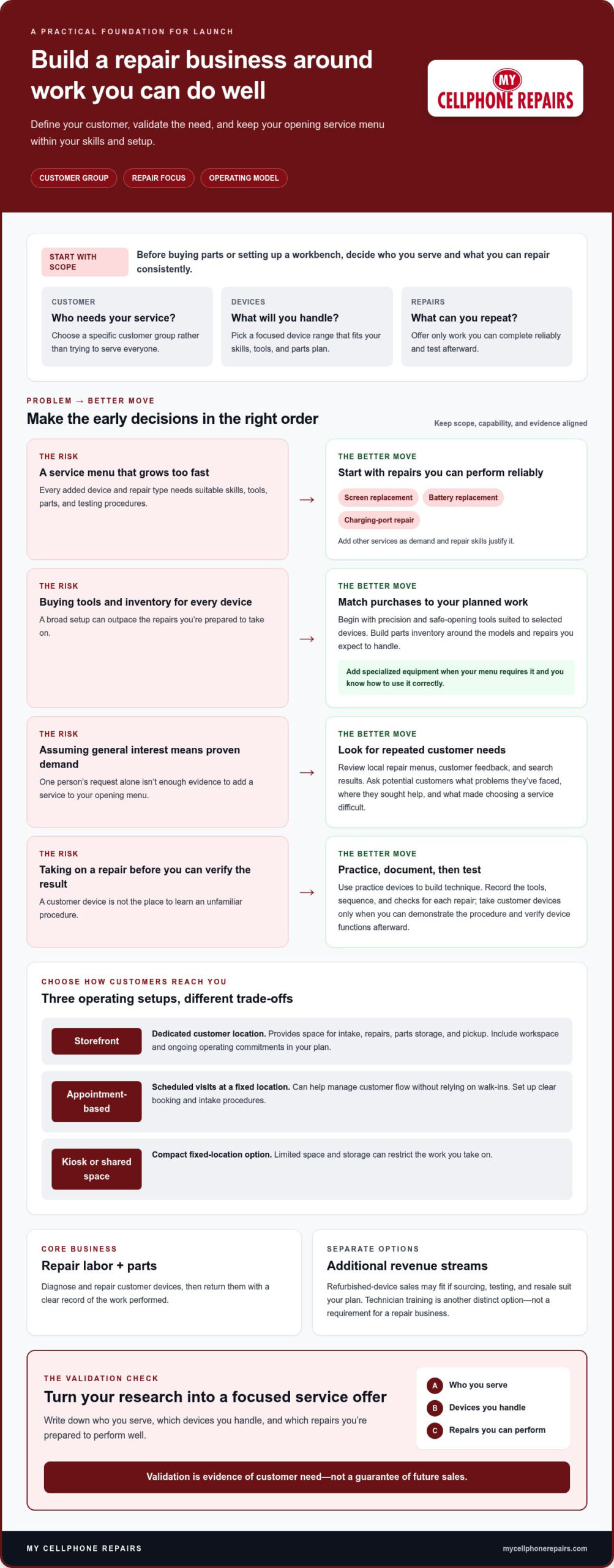
Before buying parts or setting up a workbench, decide which customers you want to serve, what you’ll repair, and how customers will reach you. A clear model keeps your opening service menu manageable and helps you plan the tools, inventory, workspace, and skills you’ll need. If you’re researching how to start a cell phone repair business, begin with a specific customer group and a short list of repairs you can perform consistently.
What does a cell phone repair business do? It diagnoses and repairs customer devices, then returns them with a clear record of the work performed. Depending on the business plan, it may also sell refurbished devices or provide technician training as separate revenue streams.
Which phone repair business model fits your goals?
A focused repair menu gives you a manageable place to start. You might specialize in iPhone screen repair and battery replacement, or offer a small set of common repairs across several device types. A broader menu could include iPhone, Samsung, and MacBook repairs, such as screen replacements, charging-port repairs, and water-damage restoration. Each added device and repair type requires suitable skills, tools, parts, and testing procedures. Don’t advertise work you can’t complete consistently.
Choose a customer setup that fits how you plan to operate:
Repair labor and parts are the core of the business. Refurbished-device sales can add a separate revenue stream if sourcing, testing, and resale fit your plan. Training is another distinct option, not a requirement for a repair business. The Right to Repair movement provides background on issues affecting independent repair. Research current rules and policies separately before setting your operating plan.
How to validate demand before committing
Look for repeated customer needs, not just general interest in repairs. Review repair menus, customer feedback, and search results for the market you intend to serve. Compare what people search for with the questions and requests you hear from potential customers. This can show which devices and problems come up often, and whether your proposed offer needs a sharper focus.
Talk with people who may become customers. Ask what device problems they’ve faced, where they looked for help, what made choosing a repair service difficult, and what they expect during diagnosis and pickup. Record the answers and look for patterns. One person’s request alone isn’t enough evidence to add a service to your opening menu.
Validation means finding evidence of customer need, not a guarantee of future sales. Before committing to a location or broad inventory, write a simple service offer based on your research: who you serve, which devices you handle, and which repairs you’re prepared to perform well.
Build the repair skills, tools, and supplier process your phone repair shop needs
A service menu is only useful if you can complete each repair safely and consistently. Match every advertised service to your skill level, a documented procedure, suitable parts, and a final test. This is a practical foundation for how to start a cell phone repair business without treating every device problem as work you’re ready to accept.
Which phone repair skills should you develop first?
Start with the fundamentals: opening devices carefully, organizing screws and components, disconnecting cables without damage, diagnosing accurately, reassembling cleanly, and testing the device afterward. Then practise the specific repairs on your planned menu. Screen replacement, battery replacement, charging-port repair, and liquid-damage diagnosis each have different steps and risks. Learn one procedure at a time, recording the tools, sequence, and checks that help you repeat it reliably.
Practice devices let you develop technique without putting a customer’s phone at risk. Take on customer devices only when you can demonstrate the full procedure, recognize common complications, and verify the device’s functions afterward. If diagnosis points to work beyond your experience, explain the limitation and decline or defer the repair. Knowing where to draw the line protects the customer and your reputation.
For structured, hands-on practice in diagnostics and repair techniques, explore cell phone repair technician training. To see examples of the repair services the company provides, explore phone repair services.
How to plan tools, parts, and quality checks
Buy tools for the repairs you’re ready to perform, not for every device on the market. Start with precision tools and safe opening tools suited to your selected devices. Add specialized equipment when your service menu requires it and you know how to use it correctly. Build parts inventory around the models and repairs you expect to handle, then expand as demand and repair skills justify it.
Use a repeatable process to assess suppliers and parts. Check that each part matches the exact device model and repair need. Track what arrives, whether it fits, and how it performs during testing. Understand return terms before ordering, and keep purchase records so you can trace each part. Link a part record to the relevant repair without recording unnecessary personal information.
Reliable repairs depend on accurate diagnosis, suitable parts, careful work, and final testing. Use a checklist before and after each repair:
- Before: Record the device model, reported symptoms, visible condition, and functions that already work.
- After: Check the repaired function, relevant device features, reassembly, and exterior condition. Note any issue that remains.
- At handoff: Explain the work completed, summarize the test results, and give the customer a clear record of the repair.
Keep these procedures with your repair records. They help you spot recurring part issues, improve repair steps, and explain clearly when a device needs further diagnosis.
Plan the finances, policies, and compliance for a cell phone repair business
A practical financial plan starts with your service menu and operating setup, not a generic startup-cost estimate. List expected purchases and obligations, then separate one-time costs from recurring expenses and costs tied to each repair. This helps you identify cash needs before opening and adjust your plan as actual expenses come in.
How to estimate revenue and control business expenses
Build a worksheet covering startup equipment, initial parts inventory, workspace setup, insurance, software, and operating reserves. For each item, record the amount you’ve verified, when it’s due, and whether it’s a one-time or recurring expense. Include a reserve for ordinary operating needs rather than assuming every repair will produce immediate cash flow.
Use this comparison as a planning template. The categories depend on your setup, so confirm each cost with a quote or invoice.
| Expense type | Examples | Planning assumption |
|---|---|---|
| Fixed | Workspace, insurance, software | Recurring on a schedule, whether or not repairs are completed |
| Variable | Parts inventory, payment processing | Changes with purchasing, sales, or transaction volume |
| Per job | Part used, transaction cost, job-specific materials | Directly attributable to an individual repair |
Set service prices by accounting for labor time, parts, allocated overhead, payment costs, and an allowance for warranty-related work. Compare the result with your target margin and the value of the service. A parts markup alone isn’t a complete pricing method.
Break-even repairs per month = monthly fixed costs ÷ contribution per completed repair. Contribution means collected repair revenue minus directly attributable parts and transaction costs. Using your own figures, if fixed costs are F and average contribution is C, estimate F ÷ C completed repairs to cover fixed costs. This is a planning estimate, not a sales forecast.
What policies and regulations should an owner research?
As part of deciding how to start a cell phone repair business, verify the requirements that apply to your business location and structure. Research formation and registration, tax accounts, permits, insurance, and employment rules using relevant government sources. Also confirm current obligations for privacy, consumer protection, electronic waste, and battery handling with authoritative agencies or qualified advisers. Requirements vary by jurisdiction, so don’t rely on a generic checklist as legal advice.
Write clear policies before accepting devices. Cover intake and condition records, diagnostic approval, customer data handling, payment, warranty terms, and what happens to devices left uncollected. Explain each policy in plain language and keep a record of customer approval. For an overview of repair categories that can inform a service menu, review professional phone repair services as you plan which jobs to offer.
Set up a dependable phone repair workflow that customers can trust
A clear workflow gives every device a traceable path from booking to pickup. It also prevents avoidable disputes: the customer knows what they reported, what you found, what work they approved, and what you tested. Set up the process before opening so every repair follows the same steps, even when work gets busy.
How should a repair shop handle intake and diagnosis?
Start with a booking record, then create a repair ticket when the device arrives. Record the customer’s contact details, device model, reported symptoms, visible condition, and the diagnostic work covered by the agreed terms. Take condition photos when appropriate and note existing cracks, marks, or other damage. Use a serial number or another device identifier only as needed to distinguish the device and maintain the repair record.
A repair ticket is the record linking a device, its diagnosis, customer approval, and the repair outcome. Keep it as the central job record. Add technician notes, parts used, customer updates, approval details, and payment status to the same ticket. This makes it easier to answer questions accurately and trace a part if an issue arises later.
Handle customer data carefully. Limit access to what’s necessary to diagnose or complete the approved repair, and don’t browse personal content unrelated to the work. Explain any access needed for testing in plain language. After diagnosis, describe the findings and proposed work clearly. Get the customer’s approval before starting chargeable work beyond the agreed diagnostic terms, and record that approval on the ticket.
How do testing, handoff, and follow-up build trust?
After a repair, test the repaired function and related features that could be affected by the work. For a screen repair, for example, check the display and touch response. For a charging-port repair, confirm that the device responds to charging. Compare the device’s appearance with the intake notes, then record test results, any remaining issue, and the parts used. Don’t mark the job complete until the ticket reflects what actually happened.
At pickup, explain the work in straightforward terms. Review relevant test results and limitations, confirm the payment record, and provide the written service terms that apply to the job. Invite the customer to ask questions before leaving. The conversation should match the ticket notes, with no surprises.
- Booking and intake: Record contact details, device information, symptoms, condition, and agreed diagnostic scope.
- Diagnosis and approval: Document findings, explain the proposed work, and record approval before proceeding.
- Repair and testing: Log technician notes and parts, then test the repair and related features.
- Pickup and follow-up: Explain the outcome, close payment records, and log any later issue against the original ticket.
Review tickets for recurring problems, such as a part that often fails testing or a step that leads to callbacks. Use those patterns to improve supplier choices and repair procedures. A consistent workflow is a practical part of how to start a cell phone repair business and earn customer confidence one device at a time. Explore professional phone repair services to see how repair categories can be presented clearly to customers.
Launch and grow your cell phone repair business with a focused plan
A steady launch is a sequence, not a one-day event. Validate demand, choose repairs you can perform consistently, prepare customer policies, test your workflow, and then open bookings. This order helps you identify gaps before they affect customers or tie up money in parts you don’t yet need.
What should your first 90 days focus on?
Use the first 90 days as a review period, not a promise of specific results. Divide the work into three phases: prepare, open in a controlled way, and review what happens. Before accepting bookings, make sure your service descriptions, intake process, repair records, parts routine, and customer communication are ready. At opening, keep the menu focused so you can monitor each job closely.
Set operating targets you can measure and adjust as you learn. For example, decide how quickly you aim to respond to inquiries, what information every repair ticket needs, which tests every completed repair requires, and how you’ll collect customer feedback. Track performance against those standards instead of assuming growth means adding more services.
- Preparation: Finalize your services, policies, website, booking process, and repair documentation.
- Controlled opening: Accept work within your current skills and capacity. Record inquiries, completed repairs, turnaround, parts issues, and feedback.
- Review: Look for recurring requests, workflow delays, repeat issues, and gaps in your records before changing the plan.
Expand only when the evidence supports it. Repeated requests for a device category may justify training and testing a new service. Consistent parts use may support a larger inventory. Add staff or refurbished-device sales only when demand, available capacity, and the work involved make a clear case.
How can an owner build credibility and keep improving?
Make your website useful and precise. Explain which repairs you perform, what customers can expect during diagnosis, and how you’ll communicate before proceeding with work. Add educational pages that answer common questions in plain language. For example, focused information about Samsung phone repair and iPhone screen repair can help customers understand specific services and options.
Keep communication consistent from the first inquiry through pickup. Explain repair decisions without jargon, share updates when a job’s status changes, and record customer concerns alongside the repair outcome. Review those records regularly. A pattern of part problems may point to a supplier issue, while recurring diagnostic delays may show where procedures or technician skills need attention.
Keep learning as your service menu develops. Hands-on instruction and diagnostic practice can strengthen repair skills, but training doesn’t guarantee business results. If you’re building your technical foundation, explore hands-on cell phone repair technician training as one option for continued skill development. Use what you learn, customer feedback, and operating records to choose your next step.
Take the next step toward professional repair skills
Starting small is a strength. Before taking responsibility for customer devices, build the confidence to diagnose carefully, work methodically, and recognize when a repair exceeds your current skill level. That foundation can shape the kind of shop you’re ready to build.
If you’re considering how to start a cell phone repair business, make skill development your next concrete step. My Cellphone Repairs offers hands-on technician instruction covering device components and diagnostic techniques. Its repair services include work on iPhones, Samsung phones, and MacBooks, including screens, batteries, charging ports, and water-damage issues. Training supports technical development; your business decisions and outcomes remain your own.
Explore My Cellphone Repairs to learn about its repair services and technician training.
Frequently Asked Questions
How much does it cost to start a cell phone repair business?
Startup costs depend on your business model and setup. A fixed workspace, opening inventory, tools, insurance, and software all affect the budget. Get current quotes for your plan instead of relying on a broad estimate. Separate one-time purchases from recurring bills, then include cash for replenishing commonly used parts and covering expenses during slower periods.
Is a license required to start a cell phone repair business?
Requirements vary by location and business structure, so check before accepting customers. Research business registration, permits, tax accounts, and rules that may apply to a customer-facing workspace or employees. Also confirm obligations related to discarded electronics and customer data. Use current government sources for your jurisdiction, and keep copies of registrations, filings, and other required records with your business documents.
Can you start a phone repair business from home?
A home-based setup may be possible, but first confirm that your location and workspace can support the activity. Check local zoning or home-business rules, lease or property restrictions, insurance terms, and requirements for receiving customers or storing devices and parts. Plan for a secure work area, controlled access to customer devices, and safe storage. A home setup still needs professional records and customer policies.
Do you need certification to repair cell phones?
Certification requirements depend on the jurisdiction and type of work, so verify applicable rules before advertising services. Even where a specific credential isn’t required, customers rely on your ability to diagnose and repair devices without avoidable damage. Build competence through supervised or hands-on practice, keep records of procedures you’ve mastered, and avoid taking on repairs outside your experience. Training can strengthen practical skills, but it doesn’t replace careful work.
How do phone repair businesses get customers?
Make it easy for customers to understand what you repair and how to book. Use a clear website, accurate service descriptions, and helpful answers to common device questions. Keep business listings current where customers search, and invite satisfied customers to share honest feedback without pressuring them. Referral relationships can also introduce your services to new customers. Track which inquiries turn into completed jobs so you can focus on effective channels.
What tools do I need to start a cell phone repair business?
Choose tools for the devices and repairs you’re prepared to handle. A basic bench may need precision screwdrivers, opening picks, spudgers, tweezers, suction tools, and suitable heat equipment. Add model-specific tools or advanced diagnostic equipment when your training and service menu call for them. Keep tools organized, inspect them regularly, and replace worn items that could slip, damage components, or make repairs less consistent.
Is a cell phone repair business profitable?
It can be, but profitability depends on completed work, pricing, costs, and how well the business controls rework and inventory. Revenue isn’t profit: account for workspace costs, insurance, software, payment processing, taxes, unusable parts, and your own labor. Review results by service type. Refurbished-device sales or training may provide separate revenue streams, but each also brings its own costs and workload.
Explore My Cellphone Repairs’ hands-on technician training program to build practical repair and diagnostic skills.