
What if that hairline crack on your display is actually a ticking clock for your phone’s internal hardware? It’s a gut-wrenching moment when your device hits the pavement. You immediately worry about high manufacturer fees or the potential for total data loss. We know a broken screen is more than a cosmetic issue. It is a major disruption to your daily life. Getting an iPhone screen repair should be a straightforward process that restores your peace of mind.
This guide provides everything you need to navigate the restoration process in 2026. You’ll learn the technical difference between simple glass cracks and deep digitizer damage. We explain the critical quality gaps between OLED and LCD replacements so you can make an informed choice. You will also find a clear checklist to prepare your phone for service. This information gives you the confidence to choose a professional path that protects your data and your device’s longevity.
Key Takeaways
- Identify the difference between surface glass cracks and deep digitizer damage to understand your specific restoration needs.
- Learn how the shift from LCD to OLED technology affects your display’s brightness, battery efficiency, and overall replacement quality.
- Understand why delaying an iPhone screen repair compromises your device’s IP68 water resistance and leaves internal components vulnerable.
- Evaluate the complex internal layout of modern devices to see why specialized tools and professional training are essential for a successful fix.
- Discover how a national technician training program ensures your hardware restoration is handled by a certified specialist.
Understanding iPhone Screen Damage: More Than Just Cracked Glass
An iPhone screen repair is more than a cosmetic fix for a spiderweb of cracks. It is the surgical restoration of an integrated display assembly. Many users assume they are only replacing a piece of glass, but modern iPhones use a bonded system where the glass, touch sensors, and display panel are fused together. When you drop your phone, you aren’t just breaking a surface. You are compromising a complex sensory system. A minor crack acts as a breach in your device’s armor, allowing moisture and dust to bypass the internal seals. Much like how Tip Top Plumbing & Restoration manages water damage in a home, our technicians focus on preventing environmental hazards from ruining your phone’s hardware.
Think of your display as the primary gateway to your digital life. If the glass is shattered but the image is clear, the damage is superficial. However, if the touch response fails or the image distorts, the underlying layers are compromised. Professional restoration ensures that every component in this stack works as the manufacturer intended.
The Anatomy of a Modern iPhone Display
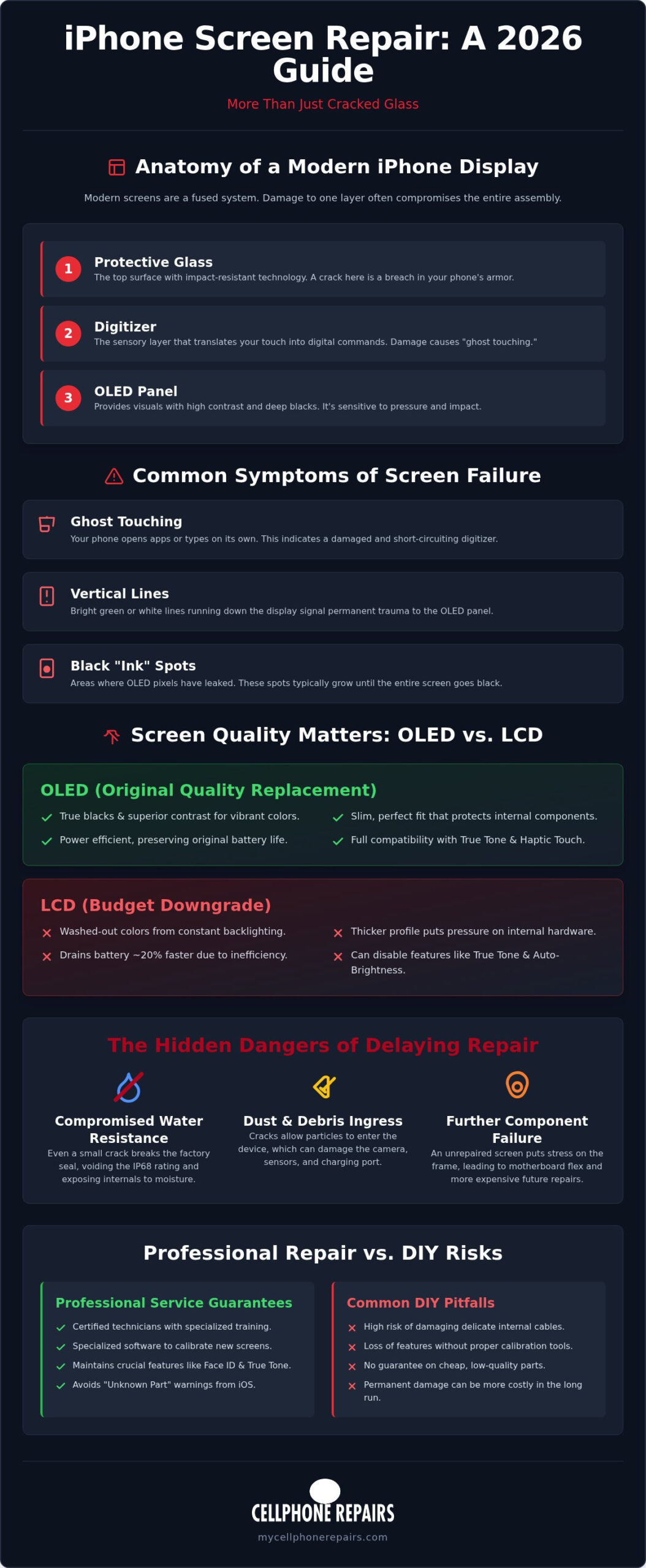
Your screen consists of three primary layers. The top layer is the protective glass, which in 2026 models features enhanced impact-resistant technology designed to survive drops on hard surfaces. Beneath that sits the digitizer. This thin layer translates your physical touch into digital commands. It is the brain of your interface. The bottom layer is the OLED panel. This technology provides the high-contrast visuals and deep blacks that make your photos pop. Unlike older LCDs, OLED panels are incredibly thin and flexible, but they are also highly sensitive to pressure and environmental exposure. To maintain the integrity of these layers, technical experts like Doctor Moviles use specialized tools for precise hardware restoration.
Common Symptoms of Screen Failure
Damage doesn’t always look like a crack. Sometimes the failure is internal. Watch for these specific red flags:
- Ghost touching: Your phone opens apps or types messages without your input. This indicates the digitizer layer is short-circuiting.
- Vertical lines: Bright green or white lines running down the display signal permanent trauma to the OLED panel.
- Black spots: Often called “ink spots,” these are areas where the OLED pixels have leaked. These spots usually grow until the entire screen is black.
By 2026, the technical requirements for a successful iPhone screen repair have evolved. New models require specialized software calibration after a hardware swap to maintain features like Face ID and True Tone. This complexity is a major focus of the Right to Repair movement, which highlights the need for specialized tools and training to fix modern electronics. Our specialists undergo a rigorous Technician Training Program to master these calibrations. We don’t just swap parts; we restore the full functionality of your device.
OLED vs. LCD: The Technology Behind Your Replacement
Choosing the right technology is the most critical decision in an iPhone screen repair. Modern iPhones have moved away from traditional LCDs. Since the iPhone X, Apple has favored OLED displays for their superior performance. Understanding the OLED vs. LCD screen technology helps you avoid poor replacements. OLED panels use self-lit pixels. This allows for true blacks and incredible contrast. LCDs require a backlight that stays on constantly. This backlight consumes more power and results in washed-out colors. If your phone was built with an OLED, putting an LCD on it is a massive downgrade.
Many budget shops use LCDs to lower their costs. This shortcut hurts your user experience. You’ll notice dimmer colors and a thicker profile. The phone might even run hotter because of the constant backlight. We recommend sticking to the original technology your phone was designed to use. This ensures your device performs exactly like it did on day one.
Why Part Quality Matters
Cheap parts cause expensive problems. Budget LCD replacements are physically thicker than original OLEDs. This extra thickness can prevent the screen from sitting flush with the frame. It puts pressure on the internal components and compromises the seal. High-quality parts also preserve your battery life. Because OLEDs only light the pixels needed, they are much more efficient. A low-grade screen can drain your battery 20% faster. You also lose color accuracy. Professional restoration ensures your True Tone and Haptic Touch features remain functional. Haptic Touch relies on precise pressure sensitivity. Cheap screens often feel mushy or unresponsive. This ruins the premium feel of your device. While phone repairs require specialist skills, those looking to upgrade their broader tech setup or find reliable computer hardware can explore the extensive range of IT equipment at Computech-Solutions.
Calibration and Software Matching
Apple uses software to lock hardware to the motherboard. If you swap a screen without the proper tools, you’ll see an “Unknown Part” message in your settings. This isn’t just an eyesore. It can disable features like Auto-Brightness and True Tone. Professional technicians use specialized programmers to transfer data from your old screen to the new one. They also carefully migrate the FaceID sensors. This requires a steady hand and microscopic precision. Our team at My Cellphone Repairs uses this exact process to ensure your phone feels brand new. We verify the software handshake is successful to prevent persistent notifications. This process maintains the resale value of your device. A phone with an “Unknown Part” warning is worth significantly less on the secondary market.
The Hidden Risks of Ignoring a Cracked Screen
Many users look at a hairline fracture and think it’s just a visual annoyance. They delay an iPhone screen repair because the phone still responds to touch. This is a dangerous gamble. Your screen is a structural component that protects the sensitive electronics inside. Once the glass integrity is compromised, the countdown to a total hardware failure begins. A small crack is an open door for environmental hazards that your phone was never designed to handle, which is why experts at First Help Tech recommend addressing even minor damage immediately.
Modern iPhones boast IP68 ratings, meaning they can survive submersion in water. This protection relies on a specialized adhesive gasket that seals the display to the frame. The moment your glass cracks, that seal is broken. Liquid doesn’t need to be poured on the phone to cause damage. The osmosis risk occurs when ambient humidity, not just direct liquid contact, enters through fissures to ruin the internal hardware. If you’ve already noticed moisture under the lens, you need to learn how to fix a water damaged iPhone before the corrosion becomes permanent. Taking action early prevents a simple crack from turning into a logic board disaster.
The “Spiderweb” Effect
Glass is a rigid material under constant tension. A single point of impact creates stress lines that naturally expand. Every time you put your phone in a pocket or tap the display, you apply pressure that forces these cracks to grow. This is the “spiderweb” effect. What starts as a corner nick quickly becomes a network of jagged edges. These glass splinters can easily slice your fingertips during a simple swipe.
The danger isn’t just external. Tiny shards of glass can break off and migrate inward. These microscopic needles can pierce the soft OLED layer or even the lithium-ion battery. A punctured battery is a significant safety hazard. By waiting to fix a minor crack, you turn a standard iPhone screen repair into a complex recovery project. Understanding your options under current right to repair laws empowers you to seek professional help before the damage escalates. We see this daily. Users who wait a week often end up needing a full hardware restoration instead of a simple part swap. Respect your device’s structural integrity and address cracks immediately.
DIY vs. Professional iPhone Screen Repair
DIY repair kits are widely available online. However, performing an iPhone screen repair in 2026 is a high-stakes procedure on a precision-engineered device. The margin for error is microscopic. Without a controlled environment and specific expertise, you risk turning a simple crack into a permanent hardware failure. Modern devices are not designed for casual entry. They require a methodical approach that most home workspaces cannot provide.
The Complexity of 2026 iPhone Models
If you prefer to leave these complexities to the experts, you can check out iRepairMan London for professional screen and back glass restoration services in the UK.
Internal access has become increasingly difficult due to the “sandwich” board design. This layout stacks logic boards to save space, leaving almost no room for error. Every component is connected by ribbon cables thinner than a human hair. Microscopic screws of varying lengths hold these parts in place. If you return a screw to the wrong hole, you can pierce the motherboard layers. This “long-screw damage” often kills the phone instantly. Additionally, the success rate for DIY FaceID sensor transfers is remarkably low. These sensors are cryptographically paired to your motherboard. A single slip with a prying tool can disable your biometric security forever.
The physical risks are also significant. Removing a bonded screen requires precise heat application to soften industrial adhesives. If you use too much heat, you damage the internal sensors. If you use too little, you have to pry harder. This increases the danger of puncturing the lithium-ion battery. A pierced battery can leak toxic fumes or cause a thermal event in your home. Professional technicians use calibrated equipment to mitigate these exact risks.
What Professional Service Includes
To ensure your hardware is handled with this level of precision, you can check out iPhone Kliniek, a specialized center dedicated to professional Apple hardware restoration.
Professional restoration involves more than just swapping a part. It starts with a comprehensive diagnostic to identify secondary damage like frame warping or sensor misalignment. Technicians work in ESD-safe environments. This prevents static electricity from frying sensitive integrated circuits during the repair. You also benefit from specialized calibration software. This ensures your new screen communicates perfectly with the iOS operating system, preserving features like True Tone and Auto-Brightness.
Perhaps the biggest advantage is the post-repair warranty. A professional shop stands behind its work. If the replacement part develops a touch glitch or a dead pixel, you are covered. DIY repairs offer no such safety net. If your home-installed screen fails after two days, you must pay for a new part and start over. Trusting a certified specialist protects your investment and your data. You can schedule an iPhone screen repair with our expert team to ensure your device is restored correctly the first time.
Restoring Your Device with My Cellphone Repairs
Choosing a specialist for your iPhone screen repair shouldn’t be a guessing game. You need a partner that understands the intricate hardware of 2026 devices. At My Cellphone Repairs, we focus on precision hardware restoration for iPhones and MacBooks, much like how NW Houston Auto Repair and Collision focuses on high-quality collision repair and precision auto paint correction. Our process is methodical and transparent. We start with a full diagnostic to identify every issue. We finish with rigorous testing to ensure your device performs perfectly. This systematic approach ensures your phone leaves our hands in peak condition.
Our high standards aren’t accidental. They are the direct result of our comprehensive cell phone repair technician training. Every specialist in our network completes this national program. They master the latest 2026 hardware techniques before they ever touch a customer’s phone. This education allows us to maintain a “can-do” attitude even with complex technical crises. While other shops might shy away from difficult water damage restoration, we lean in. We use the same specialized tools and calibration software mentioned earlier to ensure every repair meets manufacturer-level specifications. Our technicians are experts who respect your time and your data.
When to Repair vs. When to Upgrade
Sometimes, a repair isn’t the best financial move. We believe in straightforward advice, even if it means not selling a repair service. If your restoration costs exceed 50% of the phone’s current market value, it’s time to consider an upgrade. To help you apply this framework with confidence, our detailed guide on phone screen repair vs replacement walks you through every factor you need to weigh before spending a dollar. This is common with older models that have multiple failures, like a shattered display and a failing charging port. We provide a clear framework to help you make this choice. You don’t have to navigate this technical crossroads alone.
If a repair isn’t economically sound, we offer a “Plan B.” Our selection of certified refurbished iPhones provides a sustainable alternative to buying a brand-new retail unit. These devices undergo the same rigorous testing as our repairs. Choosing refurbished hardware keeps electronics out of landfills and saves you money. It’s a smart, eco-friendly way to stay connected without the high cost of a new flagship model. For those looking to complement their setup with quality tech accessories, Mr T offers a variety of solutions to enhance your mobile experience. Whether you need a surgical iPhone screen repair or a high-quality replacement device, we provide a reliable path to resolution.
A cracked display is a ticking clock for your internal hardware. You now understand that an iPhone screen repair is a precision procedure that involves more than just swapping glass. It is about restoring the structural integrity and water-resistance of your device. Choosing high-quality OLED components ensures your battery life and touch sensitivity remain at factory standards. Professional restoration avoids the catastrophic risks of DIY attempts, such as permanent FaceID failure or motherboard damage. Our methodical approach gives your phone a second life while protecting your valuable data.
Our network of nationwide expert technicians follows comprehensive 2026 training standards to handle even the most complex technical crises. We provide the specialized tools and calibration software necessary for a perfect finish. If your current device is beyond an economical fix, we offer certified refurbished alternatives to get you back online quickly. Don’t wait for a hairline fracture to become a total hardware failure. Take the first step toward a seamless fix today. Get Your iPhone Screen Restored Today and enjoy a device that looks and feels brand new.
Frequently Asked Questions
How long does a professional iPhone screen repair usually take?
Most professional repairs take between 45 and 90 minutes. This timeframe includes the physical part swap and the necessary software calibration for 2026 models. We also perform a post-repair diagnostic to ensure all sensors are functioning correctly. Complex cases involving frame damage or internal debris might take longer. We value your time and aim for a same-day resolution whenever possible.
Will I lose my data if I get my iPhone screen replaced?
You typically won’t lose any data during a standard iPhone screen repair. We focus strictly on hardware restoration and don’t need to wipe your storage. However, we always recommend creating a full iCloud or local backup before any service. This protects your photos and messages in the rare event of a hardware complication during the disassembly process.
Is a cracked screen covered under the standard Apple warranty?
No, the standard one-year Apple Limited Warranty doesn’t cover accidental damage like a cracked screen. It only covers manufacturing defects. If you have AppleCare+, you’re eligible for a reduced service fee. Without that coverage, you’re responsible for the full cost of the restoration. Third-party professional repair is often the most efficient path for out-of-warranty devices, and you can explore Flat-rate and hourly technology repair service fees from providers like Pleasanton Computer Repair to plan your restoration budget.
Yes, a cracked screen often damages the digitizer layer responsible for touch input. Even if the display looks fine, a hairline fracture can sever the microscopic sensors that track your finger movements. This leads to dead zones or “ghost touching” where the phone acts on its own. Prompt hardware replacement restores full responsiveness and prevents these frustrating interface glitches.
What is the difference between an OEM screen and an aftermarket screen?
OEM screens are made by the original manufacturer and match your phone’s factory specifications exactly. Aftermarket screens are produced by third parties and vary in quality. High-end aftermarket parts offer excellent performance, but low-quality “budget” options often have poor color accuracy and higher battery drain. We prioritize premium components to ensure your display remains bright and efficient.
Should I put a screen protector on a screen that is already cracked?
You should only use a screen protector on a cracked screen as a temporary safety measure. The adhesive film can hold glass shards in place and protect your fingers from cuts. However, it doesn’t fix the structural damage or restore water resistance. Pressure from the protector can actually force cracks to spread deeper into the OLED panel over time.
What should I do to prepare my iPhone before bringing it in for repair?
Follow these three steps to ensure a smooth service experience:
- Back up your data to iCloud or a computer.
- Disable “Find My iPhone” in your settings.
- Charge your battery to at least 30%.
Removing your passcode isn’t required, but having it ready helps our technicians verify the touch response and camera functionality after the swap.
Can you fix an iPhone screen if the display is completely black?
Yes, we can restore a phone with a black display. A black screen usually means the OLED panel has suffered internal trauma, even if the glass isn’t shattered. As long as the logic board is still functioning, a professional iPhone screen repair will bring the image back. We perform a diagnostic to rule out deeper motherboard issues before starting the replacement. If your screen goes dark but the device is otherwise functional, you may first want to try the expert fixes for an iPhone touchscreen not responding before committing to a full hardware replacement.