
A busy repair bench doesn’t automatically make a profitable shop. So, is phone repair a profitable business? It can be, but each repair’s margin is only part of the picture. Parts, labor, rent, rework, and warranty claims all affect what the business keeps.
The idea is appealing: phones need repairs, and a shop can earn revenue from different types of work. But steady demand alone won’t cover costs if parts lead to repeat repairs or the shop doesn’t attract enough customers.
This article explains how repair margins vary by service and how parts quality, warranty risks, pricing, customer demand, and operating costs shape profitability. It also covers how screen and battery repairs can fit into a broader business model, and what to consider when assessing whether a repair shop can make money.
Key Takeaways
- Separate gross margin from net profit by accounting for parts, labor, rent, and other operating costs.
- Include the cost of faulty parts, repeat repairs, and warranty claims when estimating what each job contributes.
- Assess local demand, competition, and pricing together; strong repair demand alone doesn’t ensure a profitable shop.
- Consider a mix of repair services to serve different customer needs and make better use of the shop’s skills and inventory.
- Track repair volume, costs, and customer retention to spot which parts of the business are supporting profitability.
What Are the Profit Margins by Repair Type?
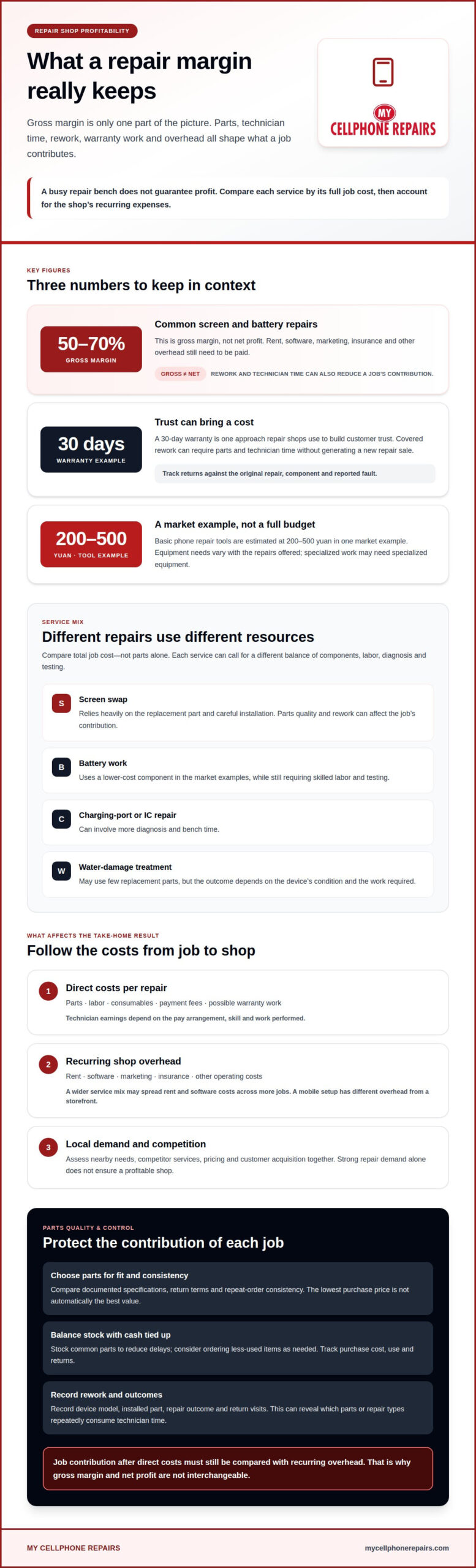
Phone repair margins depend on the gap between what a customer pays and the costs of completing the job. Common screen and battery repairs can carry gross margins of 50% to 70%. That is not the same as net profit: rent, software, marketing, insurance, and other overhead still need payment. A screen repair may look attractive on paper, but parts quality, technician time, and rework can reduce its contribution.
Repair types bring different parts and labor demands. A screen swap relies heavily on the replacement part and careful installation. Battery work uses a lower-cost component in the market examples, but still requires skilled labor and testing. Charging-port or IC repairs can involve more diagnosis and bench time. Water-damage treatment may use few replacement parts, yet the outcome can depend on the device’s condition and the work required. Compare each service by total job cost, not parts alone.
These expenses vary with the business format and the range of repairs offered.
The business format affects how much capital is needed before the first customer arrives. Starting lean can reduce fixed costs; a physical location may help attract walk-in customers.
Technician earnings depend on the pay arrangement, skill, and work performed; no U.S. wage figure is available here. That is a model input in pounds, not a U.S. wage benchmark. For each repair, account for labor alongside parts, consumables, payment fees, and possible warranty work.
To compare business models, estimate each repair’s contribution after direct costs, then compare it with recurring overhead. A shop with a wider service mix may spread rent and software costs across more jobs. A mobile setup has different overhead from a storefront. These figures are planning ranges, not a single startup budget: equipment, inventory, location, and operating choices determine the total.
Parts quality, rework, and warranty risks
A replacement part affects more than the cost of one repair. Fit, function, and consistency influence installation time, device performance, customer satisfaction, and repeat work. For example, a screen that doesn’t respond properly after installation can turn a completed job into more labor. That rework reduces the income the original repair was meant to generate.
Source parts that match the device model and repair task. Compare suppliers by documented specifications, return terms, and consistency across repeat orders. These checks help control costs without assuming the lowest purchase price is the best value. A faulty battery component can require extra labor and delay other jobs.
The right parts mix depends on the devices a shop repairs and the components customers request. Stocking common parts can reduce delays, while ordering less-used items as needed can limit cash tied up in inventory. Track each part’s purchase cost, use, and returns so cost changes show up in job estimates.
Tool purchases also shape repair consistency. Precision screwdrivers, opening tools, and a suitable work surface support careful disassembly, while specialized equipment may be needed for particular repairs. Basic phone repair tools are estimated at 200-500 yuan in one market example. Treat that figure as an example, not a complete tool budget for every shop or repair range.
Rework can use labor twice: first for installation, then for diagnosis and correction. Record the device model, installed part, repair outcome, and any return visit. This reveals which components or repair types repeatedly consume technician time. It also helps distinguish a parts issue from an installation problem before changing suppliers.
A 30-day warranty is one approach repair shops use to build customer trust. A warranty also creates a potential cost, since covered rework uses parts and technician time without generating a new repair sale. Set clear records for the repair date, component, and reported fault. Track warranty returns against the original job so the shop can see their effect on margins.
For customer-facing repair work, clear diagnostics and careful testing help explain what the repair includes. A battery replacement repair is one example where component quality and post-repair checks matter to the customer. Strong inventory controls, consistent parts, and recorded outcomes make it easier to manage costs while protecting repair revenue.
Is Phone Repair a Good Business in 2026?
Profitability depends on local demand, competition, pricing, and operating costs. In 2026, the useful question is whether nearby customers need the repairs your shop can deliver.
Local Repair Demand and Competitor Research
Local demand reflects the number and mix of repair jobs customers in an area are likely to seek. Review common needs such as screen damage, battery problems, and charging faults, then compare them with the services your business can perform. This connects startup costs to realistic customer demand rather than broad market interest.
Map the local area and note where repair shops operate, which devices they serve, and how they describe their services. Look for gaps in coverage or repair types. For example, nearby shops may focus on screens while customers also need battery replacements. Demand patterns can guide staffing, parts planning, and promotion.
Assessing Local Competition
Local competition includes nearby repair shops seeking the same customers. Study their visible service mix, customer feedback, location, and booking process. This can show where your business can explain its value clearly, such as through a relevant repair range or an easy-to-understand process.
Competition does not automatically make an area unprofitable. Compare services and customer needs, not just the number of shops. A cluster of repair shops may indicate established demand, but it can also make customer acquisition harder. Use those observations to shape pricing, service focus, and local marketing.
Demand also depends on the choices customers face. Someone with a damaged phone may weigh repair against replacement, while a person with a battery issue may seek a targeted fix. Track customer requests, device types, and which inquiries become completed jobs. These patterns reveal which services support local revenue.
Startup costs only make sense alongside local conditions. A storefront has different fixed expenses from a mobile or mail-in model, so estimate whether nearby customer volume can support your format. Consider foot traffic, nearby businesses, and ease of access. A strong location can help attract customers, but it does not replace clear pricing and effective operations.
Business setup in the United States may involve registration, an EIN, a state sales tax permit, and a local business license. Requirements vary by location, so treat these as planning items rather than a universal checklist. Local rules may also affect device intake. Use a consistent process to record the device, reported issue, condition, and customer authorization.
Use the findings together. Local demand points to likely repair types, competitor research shows how shops position themselves, and location-specific requirements shape operations. A shop near competing storefronts, for example, may need a distinct service mix, while a mail-in model depends more on clear intake and return processes. Each factor affects whether local revenue can cover ongoing costs.
Phone repair services and device maintenance
A repair shop can meet different customer needs with screen, battery, charging-port, and water-damage repairs. Each addresses a distinct problem, so diagnosis helps match the work to the device. A smartphone that won’t charge, for example, may need port inspection rather than a battery replacement. Accurate diagnosis helps avoid unnecessary work and keeps the proposed repair focused on the fault.
Maintenance creates opportunities to help customers before a small issue disrupts daily use. A technician at My Cellphone Repairs can inspect charging behavior, battery performance, buttons, cameras, and visible damage during an approved repair. If a device has both a cracked screen and charging trouble, document each issue separately and explain which repairs address them. That makes the work easier to understand and gives customers a clear choice.
Repeat business depends on the customer’s experience after the first repair. Clear intake notes, careful testing, and a useful explanation of the completed work help customers understand what changed. After replacing a mobile display, for example, test touch response and display function before returning the device. When customers understand the repair and receive a device that works as expected, they have a reason to return.
Accessories can add another revenue stream beside repair services. Cases and screen protectors are relevant examples because they relate directly to everyday device handling. The business should treat accessory sales as a separate category, tracking purchase cost, sales, and inventory rather than blending them with repair income. Phone accessories can carry gross profit margins above 50%, but actual results depend on what sells and the costs of stocking it.
Additional services can broaden the range of customer needs a shop addresses. Refurbished phone sales, tablet repairs, and computer repairs may complement phone work. Each brings its own requirements for parts, technician skills, testing, and inventory. Before adding a service, assess whether customer requests and operating capacity support it.
Device care creates natural conversations about related issues without turning every repair into an upsell. If a phone arrives with water damage, focus first on diagnosis and explain options based on its condition. If the customer reports a weak battery, assess that separately from a damaged screen. Distinguishing problems keeps recommendations relevant and protects trust.
To balance the service mix, track which repair categories bring repeat visits, which accessories sell alongside completed jobs, and where technician time goes. Compare the records over time. If charging-port repairs regularly lead to follow-up visits, review diagnosis and testing. If customers ask for screen protection after repairs, consider whether suitable accessories would support a more complete service experience.
Factors affecting phone repair shop profitability
The main risks are uneven job volume, high fixed costs, faulty parts, repeat repairs, and strong competitors. Technical skill matters, but so do customer service, pricing, and control of daily operating costs.
Repair volume can change the numbers quickly. An illustrative model assumes £7,000 in monthly fixed costs and £35 contribution per completed job. It requires 200 completed and paid jobs per month to cover those costs. Over 26 trading days, that is about 7.7 jobs per day. The example shows why a shop needs enough steady work, not just attractive margins on individual repairs.
Actual operating costs depend on the format. A storefront example estimates $5,000 per month in fixed costs, including rent, utilities, insurance, and software. At eight repair tickets per day, one model estimates roughly $14,400 in monthly gross profit and about $9,000 net profit after those fixed costs. At four tickets per day, estimated net profit falls to $2,200. These are illustrative figures, not a forecast for every shop.
Rework also reduces the contribution from completed jobs. A repeat visit can consume technician time, replacement parts, and capacity that could have served another customer. The research model recommends keeping the comeback rate under 5%. Tracking returns by repair type helps identify whether a pattern relates to parts, diagnosis, installation, or testing.
Parts and inventory decisions affect cash as well as profit. Stock too much, and money sits in components customers may not need soon. Stock too little, and a missing screen or battery can delay work and keep a technician waiting. Track inventory costs alongside customer requests and completed jobs. Adjust purchasing to the repair patterns you actually see.
Competitors create another pressure point. A shop that competes only by lowering prices may leave less room for labor, overhead, and warranty work. Clear diagnosis, reliable repairs, and helpful customer service can distinguish a business without price cuts. Relevant accessories or additional repair categories may also broaden revenue if the shop can support them.
Technical repair ability alone doesn’t make an operation profitable. Owners also need to manage customer service, job flow, expenses, and retention. Regularly review revenue, requested services, inventory costs, and repeat visits. If charging repairs bring frequent comebacks, investigate the process before increasing volume. If demand is strong but net income is low, examine fixed costs and each job’s contribution.
The clearest takeaway is to measure completed, paid jobs against fixed costs, then review rework and inventory. Those operating factors determine whether a repair shop turns technical work into sustainable profit.
My Cellphone Repairs: Samsung Phone Repair
My Cellphone Repairs handles Samsung phone repairs for customers whose devices need professional attention. Turn to the team when a Samsung phone has a fault affecting everyday use and you want a repair-focused next step.
The business also provides iPhone screen repair, MacBook repair, and battery replacement. These services address common device problems with a focus on the repair the customer needs. A clear description of the issue helps the repair team understand what needs attention.
When weighing repair against replacement, consider the fault, the device’s condition, and the repair needed. My Cellphone Repairs can help with the listed services that address those needs.
Contact My Cellphone Repairs to discuss your repair.
Turn Your Next Repair Decision Into Action
Whether phone repair is a profitable business depends on decisions made before and after each job. If you’re considering starting a shop, turn your estimates into a working plan: define the repair mix, map expected customer demand, and track actual costs as jobs come in. Use those records to adjust your approach rather than relying on assumptions. A clear view of the numbers gives you a practical basis for deciding what to do next.
If your device needs attention, the next step is simple. My Cellphone Repairs offers Samsung phone repair, iPhone screen repair, and MacBook repair. Describe the device and issue so the repair conversation can focus on the work you need.
Contact My Cellphone Repairs to discuss your repair needs. Take the next step with a clear understanding of the problem and move forward with confidence.
Frequently Asked Questions
Can reselling phones really add to profit?
Refurbished phone sales can add a revenue stream, but calculate the full cost of each device before counting profit. Include the purchase, parts, testing, unsold inventory, and time spent preparing it for sale. A phone that sells quickly may help cash flow; one that remains unsold ties up money and shelf space. Track refurbished sales separately from repair jobs to see whether they contribute meaningfully.
How do I get my first repair customers?
Start with local visibility and clear service information. Use local SEO, social media, promotions, partnerships, and helpful customer service to make the business easy to find and trust. Build a plan around the first 100 customers, then track which channels bring actual repair bookings. For a locally focused shop, tailor pages and posts to the communities it serves, such as Towson, Harrisburg, Kentwood, or Bowie.
How do I increase my shop’s profit?
Improve each completed job’s contribution, not just the number of bookings. Check that estimates account for diagnosis, parts, labor, payment costs, and follow-up work. Make scheduling and intake efficient so technicians spend more time repairing devices and less time waiting for information. Compare each service category’s performance and focus promotion on work your team can complete consistently.
How long does it take to break even?
There isn’t one reliable timeline for every shop. Break-even depends on startup spending, monthly overhead, and each completed job’s contribution after direct costs. Estimate the monthly job volume needed to cover fixed expenses, then compare it with realistic local demand. Lower overhead may help a business reach break-even sooner, but the actual timing depends on its sales and costs.
Is it better as a side business or a full-time shop?
A side business may suit an owner who wants to build repair skills and test local demand while keeping operations lean. A full-time shop needs enough steady work to cover regular expenses and the owner’s working time. Consider the hours available for repairs, customer communication, inventory, and bookkeeping. The right structure depends on customer flow, operating costs, and whether repair work can support the owner’s income needs.
What Does Revenue Actually Look Like?
Revenue is what customers pay for completed repairs and other sales before expenses. For a simple monthly view, multiply completed jobs by the average collected per job, then add other sales. That total is not take-home profit. Parts, technician labor, rent, software, and rework reduce what remains. Track collected payments separately from estimates and unpaid jobs.
What Is the Bull Case for Phone Repair?
The case for phone repair is that customers continue to need help with damaged or malfunctioning devices, and a repair can address a specific fault without replacing the entire device. A shop may meet different needs with screen, battery, charging, and other repairs. A suitable service mix, repeat customers, and controlled overhead can support a durable business. The outlook weakens if local demand is limited or costs outpace job contribution.
How profitable is a phone repair business in the United States?
Whether phone repair is a profitable business in the United States depends on local demand, competition, pricing, repair volume, and costs. A national average cannot show whether a particular location can cover its expenses. Use local booking and sales records to estimate job volume, then compare collected revenue with direct and fixed costs. Review the results regularly as customer demand and operating expenses change.
Get it fixed at My Cellphone Repairs: most repairs are done the same day. Walk in or book online.
Book NowPhone frozen or acting up? See our step-by-step restart & reset guides →
Our locations
- Towson Mall825 Dulaney Valley Rd, Second Level, Towson, MD 21204
(410) 828-4404 - Grand Rapids3077 28th St SE, Grand Rapids, MI 49512
(616) 799-6996 - PG Plaza Mall (Hyattsville)3500 East-West Hwy, Mall at Prince George's, Target Entrance, Hyattsville, MD 20782
(301) 559-1105 - Bowie Town Center15630 Emerald Way, Bowie, MD 20716
(240) 614-3600 - Capital City Mall (Camp Hill / Harrisburg area)3604 Capital City Mall Dr, Camp Hill, PA 17011
(717) 919-7868 - Cumberland Mall (Vineland)3849 S Delsea Dr, next to Boost Mobile, Dick's Sporting Goods entrance, Vineland, NJ 08360
(856) 765-5049 - Mondawmin Mall2401 Liberty Heights Ave, Lower Level, Baltimore, MD 21215
(443) 826-7711 - Baltimore Inner Harbor100 East Pratt St, Suite 101, Baltimore, MD 21202
(443) 838-8989 - St Charles Mall (Waldorf)11110 Mall Cir, Waldorf, MD 20603
(301) 645-7755 - Alexandria7650 Richmond Hwy, Alexandria, VA 22306
(703) 341-6789