
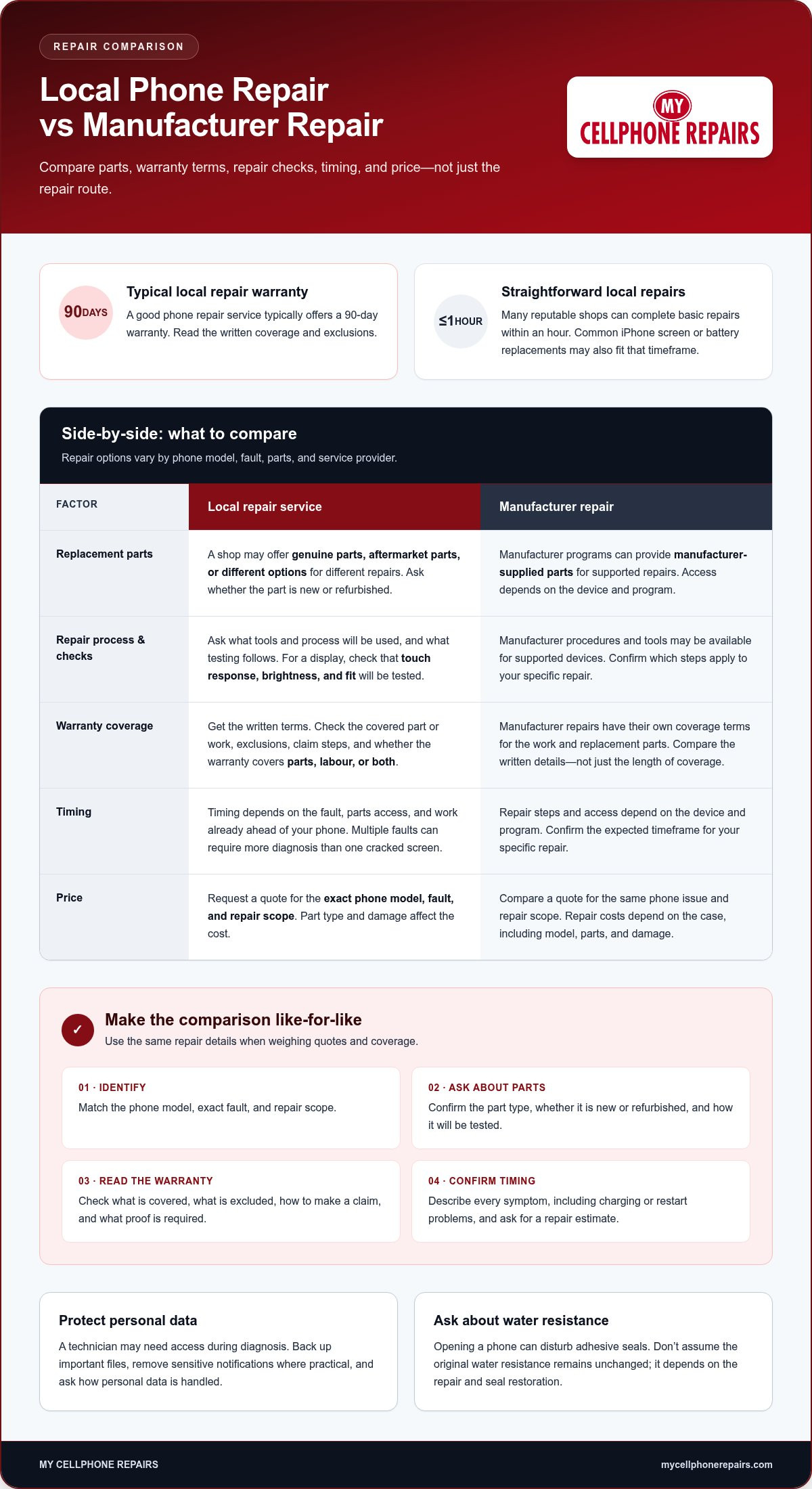
The lowest-cost repair isn’t automatically the best value. In the local phone repair vs manufacturer repair decision, the right choice depends on the phone, the replacement parts, warranty coverage, and how quickly you need it back. A good phone repair service typically offers a 90-day warranty.
It’s reasonable to compare more than the initial cost. Repair costs depend on the case, including the phone model, parts, and damage, and a price is given after a quote request. This guide explains how local and manufacturer repairs compare on parts, warranties, turnaround, convenience, and pricing, so you can weigh the trade-offs and choose the route that fits your repair.
Key Takeaways
- Compare replacement-part type and repair quality, not just the repair route.
- Read warranty terms closely so you understand what the coverage applies to.
- Factor in repair time and travel or shipping convenience when weighing your options.
- Compare quotes for the same phone issue and repair scope to make the pricing clearer.
- Use the repair details that matter most to choose between local service and manufacturer repair.
1. Genuine and aftermarket replacement parts
Part choice affects fit, function, repair process, and what happens if another fault appears. A genuine part comes through the phone manufacturer’s supply chain or repair program. An aftermarket part comes from another supplier and may vary in materials, design, and testing. For a cracked display, compare more than the label: ask what type of screen the repair uses and whether touch response, brightness, and fit will be tested afterward.
Can local shops and manufacturers repair the same types of phone damage? Often, yes. Both may handle common problems such as broken screens, weak batteries, faulty charging ports, or liquid damage, but the available repairs depend on the phone model and service provider.
Manufacturer repair programs can provide manufacturer-supplied parts, tools, or procedures for supported repairs. Access and repair steps depend on the device and program. A local shop may use genuine parts, aftermarket parts, or different options for different repairs. A replacement battery, for example, may be sourced differently from a display. Ask what part will be installed, whether it is new or refurbished, and what testing follows the repair. Clear answers let you compare like with like.
Tools and procedures matter as much as the component. Opening a modern phone can involve adhesive, small connectors, and delicate cables. A display replacement, for example, requires careful handling of internal components. The repair should also include checks related to the original problem, such as testing the display after installation or confirming that a charging port connects properly. Manufacturer procedures may specify steps for supported devices; independent technicians may use their own process and compatible tools.
What are the risks of using a local phone repair shop, including data privacy and water resistance? A technician may need access to the device during diagnosis, and opening the phone can disturb adhesive seals that help resist water. Before service, back up important files, remove sensitive notifications where practical, and ask how personal data is handled. Afterward, don’t assume the original water resistance remains unchanged; that depends on the repair and seal restoration.
Use a simple comparison before choosing. Match the quote to your exact phone model and fault, then compare the part type, repair steps, testing, and warranty terms. If a shop offers different display options, consider the component source and the features you rely on, such as accurate colour or responsive touch. In the local phone repair vs manufacturer repair comparison, the part name alone doesn’t settle the decision. The repair method and checks matter too.
2. Repair warranties
A repair warranty helps define what happens if the same fault returns. A good phone repair service typically offers a 90-day warranty. Compare that period with the written terms, not just a verbal summary. A manufacturer repair may have its own coverage terms for the work and replacement parts. The length alone doesn’t show which option protects you better. Read what the warranty covers, how to make a claim, and which conditions can limit coverage.
Separate the repair warranty from the phone’s original manufacturer warranty. The first applies to the specific service under its terms. The second relates to the device and its existing coverage. A screen replacement warranty, for example, may address a fault with the replacement screen, while excluding later damage caused by a new drop. A battery repair may have different terms. Ask for the written warranty before approving work, and keep the receipt with the repair date and details.
Coverage often depends on the cause of the problem and the part involved. Terms may distinguish a faulty replacement component from accidental damage, liquid exposure, or a separate issue that appears later. For example, a charging problem after a screen repair may not be covered by terms for the screen itself. Don’t assume every new symptom is included. Check whether the warranty covers parts, labour, or both, and whether it applies only to the original repair.
Before sending a phone to its manufacturer, review its repair instructions and warranty status. Back up important data, record existing damage, and describe the problem clearly. Check whether the manufacturer requires particular packaging or accessories. Remove personal items such as a case or SIM card when the instructions call for it. Keep the repair confirmation and tracking details together to document the device’s condition and follow the return process.
Compare the terms side by side. Look for the covered component, warranty period, exclusions, claim process, and proof-of-purchase requirements. One repair might cover a replacement display and labour, while another covers only the part. The details matter more than a broad promise of “warranty included.” Get the terms in writing before the repair begins, then keep them with your receipt.
- Covered work: Identify the exact part or repair named.
- Exceptions: Note exclusions for drops, liquid, or unrelated faults.
- Claim steps: Find out what receipt or repair record is needed.
Use those points to compare phone repair options without treating every warranty as equal. Clear terms make it easier to understand what support applies if the repaired component develops a problem.
3. Local phone repair services and turnaround times
Repair time depends on the fault, parts access, and the work already ahead of your phone. Many reputable phone repair shops can complete basic repairs within an hour. Most common iPhone screen or battery replacements can also be completed within an hour. Those timeframes describe straightforward repairs, not every device or damage type. A phone with multiple faults needs more diagnosis than a single cracked screen.
Start by describing the exact problem. Say whether the iPhone screen is cracked, touch response has stopped, or the battery drains unusually fast. If the phone also restarts or fails to charge, mention that before the technician begins. Multiple symptoms can mean more than one repair task. Clear details help the shop identify the likely repair and give a useful time estimate.
Parts availability is another practical factor. A common screen replacement may move quickly when the correct component is ready. A less common model or a repair requiring an additional component can take longer. The same is true when inspection reveals damage beyond the issue you first noticed. For example, a phone that stopped charging after a fall may need checks beyond the charging port. A quick repair window applies most clearly to a defined, uncomplicated job.
How do you find a reputable local phone repair shop near you? Compare shops that work on your phone model and explain the repair steps, estimated turnaround, part choice, and warranty terms clearly. A specific estimate for your cracked display is more useful than a general promise about speed.
Ask how the estimate changes if diagnosis finds another fault. A clear answer separates the initial repair from additional work. Also ask when the turnaround estimate begins: at drop-off, after diagnosis, or once the required part is ready. These details matter if you rely on your phone for work, maps, or account sign-in. Plan another way to access essential accounts before handing over the device.
Manufacturer repair and local service can involve different handoff steps. A manufacturer process may require arranging service and sending or bringing in the device. A local shop offers an in-person handoff, making it easier to describe symptoms and understand the repair plan. The faster option depends on the repair process, parts, and queue, not simply the provider’s name.
For the local phone repair vs manufacturer repair comparison, weigh the actual estimate against your schedule. Confirm the repair scope, what could extend the work, and how you’ll be told when the phone is ready. An hour is a useful reference for common repairs, not a blanket timeline for every model and fault.
4. Local repair convenience and walk-in or appointment options
A local repair visit keeps the phone and conversation in one place. You can bring a device with a cracked screen, describe what happened, and show the technician the fault. A walk-in suits people already nearby, while an appointment gives the visit a planned start time. Choose the route that fits your schedule and the shop’s intake process.
Before leaving home, review the shop’s booking instructions. If it accepts walk-ins, prepare for an in-person assessment and explain the issue at the counter. If appointments are offered, choose a time and note the repair needed, such as a battery replacement or charging-port repair. A clear description helps the staff understand why you’re visiting and what to inspect.
Convenience also depends on how much time you can spend without your phone. A parent coordinating school pickup, for example, may prefer an appointment that fits between errands. Someone working nearby may find a walk-in easier. In either case, plan how you’ll manage calls, maps, and account sign-ins while the device is being assessed. Keep essential information accessible on another device or written securely.
Manufacturer service follows its own intake route. The process may involve booking a visit or arranging to send the phone, depending on the manufacturer’s options. A mailed repair adds packing and transit steps. An in-person option requires travel to the designated service location. Compare the full trip, not only the repair: travel, handoff arrangements, and collecting the phone all affect convenience.
Use this short preparation list before choosing a route:
- Describe the fault: Note what stopped working and when it began.
- Plan access: Arrange another way to handle calls or verification codes.
- Choose the handoff: Compare a local visit with the manufacturer’s service process.
- Save the details: Keep appointment or service records together.
For example, a phone that still turns on but has a damaged screen can be easier to explain face to face. A device that won’t power on still needs a clear written description, whether it goes to a local shop or through manufacturer service. Share what you observed, such as whether the screen lights up or charging changes anything. These details help explain the issue at intake.
Walk-ins and appointments solve different scheduling problems. A walk-in avoids choosing a time in advance, while a booked visit creates a defined arrival plan. Manufacturer service may reduce local travel if it offers shipping, but mailing adds handling steps. Compare the handoff, travel, and collection tasks against your day. The most convenient option is the one you can complete without disrupting essential phone use.
5. Repair pricing and local price matching
A repair quote depends on the phone model, fault, replacement part, and work required. A cracked display on one model may need a different component and process than a screen repair on another. Additional damage can also change the repair scope. Price depends on the case and is given after a quote request, with factors such as model, parts, and damage affecting the cost. Compare the full repair, not a headline figure.
For a useful comparison, describe the same fault to each repair service. Specify the phone model and explain what happened, such as a screen cracking after a fall. Compare quotes for the same repair and part type. One quote may include a different component or scope of work. If the details don’t match, the lower figure may not represent the same repair.
Manufacturer repair pricing may reflect its parts and service process. Local repair pricing can reflect the selected component, technician work, and the fault’s complexity. A basic display replacement, for example, differs from a repair that also requires diagnosing touch issues. Ask what the quoted repair includes, such as inspection, parts, labour, and warranty. Those details make the price comparison clearer.
Price matching is a separate policy, not an automatic feature of local repair. A shop sets its own terms for whether it matches another quote and what information it needs. A quote for a different phone model, part type, or repair scope isn’t a direct comparison. Use written estimates that clearly identify the device model and repair details. A lower quote is relevant only if both estimates cover equivalent work.
- Identify the device: Include the exact phone model and fault.
- Compare the part: Note whether each estimate uses the same part category.
- Compare the work: Check which repair tasks and tests are included.
- Review warranty terms: Compare coverage alongside the quoted repair.
- Read price-match terms: See whether the competing estimate qualifies.
In the local phone repair vs manufacturer repair comparison, the lowest quote isn’t the only measure of value. A clear scope helps you see what the price covers and what could change after diagnosis. Use the same phone details and repair description for each estimate. For a repair quote based on your device and issue, request a phone repair quote.
Treat this range as a broad reference rather than a quote for a particular device. The price for your repair may differ once the model, fault, and suitable replacement part are confirmed, so ask the repair service to explain how its estimate reflects those details.
My Cellphone Repairs: Samsung Phone Repair
My Cellphone Repairs provides Samsung Phone Repair for people weighing repair options for a Samsung device. The company also handles iPhone Screen Repair, MacBook Repair, and Battery Replacement. If your Samsung phone needs attention, share its model and the fault when arranging service. For other repair needs, choose the relevant service, such as iPhone Screen Repair for a damaged display. Compare repair scope, parts, warranty terms, and convenience to decide whether local service suits your situation. Contact My Cellphone Repairs to discuss your repair.
Choose the repair path that fits your next step
Your phone is part of your daily routine, so choose the repair route that fits how you use it and what matters most. If maintaining the manufacturer service relationship is your priority, start there. If a nearby repair visit better fits your day, weigh that convenience against the repair details that matter to you. The right choice in the local phone repair vs manufacturer repair decision supports your needs, not simply the option that sounds cheaper.
For a local repair option, My Cellphone Repairs offers Samsung Phone Repair, iPhone Screen Repair, and MacBook Repair. Share which device needs attention and what problem you’re facing to take the next step.
Contact My Cellphone Repairs today to discuss your repair and move toward a practical solution.
Frequently Asked Questions
What are the cost differences between local phone repair shops and manufacturer repair in the US?
There’s no single lower-cost option for every phone or fault. Compare written quotes for the same device and repair, then review the total and what it covers. Check whether inspection, parts, labour, shipping, or additional work affect the quote. Ask how approval works if inspection reveals another problem, so you can decide before extra work begins.
How long does local phone repair take compared with manufacturer repair?
Local repair may involve an in-person handoff, while manufacturer service may involve booking or shipping the phone. The elapsed time depends on the repair, parts, intake process, and whether diagnosis reveals another fault. For a fair comparison, ask when work can begin and how you’ll receive updates. If you rely on your phone for account access, arrange another way to receive verification codes during the repair.
Do local phone repairs void the phone manufacturer’s warranty?
A local repair doesn’t determine how a manufacturer will handle every later warranty claim. The relevant details are the written warranty terms, the fault being claimed, and whether it relates to the earlier repair. Keep the repair record and describe any new problem accurately. For example, a later camera fault differs from a previously repaired screen, so document both separately.
Will manufacturer repair use genuine parts, and do local shops use OEM parts?
Don’t rely on “OEM” alone to identify a part’s source. Ask whether the component is manufacturer-supplied, made by the original equipment manufacturer, or compatible aftermarket. Manufacturer repair is the route to consider if you specifically want manufacturer-supplied parts; local repair parts can vary. For a screen or battery, ask for the part description on the repair paperwork so you can compare what each option uses.
How do local repair shops and manufacturers compare on repair quality and warranties?
Judge the repair by how clearly the fault is diagnosed, how the device is tested afterward, and what written support applies to the work. A repair record should identify the work performed and the component involved. For example, if a touch problem continues after a screen repair, the record helps distinguish an unresolved original fault from a separate issue. Compare warranty terms alongside the repair details, not as a standalone promise.